Argentometric Titrations: Mohr, Volhard and Fajans Methods with Calculations
Silver nitrate is the classic titrant for chloride, bromide and similar anions. Because the reaction forms an insoluble precipitate, the end point cannot be seen with an ordinary acid–base indicator, so three special end-point methods were developed: Mohr, Volhard and Fajans. Questions on these appear in analytical chemistry papers, and they combine three skills you already have: Ksp, stoichiometry and titration arithmetic.

The three methods at a glance
| Method | Type | Indicator | End-point signal | Condition |
|---|---|---|---|---|
| Mohr | Direct (Ag+ added to Cl−) | K2CrO4 | First permanent red-brown Ag2CrO4 | Roughly neutral pH (about 6.5–10) |
| Volhard | Back titration | Fe3+ (ferric alum) | Red [Fe(SCN)]2+ colour | Acidic (HNO3) solution |
| Fajans | Direct | Adsorption indicator (e.g., fluorescein) | Colour change on the precipitate surface | pH range suited to the dye |
Mohr method: why chromate works
AgCl (Ksp ≈ 1.8 × 10⁻¹⁰) precipitates first. Ag2CrO4 (Ksp ≈ 1.1 × 10⁻¹²) appears only after the chloride is almost used up. At the equivalence point of AgCl, [Ag+] = √Ksp = √(1.8 × 10⁻¹⁰) = 1.34 × 10⁻⁵ M. For Ag2CrO4 to start precipitating exactly then:
(The [Ag+]² equals Ksp(AgCl) = 1.8 × 10⁻¹⁰, which is why the division is so neat.) Those Ksp values are typical textbook figures; use the ones given in your question. In practice, a slightly lower chromate concentration is used because the yellow colour of chromate itself makes the end point hard to see, which is why a small blank correction is applied.
Volhard method. A known excess of AgNO3 is added to the chloride sample. The unreacted Ag+ is then titrated with standard thiocyanate: Ag+ + SCN− → AgSCN(s). The first excess SCN− reacts with Fe3+ to give a red complex. Acidic conditions stop Fe3+ from hydrolysing. Because AgCl is slightly more soluble than AgSCN, it can react with thiocyanate and cause a fading end point, so the AgCl is usually filtered off or coated (for example with nitrobenzene) first.
Worked examples
Example 1: Mohr titration, % NaCl. A 0.2500 g sample containing NaCl is dissolved and titrated with 0.1000 M AgNO3, needing 38.20 mL. Find the % NaCl.
Ag+ + Cl− → AgCl, ratio 1 : 1.
mmol Ag+ = 0.1000 × 38.20 = 3.820 mmol = mmol Cl− = mmol NaCl.
Mass of NaCl = 3.820 × 10−3 mol × 58.44 g mol−1 = 0.2232 g.
% NaCl = (0.2232 / 0.2500) × 100 = 89.3%.
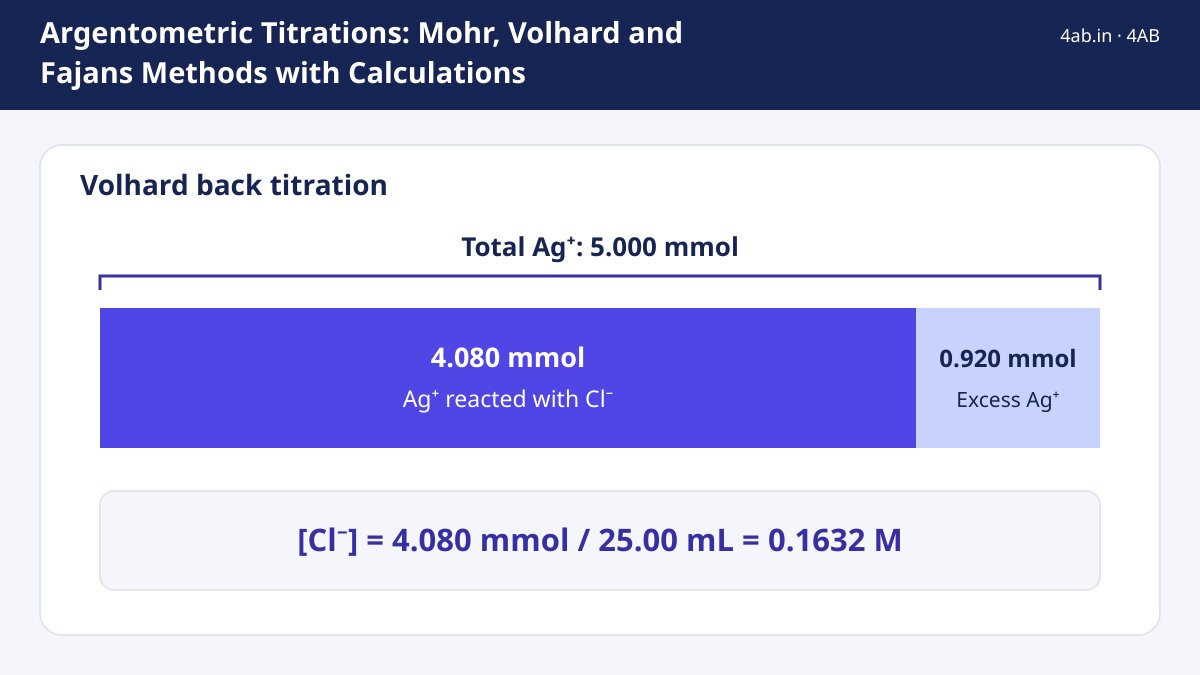
Example 2: Volhard back titration. To 25.00 mL of a chloride solution, 50.00 mL of 0.1000 M AgNO3 is added. The excess Ag+ needs 18.40 mL of 0.0500 M KSCN. Find [Cl−].
Total Ag+ added = 0.1000 × 50.00 = 5.000 mmol.
Excess Ag+ = mmol SCN− = 0.0500 × 18.40 = 0.920 mmol.
Ag+ that reacted with Cl− = 5.000 − 0.920 = 4.080 mmol = mmol Cl−.
[Cl−] = 4.080 mmol / 25.00 mL = 0.1632 M.
Example 3: [Ag⁺] part-way through the titration. 20.0 mL of 0.100 M AgNO3 is added to 50.0 mL of 0.0500 M NaCl. Find [Ag+] and pAg.
mmol Cl− = 0.0500 × 50.0 = 2.50 mmol; mmol Ag+ = 0.100 × 20.0 = 2.00 mmol.
Cl− left = 2.50 − 2.00 = 0.50 mmol in 70.0 mL → [Cl−] = 7.14 × 10⁻³ M.
[Ag+] = Ksp / [Cl−] = 1.8 × 10⁻¹⁰ / 7.14 × 10−3 = 2.52 × 10⁻⁸ M.
pAg = −log(2.52 × 10⁻⁸) = 7.60.
Example 4: volume at equivalence. For the same 50.0 mL of 0.0500 M NaCl and 0.100 M AgNO3: V = 2.50 mmol / 0.100 mmol mL−1 = 25.0 mL. At this point [Ag+] = √Ksp = 1.34 × 10⁻⁵ M, so pAg = 4.87 — a much sharper jump than the pAg of 7.60 seen at 20.0 mL, which is why the end point is detectable.
Common mistakes
- Using the Mohr method in acidic solution. Chromate turns into dichromate and the indicator stops working; strongly basic solution precipitates Ag2O.
- Forgetting to subtract the excess in a back titration. Chloride = total Ag+ − back-titrated Ag+.
- Using mL and M with mixed units. Millimoles = M × mL keeps everything consistent.
- Applying the 1:1 ratio to the chromate step. Ag2CrO4 needs [Ag+]2, so Ksp has a square.
- Writing the Volhard indicator as an “acid-base indicator”. It is a complex-formation (Fe3+–SCN−) signal.
Exam-relevance table
| Problem | Method |
|---|---|
| Direct titration with AgNO3 | mmol Ag+ = mmol halide (1:1) |
| Back titration | Total Ag+ − excess (= SCN−) = halide |
| Indicator concentration | [CrO42−] = Ksp(Ag2CrO4) / [Ag+]2 |
| pAg before equivalence | [Ag+] = Ksp / [Cl− left] |
Check your exam’s syllabus for which of these methods and which constants it expects.
Test the Ksp values and solubilities used in these end-point calculations with the solubility product calculator.
Open the Solubility Product (Ksp) Calculator →Turn this concept into marks: solve previous-year CSIR-NET questions and take a timed quiz.
More Equilibrium articles