Average Atomic Mass from Isotopic Abundance: Formula and Worked Examples
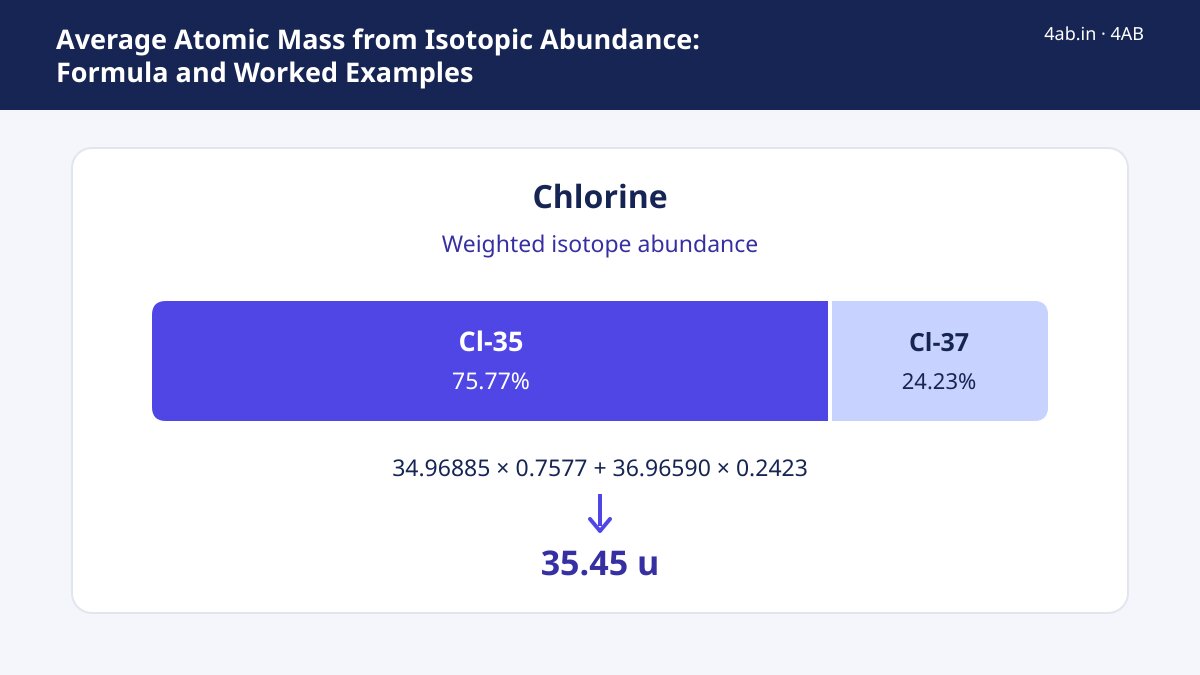
Open any periodic table and look at chlorine. The mass is written as 35.45, not 35 and not 37. No single chlorine atom weighs 35.45 u. The number is an average, taken over the different isotopes of chlorine as they occur in nature. Class 11 and Class 12 papers ask this as a short numerical every year in some form: either “find the average atomic mass” or the reverse, “find the percentage of each isotope”. Both come from one formula.

The formula for average atomic mass
(when abundances a are written in per cent)
Average atomic mass = m1f1 + m2f2 + … (when f is a fraction and f1 + f2 + … = 1)
Here m is the mass of one isotope, in atomic mass units (u), and a is its natural abundance, that is, the share of atoms in a natural sample that are that isotope. The abundances must add up to 100 per cent. This is a weighted average, the same idea as finding the average marks of a class when different numbers of students scored different marks. Isotopes that are more common pull the answer towards their own mass.
Two words are often mixed up. The mass number is a whole number (protons + neutrons), such as 35 or 37. The isotopic mass is the measured mass of that isotope, such as 34.96885 u, which is very close to the mass number but not exactly equal to it. In school problems the question usually tells you which one to use. If it gives only mass numbers, use them and your answer will be a little different from the periodic-table value. That small difference is normal.
Worked example 1: chlorine with isotopic masses
Question. Chlorine has two natural isotopes: Cl-35 (mass 34.96885 u, abundance 75.77%) and Cl-37 (mass 36.96590 u, abundance 24.23%). Find the average atomic mass.
Step 1. Check the abundances: 75.77 + 24.23 = 100.00. Good.
Step 2. Multiply each mass by its share: 34.96885 × 0.7577 = 26.4959. And 36.96590 × 0.2423 = 8.9568.
Step 3. Add: 26.4959 + 8.9568 = 35.4527 u.
Answer. Average atomic mass of chlorine = 35.45 u, which matches the periodic table.
Worked example 2: using mass numbers only
Question. Use the same abundances but the mass numbers 35 and 37.
35 × 0.7577 = 26.5195. And 37 × 0.2423 = 8.9651. Sum = 35.4846, so about 35.48 u.
This is slightly above 35.45 because the true isotopic mass of Cl-35 (34.96885) is a little below 35. If your board question gives mass numbers only, write 35.48 (or what the working gives) and do not “correct” it to 35.45.
Worked example 3: three isotopes of magnesium
Question. Magnesium: Mg-24 (23.98504 u, 78.99%), Mg-25 (24.98584 u, 10.00%), Mg-26 (25.98259 u, 11.01%).
Check: 78.99 + 10.00 + 11.01 = 100.00.
23.98504 × 0.7899 = 18.9458
24.98584 × 0.1000 = 2.4986
25.98259 × 0.1101 = 2.8607
Sum = 18.9458 + 2.4986 + 2.8607 = 24.3051, so the average atomic mass is 24.31 u, close to the table value 24.305. Notice the answer sits very near 24 because 79% of the atoms are Mg-24.
Worked example 4: the reverse problem for boron
Question. Boron has two isotopes, B-10 (10.0129 u) and B-11 (11.0093 u). The average atomic mass is 10.81 u. Find the percentage of each.
Step 1. Let the fraction of B-11 be x. Then the fraction of B-10 is (1 − x).
Step 2. 10.0129(1 − x) + 11.0093x = 10.81. Open the bracket: 10.0129 + (11.0093 − 10.0129)x = 10.81, so 0.9964x = 10.81 − 10.0129 = 0.7971.
Step 3. x = 0.7971 ÷ 0.9964 = 0.800. So B-11 is 80.0% and B-10 is 20.0%.
Check: 10.0129 × 0.200 + 11.0093 × 0.800 = 2.0026 + 8.8074 = 10.8100. Correct.
Quick version with mass numbers: 10.81 lies 0.81 above 10 and 0.19 below 11. The isotope closer to 10.81 is more abundant, so B-11 is about 81% and B-10 about 19%. This shortcut gives an approximate answer; it is good for checking, but use the full method when the question gives isotopic masses.
Common mistakes
- Taking the simple average. (35 + 37) ÷ 2 = 36 is wrong for chlorine. Isotopes are not present in equal amounts, so each mass must be weighted by its abundance.
- Forgetting to divide by 100 when abundances are in per cent, or dividing when they are already fractions.
- Abundances that do not add to 100. Always add them first. If a question gives two of three abundances, find the third by subtraction.
- Expecting a whole number. An average atomic mass is rarely a whole number, and that is the main reason it is written with decimals.
- Mixing mass number and isotopic mass inside one problem.
- Writing the unit as g. Average atomic mass is in u. The molar mass in g mol−1 has the same number, which is how the mole concept connects the two.
Why this number is used in molar mass
When you calculate the molar mass of NaCl, you use 35.45 for chlorine. You are not saying that one particular Cl atom has this mass. You are saying that in a large sample, which always contains the usual mixture of isotopes, the average atom behaves as if it had this mass. That is why the value works for mole calculations, where we count enormous numbers of atoms together. Only in mass spectrometry, where single isotopes are separated, do you meet the individual isotopic masses.
Exam relevance
| Question type | What to do |
|---|---|
| Given isotopic masses and abundances | Weighted average: Σ(mass × abundance) ÷ 100 |
| Given average mass and two isotopes | Let one fraction be x, the other 1 − x, and solve |
| Given only mass numbers | Use the mass numbers; the answer may differ slightly from the table |
| Assertion–reason: “atomic mass is not a whole number” | Reason: it is a weighted average over isotopes |
| Link to moles | Average atomic mass in u = molar mass in g mol−1 (numerically) |
Check the isotope data given in your own question or textbook. Different books round the abundances differently, so your last digit can change by a small amount.
Look up chlorine, magnesium or boron on the interactive periodic table and compare its atomic mass with your own weighted-average answer.
Open the Interactive Periodic Table →Trends and exceptions are asked every year: practise previous-year CSIR-NET questions and quizzes.
More Exam guides articles