Balancing Redox Equations by the Ion-Electron Method
Many redox equations cannot be balanced by simple inspection. Equations with MnO₄⁻, Cr₂O₇²⁻ or I⁻ have electrons, H⁺ or OH⁻ hiding inside them. The ion-electron method (also called the half-reaction method) splits the reaction in two, balances each half, and joins them. Once you learn the same eight steps, every question becomes routine.

The steps
2. Split it into an oxidation half and a reduction half.
3. Balance atoms other than O and H.
4. Balance O by adding H₂O.
5. Balance H: add H⁺ (acidic medium). In basic medium add H⁺ first, then add the same number of OH⁻ to both sides and combine H⁺ + OH⁻ into H₂O.
6. Balance charge by adding electrons.
7. Multiply the halves so the electrons are equal, then add and cancel.
8. Check atoms and charge on both sides.
Why the medium matters
In acidic solution, H⁺ and H₂O are available to balance O and H. In basic solution, OH⁻ and H₂O are available. The same skeleton can give different final equations in the two media. For example, permanganate gives Mn²⁺ in acid, but MnO₂ in neutral or weakly basic solution. The question normally tells you the product or the medium; use what it gives.
Worked examples
Example 1: MnO₄⁻ and Fe²⁺ in acidic medium. Skeleton: MnO₄⁻ + Fe²⁺ → Mn²⁺ + Fe³⁺.
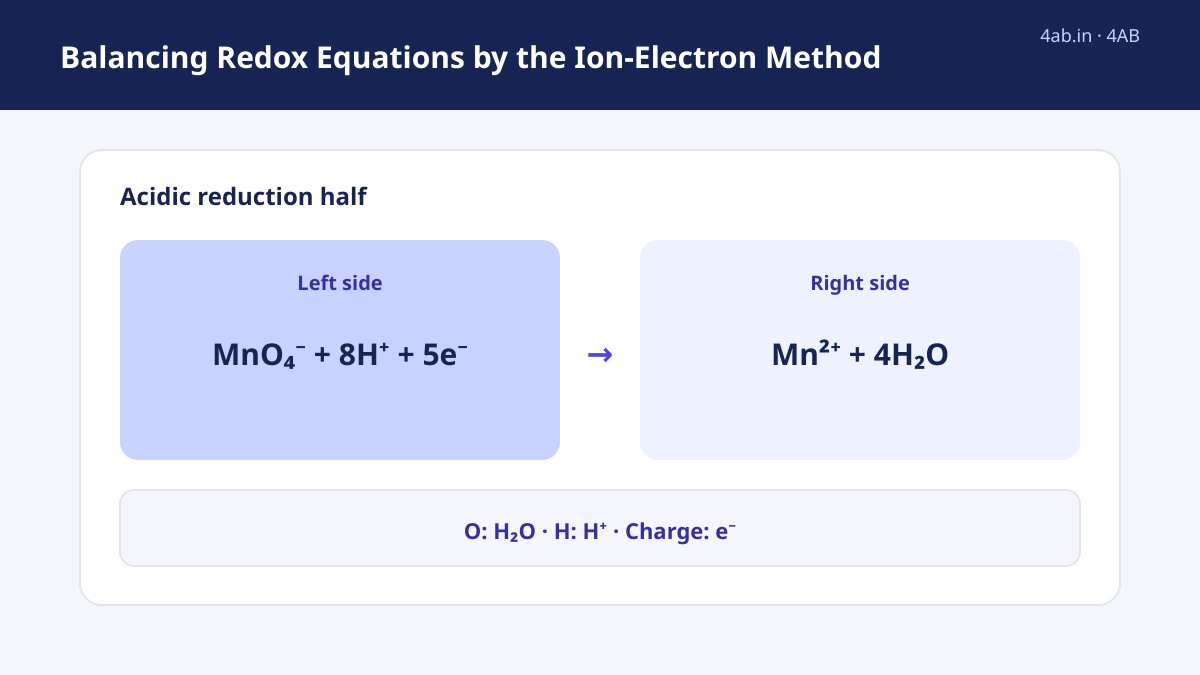
Reduction half: MnO₄⁻ → Mn²⁺. Mn is balanced. Add 4H₂O on the right to balance O: MnO₄⁻ → Mn²⁺ + 4H₂O. Add 8H⁺ on the left to balance H: MnO₄⁻ + 8H⁺ → Mn²⁺ + 4H₂O. Charge: left = −1 + 8 = +7; right = +2. Add 5e⁻ on the left: MnO₄⁻ + 8H⁺ + 5e⁻ → Mn²⁺ + 4H₂O.
Oxidation half: Fe²⁺ → Fe³⁺ + e⁻.
Multiply the oxidation half by 5 so that 5 electrons are lost and 5 gained, then add:
MnO₄⁻ + 8H⁺ + 5Fe²⁺ → Mn²⁺ + 5Fe³⁺ + 4H₂O
Check: Mn 1 = 1; Fe 5 = 5; O 4 = 4; H 8 = 8. Charge: left = −1 + 8 + 10 = +17; right = +2 + 15 = +17. ✓
Example 2: Cr₂O₇²⁻ and I⁻ in acidic medium. Skeleton: Cr₂O₇²⁻ + I⁻ → Cr³⁺ + I₂.
Reduction half: Cr₂O₇²⁻ → 2Cr³⁺ (balance Cr first, the factor 2 matters). Add 7H₂O on the right: Cr₂O₇²⁻ → 2Cr³⁺ + 7H₂O. Add 14H⁺ on the left. Charge: left = −2 + 14 = +12; right = +6. Add 6e⁻ on the left: Cr₂O₇²⁻ + 14H⁺ + 6e⁻ → 2Cr³⁺ + 7H₂O.
Oxidation half: 2I⁻ → I₂ + 2e⁻ (balance I atoms first). Multiply by 3 to get 6 electrons: 6I⁻ → 3I₂ + 6e⁻.
Add: Cr₂O₇²⁻ + 14H⁺ + 6I⁻ → 2Cr³⁺ + 3I₂ + 7H₂O
Check: Cr 2 = 2; I 6 = 6; O 7 = 7; H 14 = 14. Charge: left = −2 + 14 − 6 = +6; right = +6. ✓
Example 3: MnO₄⁻ and I⁻ in basic medium. Skeleton: MnO₄⁻ + I⁻ → MnO₂ + I₂ (OH⁻ present).
Reduction half: MnO₄⁻ → MnO₂. Add 2H₂O on the right: MnO₄⁻ → MnO₂ + 2H₂O. Add 4H⁺ on the left: MnO₄⁻ + 4H⁺ → MnO₂ + 2H₂O. Now convert to basic medium: add 4OH⁻ to both sides. The 4H⁺ + 4OH⁻ on the left become 4H₂O: MnO₄⁻ + 4H₂O → MnO₂ + 2H₂O + 4OH⁻. Cancel 2H₂O: MnO₄⁻ + 2H₂O → MnO₂ + 4OH⁻. Charge: left = −1; right = −4. Add 3e⁻ on the left: MnO₄⁻ + 2H₂O + 3e⁻ → MnO₂ + 4OH⁻.
Oxidation half: 2I⁻ → I₂ + 2e⁻.
The lowest common multiple of 3 and 2 is 6. Multiply the reduction half by 2 and the oxidation half by 3:
2MnO₄⁻ + 4H₂O + 6e⁻ → 2MnO₂ + 8OH⁻
6I⁻ → 3I₂ + 6e⁻
Add: 2MnO₄⁻ + 6I⁻ + 4H₂O → 2MnO₂ + 3I₂ + 8OH⁻
Check: Mn 2 = 2; I 6 = 6; O 8 + 4 = 12 and 4 + 8 = 12; H 8 = 8. Charge: left = −2 − 6 = −8; right = −8. ✓
Quick table: what to add in each medium
| To fix… | Acidic medium | Basic medium |
|---|---|---|
| Extra O atoms on one side | add H₂O to the other side | add H₂O to the other side (then fix H with H⁺, convert to OH⁻) |
| Extra H atoms | add H⁺ | add H₂O on the side that needs H and OH⁻ on the other side |
| Charge | add e⁻ | add e⁻ |
Common mistakes
- Balancing O and H before balancing the main atoms (Cr, I, Mn). Always do the main atom first. In Example 2, forgetting the 2 in 2Cr³⁺ breaks everything after it.
- Adding electrons on the wrong side. Reduction half: electrons on the left. Oxidation half: electrons on the right.
- Using H⁺ in a basic-medium answer. A final equation in basic medium should contain OH⁻, not free H⁺.
- Skipping the final check. Counting atoms and total charge takes 20 seconds and catches most errors.
- Forgetting that the same half-reaction needs different forms in different media (MnO₄⁻ → Mn²⁺ in acid, → MnO₂ in neutral or basic).
Where this appears
| Where | Typical use |
|---|---|
| CBSE and ICSE Class 11 redox chapter | Balance by oxidation-number method or ion-electron method; check your textbook for the method it asks. |
| Class 12 electrochemistry, titrations | The balanced equation gives the mole ratio, for example 1 MnO₄⁻ : 5 Fe²⁺ in Example 1. |
The two methods (oxidation-number and ion-electron) must give the same final equation. If you have time in an exam, balance one way and verify the other way.
After balancing by hand, use the equation balancer to check the atom counts of your final answer. Charge balance you must still check yourself.
Open the Chemical Equation Balancer →Turn this concept into marks: solve previous-year CSIR-NET questions and take a timed quiz.
More Electrochemistry articles