Boltzmann Distribution: Population Ratio of Energy Levels
The Boltzmann distribution answers a basic question of statistical thermodynamics: at temperature T, how many molecules sit in a higher energy level compared with a lower one? It sits behind the intensities of rotational and vibrational spectral lines, the temperature dependence of reaction rates and the idea of the partition function. In IIT-JAM, GATE and CSIR-NET physical chemistry it appears as short numericals that depend on two things only: keeping units consistent and not forgetting degeneracy.

The formula
For two levels with energies E1 and E2 (E2 > E1) in a system at thermal equilibrium:
Molar form: N2 ÷ N1 = (g2 ÷ g1) × exp(−ΔEm ÷ RT)
Wavenumber form: ΔE ÷ kBT = (hc/kB) × ν̃ ÷ T, with hc/kB = 1.4388 cm K
N2, N1 are the numbers of molecules in the two levels. g is the degeneracy, the number of distinct states at that energy. ΔE = E2 − E1 is the gap in joules per molecule. kB = 1.380649 × 10⁻²³ J K−1 is the Boltzmann constant. ΔEm is the same gap per mole (J mol−1), used with R = 8.314 J K−1 mol−1. ν̃ is the wavenumber of the gap in cm−1. Use kB with J per molecule, or R with J per mole, never one with the other.
The exponent ΔE ÷ kBT is a pure number. It compares the gap with the thermal energy kBT. If the gap is much larger than kBT, the upper level is almost empty; if the gap is much smaller, the two levels are nearly equally populated (apart from g).
Worked example 1: gap equal to kBT
Question. Two non-degenerate levels are separated by ΔE = 4.142 × 10⁻²¹ J. Find N2 ÷ N1 at 300 K.
Thermal energy. kBT = 1.380649 × 10−23 × 300 = 4.142 × 10⁻²¹ J.
Exponent. ΔE ÷ kBT = 1.000.
Ratio. N2 ÷ N1 = e−1 = 0.3679. Fraction in the upper level of a two-level system = 0.3679 ÷ (1 + 0.3679) = 0.269, and in the lower level 0.731.
Worked example 2: a gap given per mole
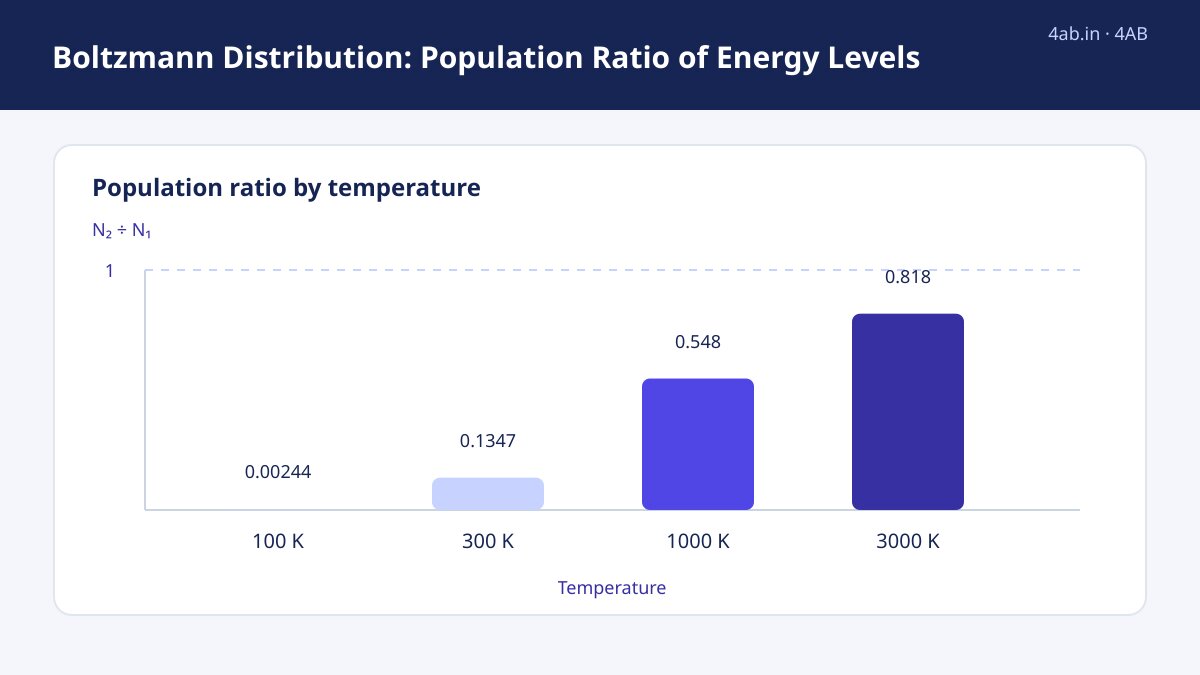
Question. Two non-degenerate levels differ by 5.0 kJ mol−1. Find the population ratio at 100 K, 300 K, 1000 K and 3000 K, and the temperature at which the ratio reaches 0.5.
Convert to J. ΔEm = 5000 J mol−1.
At 300 K. RT = 8.314 × 300 = 2494 J mol−1. Exponent = 5000 ÷ 2494 = 2.005. Ratio = e−2.005 = 0.1347.
Other temperatures. At 100 K: exponent 6.014, ratio 0.00244. At 1000 K: exponent 0.6014, ratio 0.548. At 3000 K: exponent 0.2005, ratio 0.818.
Ratio = 0.5. ln 2 = ΔEm ÷ RT, so T = 5000 ÷ (8.314 × 0.6931) = 867.6 K.
| T (K) | ΔEm ÷ RT | N2 ÷ N1 |
|---|---|---|
| 100 | 6.014 | 0.00244 |
| 300 | 2.005 | 0.1347 |
| 1000 | 0.6014 | 0.548 |
| 3000 | 0.2005 | 0.818 |
As T rises, the ratio climbs towards 1 for non-degenerate levels but never exceeds it. At infinite temperature the populations depend only on g.
Worked example 3: a gap in wavenumbers
Question. A vibrational level lies 2000 cm−1 above the ground level (a round number chosen for practice, not a specific molecule). Find the population ratio at 300 K and at 1000 K, taking both levels as non-degenerate.
At 300 K. Exponent = 1.4388 × 2000 ÷ 300 = 9.592. Ratio = e−9.592 = 6.83 × 10⁻⁵.
At 1000 K. Exponent = 1.4388 × 2000 ÷ 1000 = 2.878. Ratio = e−2.878 = 0.0563.
At room temperature almost every molecule is in the lowest vibrational level. This is why a spectrum of a gas at room temperature is dominated by transitions starting from the ground state, while a hot gas shows additional lines from excited levels.
Worked example 4: degeneracy matters
Question. A non-degenerate ground level (g1 = 1) lies below a triply degenerate level (g2 = 3). The gap is 0.5 kBT at the temperature of interest. Find N2 ÷ N1 and the fraction of molecules in the upper level.
Ratio. N2 ÷ N1 = 3 × e−0.5 = 3 × 0.6065 = 1.820.
Fraction in the upper level. 1.820 ÷ (1 + 1.820) = 0.645.
The upper level holds more molecules than the lower one, even though its energy is higher, because there are three states there to occupy. The Boltzmann factor applies to each state; the degeneracy multiplies it for a whole level.
Worked example 5: finding the gap from populations
Question. At 400 K the upper level of a non-degenerate pair has one quarter of the population of the lower. Find ΔE per mole.
Solution. ln(N2÷N1) = −ΔEm ÷ RT, so ΔEm = RT ln 4 = 8.314 × 400 × 1.3863 = 4610 J mol−1 = 4.61 kJ mol−1.
Another case. If the ratio at 300 K were 10−3: ΔEm = 8.314 × 300 × ln 1000 = 17.2 kJ mol−1.
Common mistakes
- Mixing kB and R. kB goes with joules per molecule; R goes with joules per mole. A kJ mol−1 gap must be turned into J mol−1 first.
- Dropping the degeneracy factor. For rotational levels g = 2J + 1, so the most populated level is not the lowest.
- Forgetting the minus sign. The exponent is negative; a ratio above 1 for non-degenerate levels is always an error.
- Using the ratio when T is very low. The formula is fine, but check that your calculator does not round e−x to zero too early.
- Confusing cm−1 with energy. A wavenumber must be multiplied by hc to become an energy, or you can use hc/kB = 1.4388 cm K directly.
- Treating the ratio as a fraction. N2 ÷ N1 is not N2 ÷ Ntotal. Add the levels to get the total.
Exam relevance
| Situation | What to remember |
|---|---|
| Gap >> kBT | Upper level almost empty |
| Gap << kBT | Ratio approaches g2 ÷ g1 |
| Rising temperature | Upper-level fraction increases |
| Degenerate levels | Multiply the Boltzmann factor by g2 ÷ g1 |
| Gap in cm−1 | Exponent = 1.4388 ν̃ ÷ T |
Check the current official notification for your exam's syllabus. The ideas here are standard, but the depth asked (two levels, many levels, partition function) varies.
The suite has no dedicated Boltzmann-distribution tool. Use the scientific calculator for the exponential and logarithm steps, and keep the constants from the Scientific Constants panel nearby to avoid typing errors.
Open the Chemistry Calculator Suite →