Bomb Calorimeter: Converting Delta U to Delta H
A bomb calorimeter burns a sample in a sealed steel vessel, so the volume cannot change. The heat it measures is therefore the change in internal energy, ΔU, and not the change in enthalpy, ΔH. Tables of combustion data are given as ΔH, so the conversion between the two is a standard step in IIT-JAM, GATE and CSIR-NET thermodynamics. This page derives the relation, shows how to calibrate the calorimeter, and works four numericals with the arithmetic done in full.

Why the heat at constant volume is ΔU
From the first law, ΔU = q + w. In the sign convention where w is work done on the system, w = −PextΔV. In a rigid bomb ΔV = 0, so w = 0 and qV = ΔU. (In books that write ΔU = q − w, the working is the same; only the sign of w differs. State which convention you use.)
Enthalpy is defined as H = U + PV. For a reaction at constant temperature involving ideal gases, PV = ngRT. Solids and liquids have a negligible PV change, so only the gases count.
Δng = (moles of gaseous products) − (moles of gaseous reactants)
R = 8.314 J K−1 mol−1, so R T at 298.15 K is 2.479 kJ mol−1. Keep R and the energy unit consistent: if ΔU is in kJ, use R = 8.314 × 10⁻³ kJ K−1 mol−1.
Calibration and the heat capacity of the calorimeter
The temperature rise ΔT is measured, and the heat capacity of the whole assembly (water, steel bomb, stirrer and thermometer), Ccal, converts it to heat:
ΔU (per mole) = − Ccal ΔT ÷ n
The minus sign appears because the heat gained by the calorimeter is lost by the reaction. Ccal is found by burning a standard sample whose heat of combustion is known, and then used for unknown samples.
Worked example 1: finding Ccal
Question. A 0.8000 g sample of a standard substance whose heat of combustion is given as 26.4 kJ per gram is burned in the bomb. The temperature rises by 2.64 K. Find the heat capacity of the calorimeter.
Heat released. q = 0.8000 × 26.4 = 21.12 kJ.
Heat capacity. Ccal = q ÷ ΔT = 21.12 ÷ 2.64 = 8.00 kJ K−1.
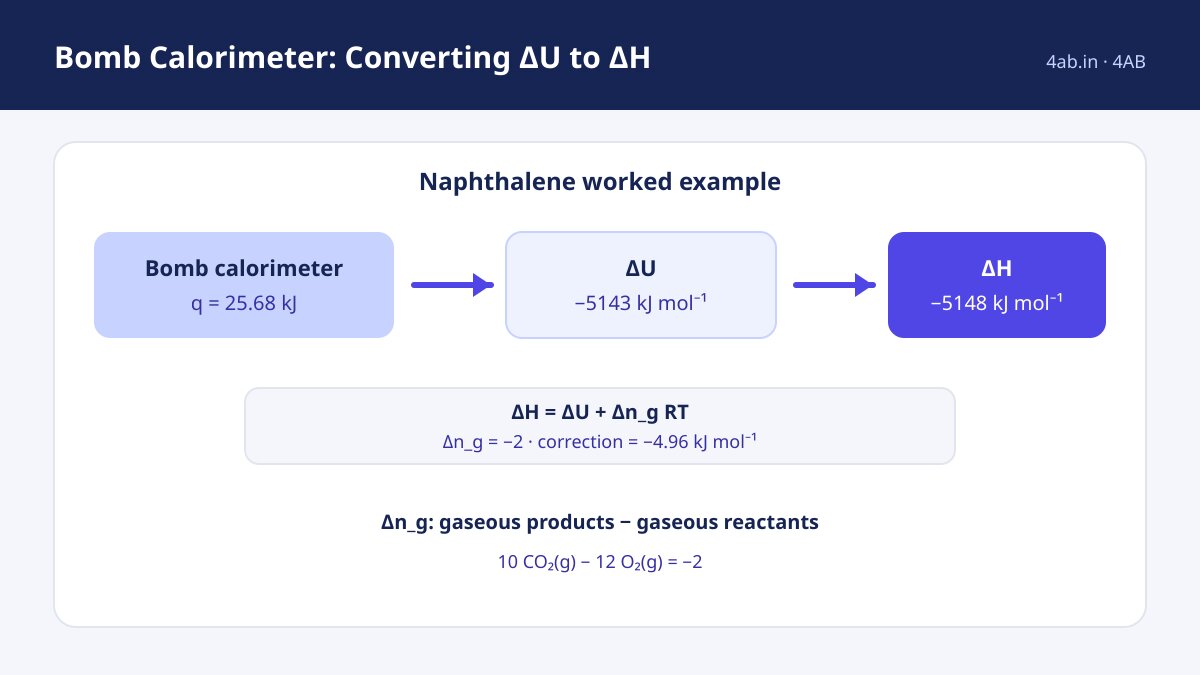
Worked example 2: naphthalene, Δng < 0
Question. Burning 0.6400 g of naphthalene, C10H8(s), in the same calorimeter (Ccal = 8.00 kJ K−1) raises the temperature by 3.21 K. Find ΔU and ΔH of combustion per mole at 298.15 K.
Reaction. C10H8(s) + 12 O2(g) → 10 CO2(g) + 4 H2O(l).
Molar mass. 10(12.011) + 8(1.008) = 128.174 g mol−1. Moles: 0.6400 ÷ 128.174 = 4.993 × 10⁻³ mol.
Heat released. q = 8.00 × 3.21 = 25.68 kJ.
ΔU. −25.68 ÷ 4.993 × 10−3 = −5143 kJ mol−1.
Δng. Gaseous products = 10, gaseous reactants = 12, so Δng = −2 (water is liquid and naphthalene is solid, so neither counts).
ΔH. ΔH = ΔU + ΔngRT = −5143 + (−2)(8.314 × 10⁻³)(298.15) = −5143 − 4.96 = −5148 kJ mol−1.
The correction is under 0.1 per cent of the total. It is small but it is exactly what a numerical asks for.
Worked example 3: glucose, Δng = 0
Question. A 1.500 g sample of glucose, C6H12O6(s), raises the temperature in the same calorimeter by 2.91 K. Find ΔU and ΔH of combustion.
Reaction. C6H12O6(s) + 6 O2(g) → 6 CO2(g) + 6 H2O(l).
Moles. M = 6(12.011) + 12(1.008) + 6(15.999) = 180.156 g mol−1; n = 1.500 ÷ 180.156 = 8.326 × 10⁻³ mol.
Heat. q = 8.00 × 2.91 = 23.28 kJ, so ΔU = −23.28 ÷ 8.326 × 10−3 = −2796 kJ mol−1.
Δng. 6 mol CO2 out, 6 mol O2 in, so Δng = 0 and ΔH = ΔU = −2796 kJ mol−1.
Worked example 4: ethanol, a liquid fuel
Question. Burning 0.9200 g of liquid ethanol in the same calorimeter raises the temperature by 3.41 K. Find ΔU and ΔH.
Reaction. C2H5OH(l) + 3 O2(g) → 2 CO2(g) + 3 H2O(l).
Moles. M = 2(12.011) + 6(1.008) + 15.999 = 46.069 g mol−1; n = 0.9200 ÷ 46.069 = 0.01997 mol.
ΔU. q = 8.00 × 3.41 = 27.28 kJ; ΔU = −27.28 ÷ 0.01997 = −1366 kJ mol−1.
Δng. 2 − 3 = −1.
ΔH. −1366 + (−1)(8.314 × 10⁻³)(298.15) = −1366 − 2.48 = −1368.5 kJ mol−1.
Going the other way: ΔU from ΔH
Question. For N2(g) + 3 H2(g) → 2 NH3(g), ΔH = −92.2 kJ at 298.15 K (value given in the problem). Find ΔU.
Δng. 2 − 4 = −2.
ΔU. ΔU = ΔH − ΔngRT = −92.2 − (−2)(8.314 × 10⁻³)(298.15) = −92.2 + 4.96 = −87.2 kJ.
When the gas moles fall, the surroundings compress the system and do work on it, so less heat is given out at constant volume than at constant pressure. That is why ΔU is less negative than ΔH here.
Common mistakes
- Counting liquids and solids in Δng. Only gas moles count. Liquid water in the products is not included.
- Ignoring the sign of the heat. The calorimeter gains heat, the reaction loses it, so ΔU is negative for combustion.
- Mixing J and kJ. Use R = 8.314 J K−1 mol−1 with joules and 8.314 × 10⁻³ with kilojoules.
- Using Δn instead of Δng. Total moles in the equation are not needed; only the gaseous ones.
- Per gram against per mole. ΔU and ΔH are asked per mole of the substance burned; divide by moles, not grams, unless asked.
Exam relevance
| Situation | Relation |
|---|---|
| Δng = 0 | ΔH = ΔU |
| Δng < 0 | ΔH is more negative than ΔU |
| Δng > 0 | ΔH is less negative (higher) than ΔU |
| Calorimeter calibration | Ccal = qstandard ÷ ΔT |
Check the current official syllabus for your exam to see whether calorimetry is tested as a numerical or a concept, and which sign convention for work it uses.
No single tool in the suite performs bomb-calorimeter conversions. The scientific calculator can still check the arithmetic of each step.
Open the Chemistry Calculator Suite →Turn this concept into marks: solve previous-year CSIR-NET questions and take a timed quiz.
More Thermodynamics articles