Carnot Cycle: Efficiency, Work and Entropy Balance
The Carnot engine sets the upper limit on how much work any heat engine can get from heat flowing between two temperatures. It is a standard physical chemistry topic for IIT-JAM, GATE, CSIR-NET and CUET-PG, and it is the cleanest way to see why the second law and entropy are linked. This page gives the formulas, four fully computed examples, and the sign conventions that cause errors.

The key relations
qh/Th = qc/Tc (reversible cycle: ΔStotal = 0)
Refrigerator: COP = Tc/(Th − Tc)
What each symbol means
- Th and Tc – temperatures of the hot and cold reservoirs, always in kelvin.
- qh – heat taken from the hot reservoir per cycle. qc – heat given to the cold reservoir. Here both are written as positive magnitudes.
- w – net work done by the engine per cycle. Some books (IUPAC convention) write w as work done on the system, so the engine's w is negative there and η = −w/qh. The physics is the same; check your book's convention.
- η – efficiency, a number between 0 and 1 (multiply by 100 for per cent).
Why the Carnot engine is the limit
The second law, in the Kelvin–Planck form, says that no engine working in a cycle can take heat from one reservoir and convert all of it into work. Some heat must always be rejected to a colder reservoir. Carnot's result goes further: among all engines working between the same two temperatures, a reversible engine has the highest efficiency, and every reversible engine has the same efficiency, whatever the working substance is. That is why the formula contains only the two temperatures. It does not matter whether the gas is helium, nitrogen or steam. For an ideal gas this can be proved by working out the heat in the two isothermal steps; the adiabatic steps cancel because they connect the same two temperatures. Real engines lose further efficiency to friction and heat leaks, so they stay below this limit.
The four steps of the cycle
| Step | Process | Heat |
|---|---|---|
| 1 | Reversible isothermal expansion at Th | qh absorbed |
| 2 | Reversible adiabatic expansion, Th → Tc | q = 0 |
| 3 | Reversible isothermal compression at Tc | qc released |
| 4 | Reversible adiabatic compression, Tc → Th | q = 0 |
Worked examples
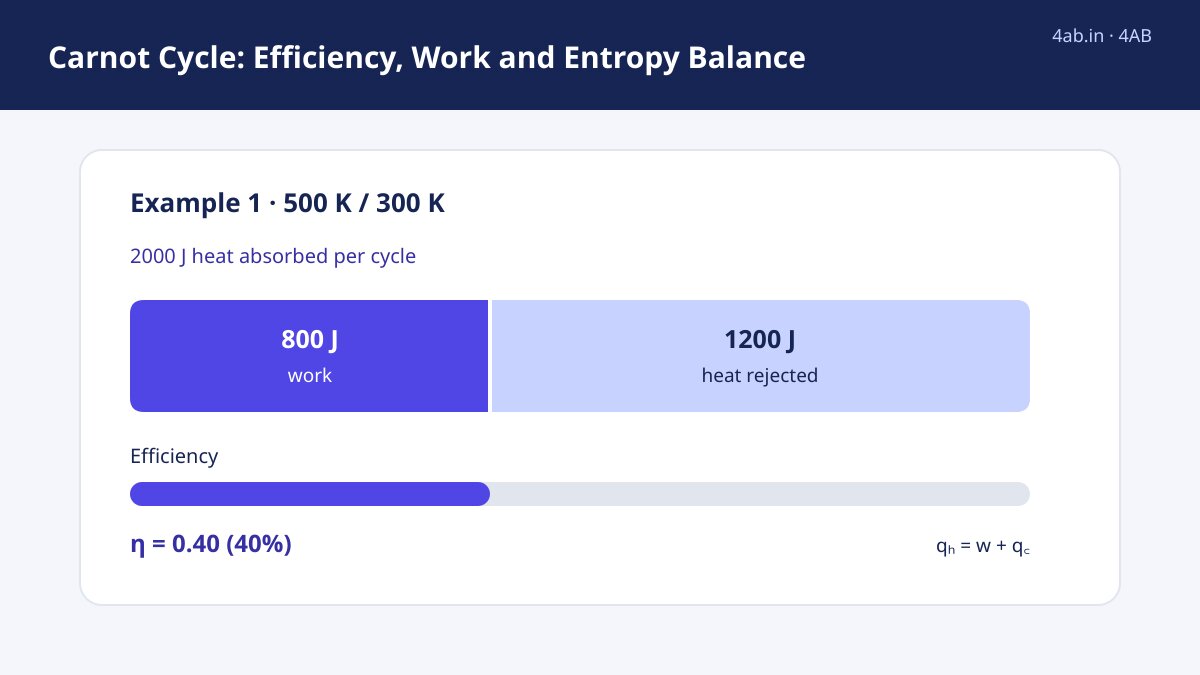
Example 1: efficiency, work and heat rejected. A Carnot engine works between 500 K and 300 K and absorbs 2000 J per cycle at 500 K.
η = 1 − 300/500 = 1 − 0.6 = 0.40 (40%).
w = η × qh = 0.40 × 2000 = 800 J.
qc = qh − w = 2000 − 800 = 1200 J.
Example 2: entropy check of Example 1. For a reversible cycle the entropy changes of the two reservoirs cancel.
qh/Th = 2000/500 = 4.0 J K⁻¹. qc/Tc = 1200/300 = 4.0 J K⁻¹.
The hot reservoir loses 4.0 J K⁻¹ of entropy and the cold reservoir gains 4.0 J K⁻¹, so ΔStotal = −4.0 + 4.0 = 0. ✓ The two routes agree. If the engine were irreversible, the cold reservoir would gain more than 4.0 J K⁻¹ and ΔStotal would be positive.
Example 3: source temperature needed. An engine rejects heat at 300 K. What hot-reservoir temperature is needed for η = 30%?
0.30 = 1 − 300/Th, so 300/Th = 0.70 and Th = 300/0.70 = 428.6 K (about 155 °C).
Example 4: is it better to raise Th or to lower Tc by 100 K? Start from the engine of Example 1 (500 K, 300 K, η = 0.40).
Raise Th to 600 K: η = 1 − 300/600 = 0.50.
Lower Tc to 200 K: η = 1 − 200/500 = 0.60.
For the same 100 K change, lowering the cold side helps more here, because Tc sits in the numerator of a fraction whose denominator (Th) is larger. In practice cooling to a very low Tc costs work of its own, so real engines are limited by the surroundings.
Example 5: refrigerator. A reversible refrigerator keeps its inside at 270 K in a room at 300 K. Find the COP.
COP = Tc/(Th − Tc) = 270/(300 − 270) = 270/30 = 9.0. It removes 9 J of heat from the cold space for each 1 J of work supplied. Real refrigerators have a lower COP.
Common mistakes
- Using °C instead of K. A formula with Tc/Th needs absolute temperatures. With 227 °C and 27 °C you must use 500 K and 300 K.
- Expecting η = 1. This needs Tc = 0 K, which cannot be reached. No engine can convert all heat to work.
- Using the Carnot formula for an irreversible engine. For a real engine, η is always less than 1 − Tc/Th.
- Mixing the sign convention. In the "work done on the system" convention, w for an engine is negative; do not put a negative efficiency in the answer.
- Applying qh/Th = qc/Tc to an irreversible cycle. It holds only for the reversible one.
Where this appears
| Exam | Typical use |
|---|---|
| IIT-JAM, CUET-PG | Numerical on efficiency and work from two temperatures. Check the latest syllabus for the exact scope. |
| GATE, CSIR-NET | Entropy changes of reservoirs and statements on the second law. Check the current official notification. |
Carnot problems need only a few divisions, so any scientific calculator works. The suite also has the Gibbs free energy tool for the related ΔG = ΔH − TΔS problems.
Open the Chemistry Calculator Suite →Turn this concept into marks: solve previous-year CSIR-NET questions and take a timed quiz.
More Thermodynamics articles