Cell Potential, ΔG° and the Equilibrium Constant: How They Link
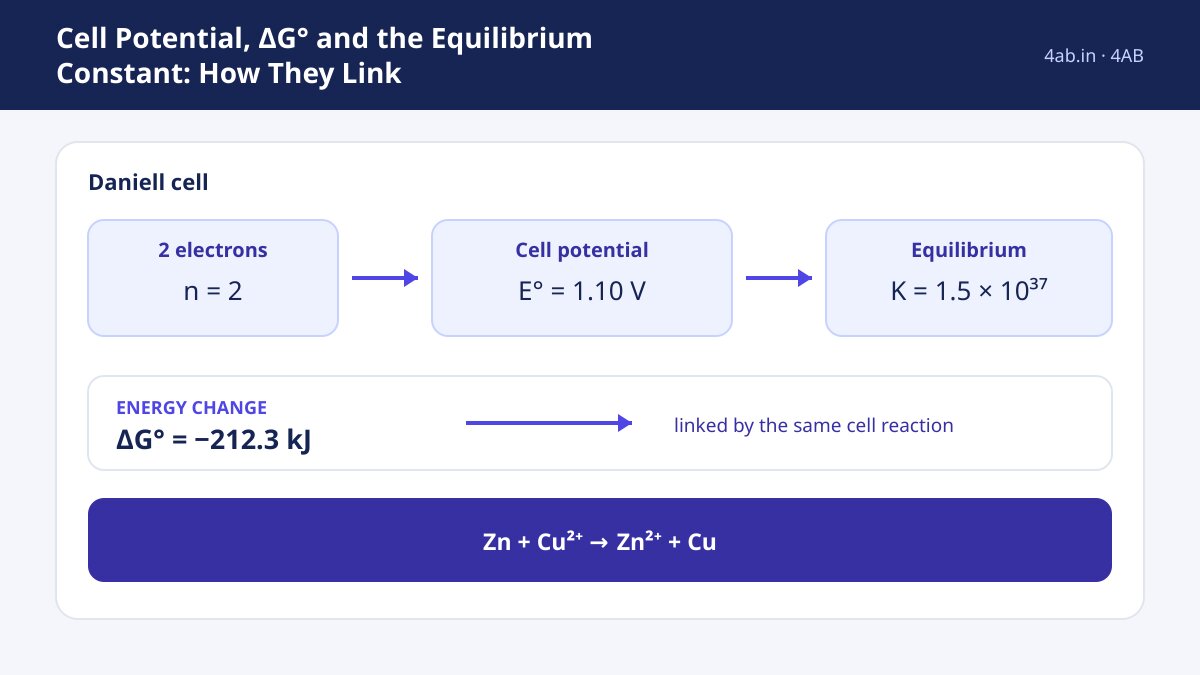
A galvanic cell is a reaction that has been given a voltage. If you know the standard cell potential E°, you already know the standard Gibbs energy change and the equilibrium constant of the cell reaction. Numerical questions in IIT-JAM, GATE, CSIR-NET and CUET-PG often hide this link: they give E° and ask for K, or give K and ask for E°. This page shows the three connected formulas and the arithmetic, step by step.

The key relations
ΔG° = −RT ln K
So: ln K = nFE° / RT, and at 298 K: log₁₀K = nE° / 0.0592
What each symbol means
- n – the number of electrons transferred in the balanced cell reaction (not in a half-reaction you have not balanced).
- F – the Faraday constant, 96485 C mol⁻¹ (often rounded to 96500).
- E° – standard cell potential in volts, E°(cathode) − E°(anode), both written as reduction potentials.
- R – 8.314 J K⁻¹ mol⁻¹. T – temperature in kelvin.
- 0.0592 – the value of 2.303RT/F at 298 K, in volts. More exactly it is 0.05916 V; many books round it to 0.059 V. Use what your question or book uses.
Remember that E° and K belong to the reaction as written. If you reverse the reaction, E° changes sign and K becomes 1/K. If you multiply the equation by 2, n doubles, but E° stays the same (E° is an intensive property), while ΔG° doubles and K is squared.
Worked examples
Example 1: the Daniell cell. Zn + Cu²⁺ → Zn²⁺ + Cu, with E° = 1.10 V and n = 2. Find ΔG° and K at 298 K.
ΔG° = −nFE° = −2 × 96485 × 1.10 = −212267 J = −212.3 kJ.
log₁₀K = nE°/0.05916 = (2 × 1.10)/0.05916 = 37.19.
K = 10^37.19 = 1.5 × 10³⁷.
Second route: ln K = −ΔG°/RT = 212267 / (8.314 × 298.15) = 85.63, and e^85.63 = 1.5 × 10³⁷. Both methods agree, so the arithmetic is safe. The huge K means the reaction goes almost completely to products.
Example 2: copper and silver ions. Cu + 2Ag⁺ → Cu²⁺ + 2Ag. Use E°(Ag⁺/Ag) = +0.80 V and E°(Cu²⁺/Cu) = +0.34 V. Find E°, ΔG° and K.
E° = E°(cathode) − E°(anode) = 0.80 − 0.34 = 0.46 V. Silver is reduced (cathode), copper is oxidised (anode). Do not multiply the 0.80 V by 2 for the two silver ions; E° does not change with coefficients.
n = 2.
ΔG° = −2 × 96485 × 0.46 = −88766 J = −88.8 kJ.
log₁₀K = (2 × 0.46)/0.05916 = 15.55, so K = 10^15.55 = 3.6 × 10¹⁵.
Example 3: from K to E°. A cell reaction with n = 2 has K = 1 × 10²⁰ at 298 K. Find E° and ΔG°.
E° = (0.05916 / n) × log₁₀K = (0.05916 / 2) × 20 = 0.592 V.
ΔG° = −nFE° = −2 × 96485 × 0.5916 = −114161 J ≈ −114 kJ.
Check with ΔG° = −RT ln K = −8.314 × 298.15 × (20 × 2.303) = −8.314 × 298.15 × 46.05 = −114,150 J. This is the same within rounding.
Example 4: from ΔG° to K without any cell. A reaction has ΔG° = −30.0 kJ mol⁻¹ at 298.15 K. Find K.
ln K = −ΔG°/RT = 30000 / (8.314 × 298.15) = 30000 / 2478.8 = 12.10.
K = e^12.10 = 1.8 × 10⁵ (log₁₀K = 5.26).
A change of only about 5.7 kJ in ΔG° changes K by a factor of 10. This is a good number to remember: at 298 K, every 5.7 kJ mol⁻¹ equals one power of ten in K.
Example 5: the reverse reaction. For Example 1 reversed (Cu + Zn²⁺ → Cu²⁺ + Zn), E° = −1.10 V. Then ΔG° = +212.3 kJ and K = 10^(−37.19) = 6.5 × 10⁻³⁸. The reaction as written practically does not happen; this is what the sign of E° tells you.
Quick table of signs
| E° | ΔG° | K | Meaning |
|---|---|---|---|
| positive | negative | greater than 1 | products favoured at equilibrium |
| zero | zero | equal to 1 | neither side favoured |
| negative | positive | less than 1 | reactants favoured at equilibrium |
Common mistakes
- Using the wrong n. Count the electrons in the balanced overall reaction. In Example 2 it is 2, not 1.
- Multiplying E° by the coefficients. E° does not scale with the equation; ΔG° and n do.
- Using the 0.0592 shortcut away from 298 K. At other temperatures, use ln K = nFE°/RT directly.
- Mixing E° with E. E° and K belong to standard conditions. At equilibrium, the cell potential E is zero, and Q equals K.
- Forgetting the units: ΔG° from −nFE° comes out in joules. Divide by 1000 for kJ.
- Calling the cell “spontaneous so it is fast”. A large K says nothing about the rate.
How this connects to the Nernst equation
The Nernst equation gives E = E° − (0.0592/n) log Q. At equilibrium the cell has run down, E = 0 and Q = K. Putting these into the Nernst equation gives E° = (0.0592/n) log K, which is exactly the relation used in Example 3. So there is only one idea here, written in three ways.
Where this appears
| Exam | Typical use |
|---|---|
| IIT-JAM, CUET-PG | Numerical on K or ΔG° from standard potentials. Check the latest syllabus for the exact scope. |
| GATE, CSIR-NET | Combined numericals with the Nernst equation, solubility products and complex-formation constants. Check the current official notification. |
Use the Nernst tool to check cell potentials at standard and non-standard concentrations.
Open the Nernst Equation Calculator →