Collecting a Gas over Water: Aqueous Tension Corrections
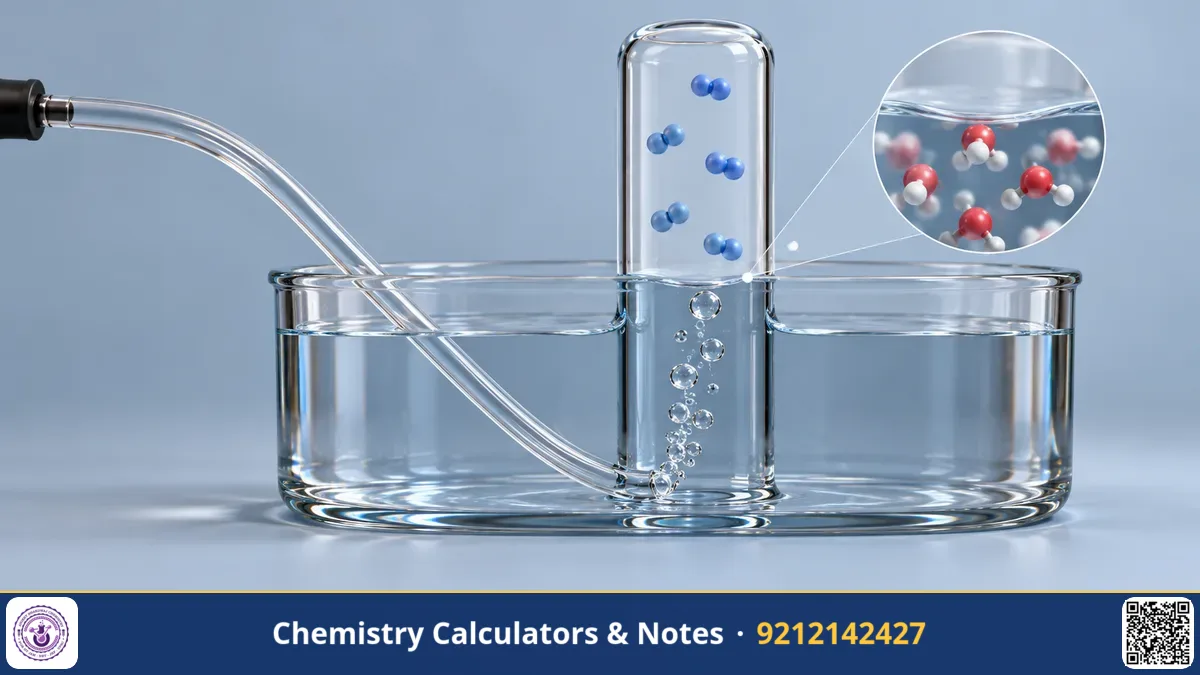
In the school laboratory, hydrogen from zinc and acid, or oxygen from heating potassium chlorate, is collected by displacing water in an inverted jar. The gas you trap is not pure. It is mixed with water vapour. Board and entrance questions ask you to correct for this, and many students lose marks by forgetting it. This article gives you the method, with four numerical checks.

The formula
Pgas = Patm − aqueous tension
n = PgasV/(RT)
Ptotal is the pressure inside the jar. When the water level inside the jar equals the level outside, it equals the atmospheric pressure. Aqueous tension is just another name for the vapour pressure of water at the temperature of the experiment. It depends only on temperature. This is Dalton’s law of partial pressures: each gas in a mixture behaves as if it were alone, and the pressures add.
Typical textbook values of the vapour pressure of water are 23.8 mmHg at 25°C, 26.7 mmHg at 27°C and 31.8 mmHg at 30°C. A question will either give you this value or give you a small table. Use what the question gives. Do not rely on memory.
Why the levels must be equal
If the water inside the jar stands higher than outside, the gas pressure is lower than the atmosphere. If it stands lower, the gas pressure is higher. Only when the two levels are the same is Ptotal = Patm. In exam questions this is usually assumed. When it is not, the question will give you the height difference and you must adjust for it.
Worked example 1: moles of hydrogen
Question. 120 mL of hydrogen is collected over water at 25°C when the barometer reads 750 mmHg. The aqueous tension at 25°C is 23.8 mmHg. Find the moles of dry hydrogen, and its volume at 0°C and 1 atm.
Step 1. P(H2) = 750 − 23.8 = 726.2 mmHg = 726.2 ÷ 760 = 0.9555 atm.
Step 2. V = 0.120 L, T = 298.15 K. n = (0.9555 × 0.120)/(0.082057 × 298.15) = 0.11466 ÷ 24.466 = 4.687 × 10⁻³ mol.
Step 3. Mass of H2 = 4.687 × 10−3 × 2.016 = 9.45 × 10⁻³ g.
Step 4. Dry volume at 0°C and 1 atm = 4.687 × 10−3 × 22.414 L = 0.1050 L = 105.0 mL.
Check using the combined gas law. V2 = 120 × (726.2/760) × (273.15/298.15) = 120 × 0.9555 × 0.9161 = 105.0 mL. Same.
Worked example 2: volume of hydrogen from magnesium
Question. 0.120 g of magnesium reacts completely with dilute HCl. The hydrogen is collected over water at 27°C and 745 mmHg. Aqueous tension at 27°C is 26.7 mmHg. What volume of gas collects?
Step 1. Mg + 2HCl → MgCl2 + H2. One mole of Mg gives one mole of H2.
Step 2. n(Mg) = 0.120 ÷ 24.305 = 4.937 × 10⁻³ mol, so n(H2) = 4.937 × 10⁻³ mol.
Step 3. P(H2) = 745 − 26.7 = 718.3 mmHg = 0.9451 atm. T = 300.15 K.
Step 4. V = nRT/P = (4.937 × 10−3 × 0.082057 × 300.15) ÷ 0.9451 = 0.12160 ÷ 0.9451 = 0.1287 L.
Answer. About 129 mL of gas collects in the jar. If you forgot the water vapour, you would divide by 0.9803 (745/760) and get 124 mL, an error of about 4%.
Worked example 3: mass of KClO3 from oxygen collected
Question. Potassium chlorate decomposes: 2KClO3 → 2KCl + 3O2. The oxygen collected over water measures 250 mL at 30°C and 742 mmHg. Aqueous tension at 30°C is 31.8 mmHg. What mass of KClO3 decomposed?
Step 1. P(O2) = 742 − 31.8 = 710.2 mmHg = 0.9345 atm. T = 303.15 K.
Step 2. n(O2) = (0.9345 × 0.250)/(0.082057 × 303.15) = 0.23362 ÷ 24.875 = 9.391 × 10⁻³ mol.
Step 3. From the equation, 2 mol KClO3 gives 3 mol O2, so n(KClO3) = 9.391 × 10−3 × 2/3 = 6.261 × 10⁻³ mol.
Step 4. M(KClO3) = 39.098 + 35.45 + 3(15.999) = 122.545 g/mol. Mass = 6.261 × 10−3 × 122.545 = 0.767 g.
Answer. About 0.767 g of KClO3 decomposed.
Worked example 4: how much of the jar is water vapour?
Question. In example 1, what percentage of the gas in the jar (by mole) is water vapour?
Step 1. In a gas mixture, mole fraction = partial pressure ÷ total pressure.
Step 2. x(water) = 23.8 ÷ 750 = 0.0317.
Answer. About 3.2% of the molecules in the jar are water vapour. That looks small, but it is large enough to change the answer at the third significant figure, so it cannot be ignored.
Common mistakes
- Using the barometer pressure directly. The pressure of the dry gas is Patm minus aqueous tension.
- Using the same aqueous tension at every temperature. The value rises quickly as temperature rises, so read it for the temperature of the experiment.
- Mixing mmHg with R = 0.082057. Convert mmHg to atm by dividing by 760.
- Forgetting to convert mL to L. 250 mL = 0.250 L.
- Using this method for a gas that dissolves well in water. Ammonia and HCl are collected differently, because they dissolve in water.
Exam relevance
| Given | Step |
|---|---|
| Gas collected over water | Subtract aqueous tension from total pressure |
| Need moles of gas | n = PgasV/(RT) with V in L and T in K |
| Need volume at STP | Combined gas law with the dry pressure |
| Need mass of reactant | Moles of gas, then the mole ratio, then molar mass |
| Water vapour fraction | Aqueous tension ÷ total pressure |
Aqueous tension values differ slightly between books. Use the table printed in your question paper or textbook.
Check the n = PV/RT step of your gas-over-water numerical with the Ideal Gas Law tool.
Open the Ideal Gas Law Calculator →