Degree of Unsaturation (DBE): Rings and Double Bonds from a Molecular Formula
Given only a molecular formula such as C5H8, can you say how many rings or double bonds the molecule has? Yes, in about ten seconds, using the degree of unsaturation (also called DBE, double bond equivalent, or index of hydrogen deficiency). It is a very useful first step in Class 11–12 organic chemistry when you are asked to write possible structures for a formula.

What it means
A saturated, open-chain hydrocarbon CnH2n+2 has the maximum number of hydrogens it can hold. Each ring, each double bond, and each triple bond reduces the hydrogen count. The degree of unsaturation counts how many “pairs of hydrogens” are missing from the saturated formula.
- C = number of carbon atoms; H = number of hydrogen atoms.
- X = number of halogen atoms (F, Cl, Br, I). A halogen takes the place of a hydrogen, so it is added to H.
- N = number of nitrogen atoms. Nitrogen is trivalent, so each N lets the molecule hold one more hydrogen, and it is added as N/2.
- Oxygen and sulphur (divalent) do not change the count, so they are ignored.
What the DBE number tells you:
| Feature | Counts as |
|---|---|
| One ring | 1 |
| One C=C or C=O double bond | 1 |
| One C≡C triple bond | 2 |
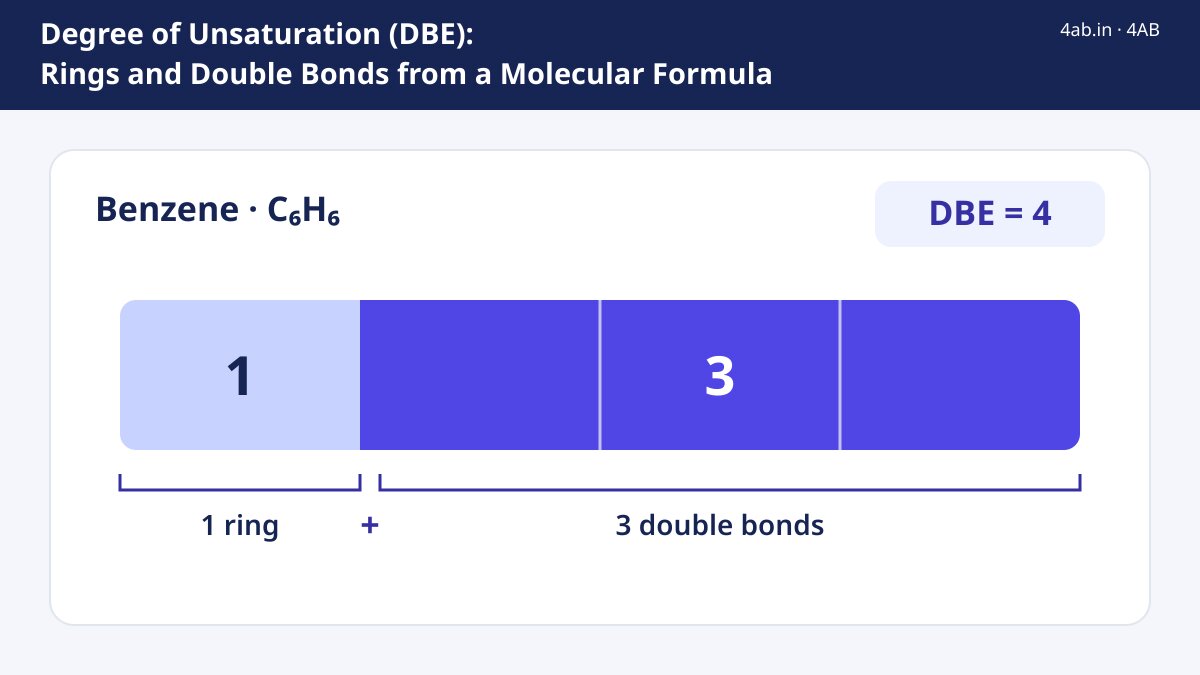
| Benzene ring (ring + 3 double bonds) | 4 |
Why the formula works
For a saturated acyclic compound with C carbons, the maximum H is 2C + 2. Each unit of unsaturation removes 2 H. So DBE = (2C + 2 − H)/2 = C − H/2 + 1. A halogen replaces H, giving C − (H + X)/2 + 1. Each nitrogen adds one extra position for H, giving + N/2. A DBE of 0 means a fully saturated open-chain molecule, and the answer is never negative for a real neutral molecule.
Example 1: benzene, C6H6.
DBE = 6 − 6/2 + 1 = 6 − 3 + 1 = 4. That matches one ring plus three C=C bonds. So any formula that gives DBE = 4 with six or more carbons is worth checking for a benzene ring.
Example 2: C4H8O. Oxygen is ignored.
DBE = 4 − 8/2 + 1 = 4 − 4 + 1 = 1. So the molecule has one ring or one double bond. Possible structures include butanal (CH3CH2CH2CHO, a C=O double bond), butanone (CH3COCH2CH3) and tetrahydrofuran (a ring with no double bond). All three have the same formula and the same DBE of 1.
Example 3: nitrobenzene, C6H5NO2, and a chloro compound, C8H9Cl.
Nitrobenzene: DBE = 6 − 5/2 + 1/2 + 1 = 6 − 2.5 + 0.5 + 1 = 5. The benzene ring accounts for 4, and the N=O bond of the nitro group accounts for the fifth.
C8H9Cl: treat Cl as H, so H + X = 10. DBE = 8 − 10/2 + 1 = 8 − 5 + 1 = 4. This fits a benzene ring with a side chain, for example 4-chloroethylbenzene or a chloro-dimethylbenzene.
Example 4: choosing a structure for C5H8.
DBE = 5 − 8/2 + 1 = 5 − 4 + 1 = 2. This could be one triple bond (pent-1-yne, pent-2-yne), two double bonds (penta-1,3-diene), one ring with one double bond (cyclopentene), or two rings (bicyclic). It cannot be a simple alkane or alkene. Check the answer by counting: cyclopentene is C5H8, since a five-membered ring with one C=C has 2 CH + 3 CH2 = 2 + 6 = 8 hydrogens. Correct.
Common mistakes
- Counting oxygen in the formula. O does not change the DBE.
- Forgetting to add halogens to H. For C2H5Cl, H + X = 6, so DBE = 2 − 3 + 1 = 0.
- Forgetting that nitrogen adds N/2. Without it, nitrobenzene (C6H5NO2) would give 4.5, which is not a whole number.
- Treating DBE = 1 as “a double bond”. It can equally be a ring.
- Counting a triple bond as 1. It counts as 2.
- Getting a fractional DBE. If you get a half, recheck the formula; neutral organic molecules give whole numbers.
Exam-relevance table
| Formula | DBE | Possible features |
|---|---|---|
| C6H14 | 0 | Saturated alkane only |
| C6H12 | 1 | Hexene or cyclohexane |
| C6H10 | 2 | Alkyne, diene, or ring plus double bond |
| C7H8 | 4 | Toluene (benzene ring plus CH3) |
| C9H8 | 6 | Benzene ring plus extra unsaturation |
DBE gives the count of rings and multiple bonds, not which ones; you need extra information such as a test or spectrum to decide. Check your syllabus for how much of this your own exam expects.
Count atoms carefully, then check every molecular formula you work with against its molar mass.
Open the Molar Mass & Composition Calculator →Turn this concept into marks: solve previous-year CSIR-NET questions and take a timed quiz.
More Solutions articles