Dipole Moment: Calculation and Percent Ionic Character
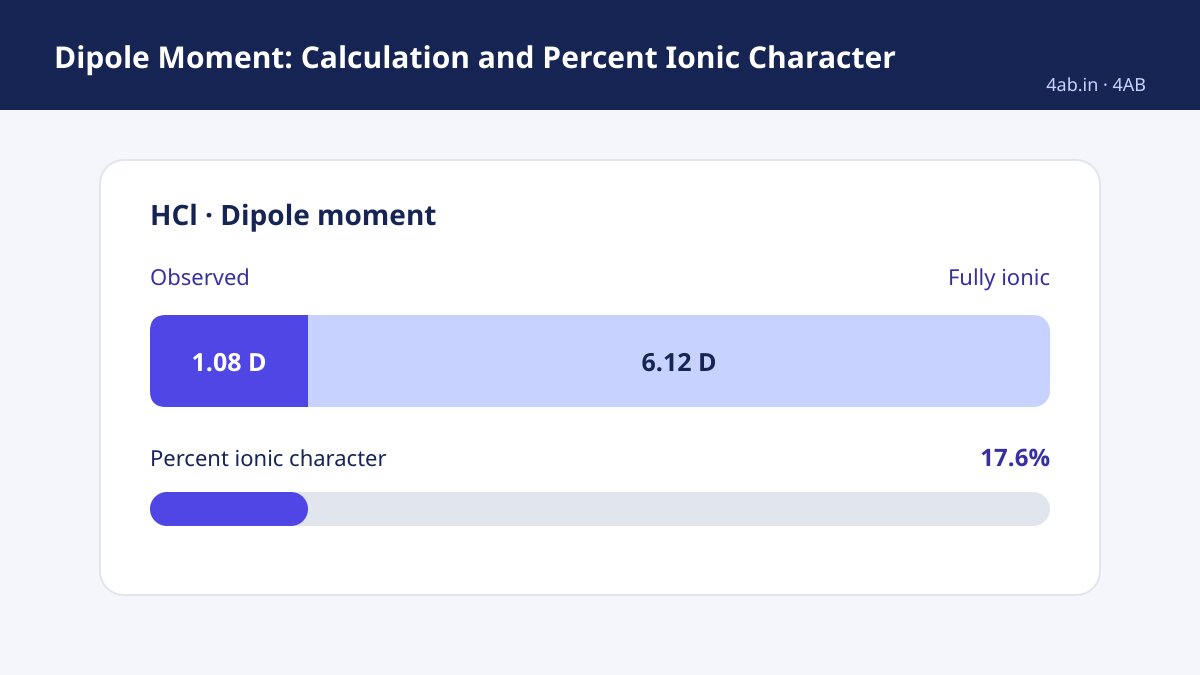
Dipole moment is a number that tells you how far a molecule is from being symmetrical in its charge. It explains why water dissolves salt but oil does not, why CO2 is non-polar even though each C=O bond is polar, and why HCl is partly ionic. In Class 11 and 12 you meet it in the chemical bonding chapter, and numericals on it are short and scoring if you know the three steps below.

The definition
If a charge +q and a charge −q are separated by a distance d, the dipole moment is the product of the two. It is a vector: it has size and direction, and chemists draw it as an arrow from the positive end to the negative end (many textbooks draw the arrow the other way round, so follow your own book).
1 debye (D) = 3.336 × 10⁻³⁰ C m
Charge of an electron, e = 1.602 × 10⁻¹⁹ C
μ is the dipole moment in coulomb metre (C m) in SI units, or in debye (D). q is the magnitude of the partial charge in coulomb. d is the distance between the charges in metres; for a bond this is the bond length, often given in picometres (1 pm = 10−12 m) or in angstrom (1 Å = 10−10 m). Many numerical errors come from not converting this distance into metres.
Percent ionic character
Imagine the bond was 100% ionic, with a full electron charge +e and −e at the bond length apart. That would give the largest possible dipole moment for that bond length. The real, measured dipole moment is smaller. Their ratio is the percent ionic character.
Percent ionic character = (μobserved ÷ μionic) × 100
Both dipole moments must be in the same unit before dividing, either both in C m or both in D.
Worked example 1: HCl
Question. The observed dipole moment of HCl is 1.08 D and the H–Cl bond length is 127.4 pm (values given in the problem). Find the percent ionic character.
Step 1: convert the observed value. μobs = 1.08 × 3.336 × 10−30 = 3.603 × 10⁻³⁰ C m.
Step 2: the fully ionic value. d = 127.4 pm = 1.274 × 10⁻¹⁰ m. μionic = 1.602 × 10−19 × 1.274 × 10−10 = 2.041 × 10⁻²⁹ C m, which is 6.12 D.
Step 3: the ratio. 3.603 × 10⁻³⁰ ÷ 2.041 × 10−29 = 0.1765, so about 17.6 % ionic.
Check by another route. Partial charge q = μ ÷ d = 3.603 × 10⁻³⁰ ÷ 1.274 × 10−10 = 2.828 × 10⁻²⁰ C. As a fraction of e: 2.828 × 10⁻²⁰ ÷ 1.602 × 10−19 = 0.1765. The same answer, because percent ionic character is just the partial charge as a percentage of a full electron charge.
Worked example 2: from C m to a percentage
Question. A diatomic molecule AB has μ = 6.0 × 10⁻³⁰ C m and bond length 160 pm. Find its dipole moment in debye and its percent ionic character.
In debye. 6.0 × 10⁻³⁰ ÷ 3.336 × 10−30 = 1.80 D.
Fully ionic value. μionic = 1.602 × 10−19 × 1.60 × 10−10 = 2.563 × 10⁻²⁹ C m.
Percent ionic. 6.0 × 10⁻³⁰ ÷ 2.563 × 10−29 = 0.2341, so 23.4 %.
Adding bond dipoles as vectors
In a molecule with more than two atoms, every polar bond has its own bond moment. The molecular dipole moment is the vector sum of all of them. For two equal bond moments m at an angle θ to each other, the resultant is:
This comes from μ = √(m2 + m2 + 2m2cos θ) and the identity 1 + cos θ = 2cos2(θ ÷ 2).
Worked example 3: water and carbon dioxide
Question. Assume each O–H bond moment in water is 1.5 D (a value given in the problem) and the H–O–H angle is 104.5°. Find the dipole moment of water. Then explain why CO2 has none.
Water. θ ÷ 2 = 52.25°, cos 52.25° = 0.6121. μ = 2 × 1.5 × 0.6121 = 1.84 D. The value from the other formula agrees: √(1.52 + 1.52 + 2 × 1.5 × 1.5 × cos 104.5°) = 1.84 D.
Carbon dioxide. The molecule is linear, so θ = 180° and cos 90° = 0. The two equal C=O moments point in opposite directions and cancel, giving μ = 0 even though each bond is polar.
| Angle between two equal bond moments | Resultant as a multiple of one bond moment |
|---|---|
| 60° | 1.732 |
| 90° | 1.414 |
| 109.5° | 1.154 |
| 120° | 1.000 |
| 180° | 0 |
Worked example 4: charge separation
Question. A bond of length 100 pm has a dipole moment of 1.0 D. What is the partial charge on each atom, as a fraction of e?
Solution. μ = 3.336 × 10⁻³⁰ C m; d = 1.00 × 10⁻¹⁰ m. q = μ ÷ d = 3.336 × 10⁻²⁰ C. Divide by e: 3.336 × 10⁻²⁰ ÷ 1.602 × 10−19 = 0.208. Each atom carries about 0.21 of a full electron charge.
Common mistakes
- Not converting pm or Å to metres. 127.4 pm is 1.274 × 10⁻¹⁰ m, not 1.274 × 10⁻¹² m or 127.4 m.
- Dividing D by C m. Convert one of them first; both must use the same unit in the ratio.
- Saying polar bonds always mean a polar molecule. Shape decides. CO2, BF3, CCl4 and BeCl2 are non-polar because their bond moments cancel.
- Adding bond moments as plain numbers. They are vectors; use the angle.
- Forgetting lone pairs. A lone pair has its own direction and affects the shape and the resultant dipole of molecules like H2O and NH3.
Exam relevance
| Question | Tool to use |
|---|---|
| Is this molecule polar? | Draw the shape, then add bond dipoles |
| Convert D to C m | Multiply by 3.336 × 10⁻³⁰ |
| Percent ionic character | (μobs ÷ e d) × 100 |
| Partial charge on an atom | q = μ ÷ d |
Always use the bond lengths and moments printed in your question; textbook tables differ slightly in the last digit.
No single tool in the suite computes dipole moments. The scientific calculator can still check the arithmetic, including the cosine step, at every stage.
Open the Chemistry Calculator Suite →Previous-year CSIR-NET questions and timed quizzes to check what you just read.
More Concepts articles