Electrolysis of Aqueous Solutions: Which Ion Is Discharged at Each Electrode?
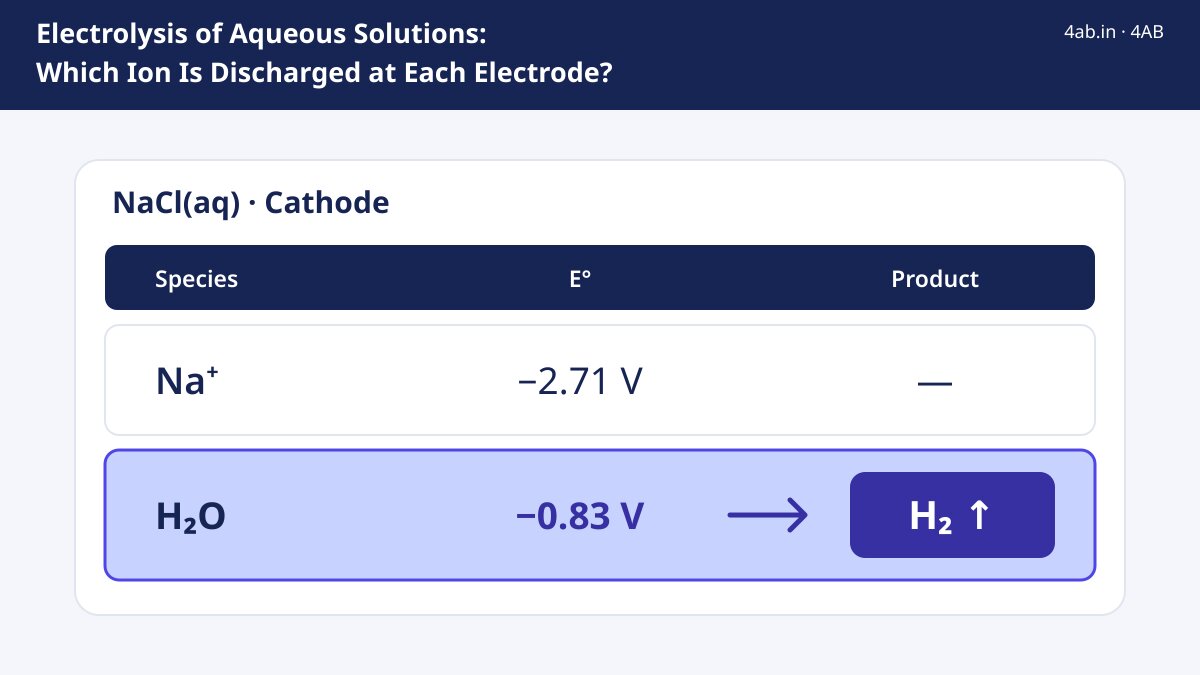
In Class 12 electrochemistry you are often asked, "What is formed at the cathode and at the anode when this solution is electrolysed?" The answer is not always the metal or the non-metal you expect. In an aqueous solution water is also present, so there are two or more possible reactions at each electrode, and only one of them happens. This page gives a simple method to decide which one, and then shows how to connect the answer to Faraday's laws.

The rule: easier reduction at the cathode, easier oxidation at the anode
Anode (oxidation): the species with the lower (less positive) E° is oxidised first.
Here E° is the standard reduction potential of the half-reaction. Some values that NCERT-style questions use are given below.
| Half-reaction (reduction) | E° (V) |
|---|---|
| Na+ + e− → Na | −2.71 |
| 2H2O + 2e− → H2 + 2OH− | −0.83 |
| Cu2+ + 2e− → Cu | +0.34 |
| Ag+ + e− → Ag | +0.80 |
| O2 + 4H+ + 4e− → 2H2O | +1.23 |
| Cl2 + 2e− → 2Cl− | +1.36 |
For the anode, remember that the half-reaction runs backwards (oxidation). The species with the smaller E° for its reduction is the easier one to oxidise. Water oxidation (E° = +1.23 V) therefore beats chloride oxidation (+1.36 V) on paper.
Three things that change the simple answer
- Metals more reactive than hydrogen. Na+, K+, Ca2+ and Al3+ have E° far below water's reduction potential. In water, H2 is released at the cathode, not the metal.
- Overpotential. Some electrode reactions, especially the release of O2, are slow and need an extra voltage. That is why, in concentrated NaCl solution, Cl2 (+1.36 V) is released at the anode even though O2 (+1.23 V) looks easier. Your textbook states this result; learn it as a fact.
- Type of electrode. With inert electrodes (Pt, graphite) only the ions and water react. With an active electrode such as copper, the electrode metal itself can oxidise at the anode, because that is easier than oxidising water or the anion.
Standard cases to remember
| Solution and electrodes | Cathode product | Anode product |
|---|---|---|
| Concentrated NaCl(aq), inert | H2 (and OH− in solution) | Cl2 |
| Dilute H2SO4, Pt | H2 | O2 |
| CuSO4(aq), Pt | Cu | O2 (solution turns acidic) |
| CuSO4(aq), Cu electrodes | Cu deposits | Cu dissolves as Cu2+ |
| AgNO3(aq), Pt | Ag | O2 (solution turns acidic) |
Example 1: why does aqueous NaCl give H2, not sodium?
At the cathode the candidates are Na+ (E° = −2.71 V) and water (E° = −0.83 V). The higher E° is reduced first, and −0.83 is higher than −2.71. So water is reduced:
2H2O + 2e− → H2 + 2OH−.
Na+ stays in solution along with the new OH−, so the solution slowly becomes NaOH. This is the idea behind the chlor-alkali process.
Example 2: copper and oxygen from CuSO4 with platinum electrodes. A current of 2 A is passed for 30 minutes. Find the mass of copper deposited and the volume of O2 at STP (use 22.4 L mol−1).
Charge Q = I × t = 2 × (30 × 60) = 3600 C.
Moles of electrons = Q / F = 3600 / 96485 = 0.03731 mol.
Cathode: Cu2+ + 2e− → Cu, so moles of Cu = 0.03731 / 2 = 0.018656 mol.
Mass of Cu = 0.018656 × 63.55 = 1.185 g.
Anode: 2H2O → O2 + 4H+ + 4e−, so moles of O2 = 0.03731 / 4 = 0.009328 mol.
Volume = 0.009328 × 22.4 = 0.2089 L = 208.9 mL at STP.
(If your book uses 22.7 L mol−1 for STP at 1 bar, the answer is 211.7 mL. Use the value your book uses.)
Example 3: pH after electrolysing NaCl solution. 500 mL of NaCl(aq) is electrolysed with inert electrodes using 2 A for 965 s. Assume the volume stays 500 mL and all the OH− formed stays in the solution. Find the pH.
Q = 2 × 965 = 1930 C, so moles of electrons = 1930 / 96485 = 0.02000 mol.
Cathode reaction: one OH− is formed per electron, so moles of OH− = 0.02000 mol.
[OH−] = 0.02000 / 0.500 = 0.0400 M.
pOH = −log(0.0400) = 1.398, so pH = 14 − 1.398 = 12.60.
Check by the anode: Cl2 formed = 0.02000 / 2 = 0.01000 mol, which is 0.224 L (224 mL) at STP with 22.4 L mol−1.
Example 4: the same CuSO4 but with copper electrodes. What changes?
At the anode, Cu(s) → Cu2+ + 2e− is easier than oxidising water, so no O2 is released and the anode loses mass. At the cathode, Cu2+ is deposited. The mass lost by the anode equals the mass gained by the cathode, and the concentration of CuSO4 stays unchanged. This is the principle of copper refining and electroplating.
Common mistakes
- Writing "Na is deposited" for aqueous NaCl. In water, H2 comes out instead.
- Forgetting that the electrode matters. Inert and active (Cu, Ag) anodes give different anode products.
- Using E° of the anode half-reaction as if it were an oxidation potential without reversing the logic. Pick the lower reduction potential for the anode.
- Using 2 electrons for O2. Releasing one O2 needs 4 electrons.
- Mixing STP values (22.4 and 22.7 L mol−1) without checking what your textbook uses.
Exam-relevance table
| Question type | What to do |
|---|---|
| "Name the products at each electrode" | Compare E° values; check for overpotential and electrode type |
| "Mass or volume formed in a given time" | Q = It, then moles of e− = Q/F, then use the half-reaction ratio |
| "What happens to pH or concentration?" | Count H+ or OH− formed or used per mole of electrons |
| "Why is X not deposited?" | Compare its E° with water's |
Board and entrance exam patterns change from year to year, so check the latest syllabus of your board for exactly which cases are asked.
Keep the constants F = 96485 C/mol and the molar masses handy while you solve electrolysis numericals.
Open the Chemistry Calculator Suite →Turn this concept into marks: solve previous-year CSIR-NET questions and take a timed quiz.
More Solutions articles