Electron Gain Enthalpy: Trends Across a Period and Down a Group, with Exceptions
Class 11 periodic-table questions often ask: “Why is the electron gain enthalpy of chlorine more negative than that of fluorine?” or “Which element has the most negative value?” These are favourite one-liners in board papers and entrance tests. This article gives a clean rule set, the exceptions, and a few numerical conversions that appear in problems.

What it means
Electron gain enthalpy (ΔegH) is the enthalpy change when a neutral gaseous atom accepts one electron to form a gaseous anion:
- If energy is released, ΔegH is negative (the usual case for the first electron of most non-metals). The atom has a high tendency to accept an electron.
- If energy must be supplied, ΔegH is positive. This happens for noble gases and for adding a second electron (O− + e− → O2−), where the incoming electron is repelled by a negative ion.
- Electron affinity is closely related, with the opposite sign convention in many books (energy released is quoted as positive). Read your textbook’s definition before copying a value.
The trends
| Direction | General trend | Reason |
|---|---|---|
| Across a period (left to right) | Becomes more negative | Increasing nuclear charge, decreasing size, so the added electron is held more strongly |
| Down a group | Becomes less negative | Increasing atomic size; the added electron is farther from the nucleus |
| Group 17 | Most negative values in the table | One electron short of a stable noble gas configuration |
| Noble gases | Positive | Full outer shell; extra electron must go into a new shell |
| Group 2 and group 15 (N) | Less negative than expected (or positive) | Full s-subshell (Be, Mg) or half-filled p-subshell (N) is stable |
The big exception: fluorine versus chlorine
By the “down the group” rule, fluorine should be higher than chlorine. In fact the commonly quoted order is Cl > F > Br > I (most negative first). Fluorine’s 2p subshell is very small, so the added electron enters a crowded space and feels strong repulsion from the seven electrons already there. Chlorine’s larger 3p subshell has more room, so its extra electron is accepted more comfortably. A similar effect makes sulphur more negative than oxygen, and phosphorus more negative than nitrogen, in the usual textbook tables.
Worked examples
The values below are typical textbook figures used only for practice. If your question or textbook gives different numbers, use those.
Example 1: energy per atom in eV. Given ΔegH(Cl) = −349 kJ mol−1, find the energy released per atom in eV. (1 eV = 1.602 × 10⁻¹⁹ J; NA = 6.022 × 10²³ mol−1.)
Energy per atom = 349 000 J mol−1 ÷ 6.022 × 1023 = 5.795 × 10⁻¹⁹ J.
In eV: 5.795 × 10⁻¹⁹ ÷ 1.602 × 10−19 = 3.62 eV released per chlorine atom.
Example 2: energy released by a given mass. How much energy is released when 1.00 g of gaseous chlorine atoms each gain one electron? Use ΔegH = −349 kJ mol−1.
Moles of Cl = 1.00 ÷ 35.45 = 0.02821 mol.
Energy = 0.02821 × 349 = 9.84 kJ released.
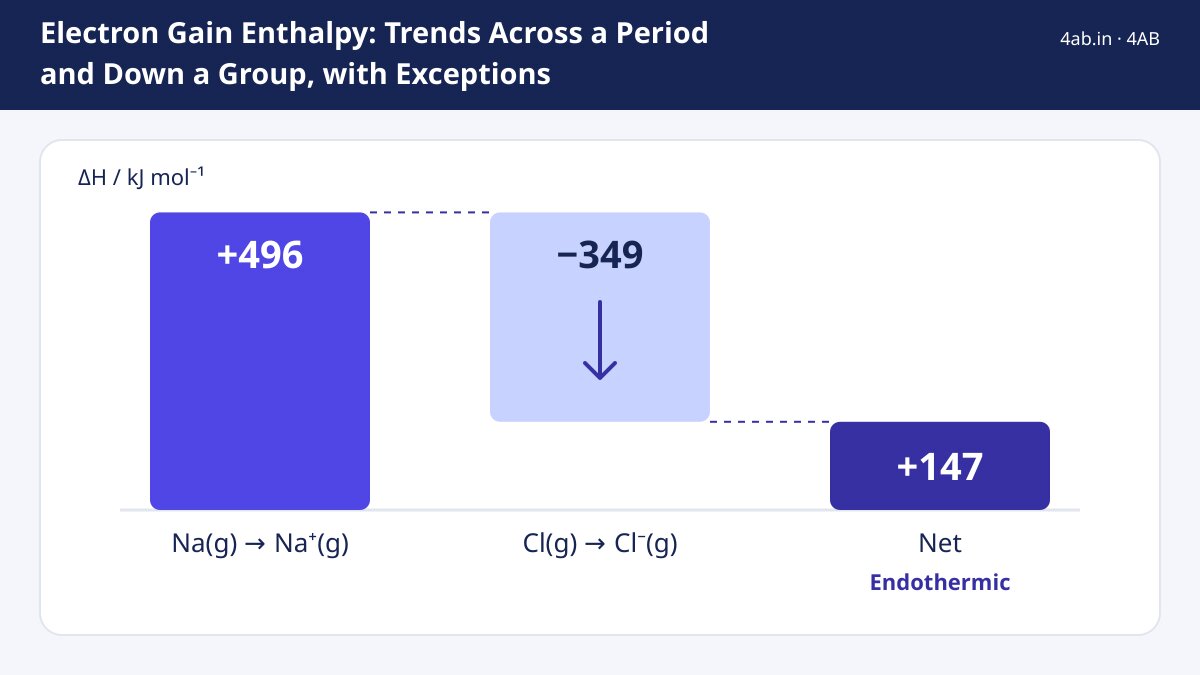
Example 3: why NaCl formation is not just “atoms to ions”. Given ionisation enthalpy of Na(g) = +496 kJ mol−1 and ΔegH of Cl(g) = −349 kJ mol−1, find the net enthalpy change for Na(g) + Cl(g) → Na+(g) + Cl−(g).
Net = +496 + (−349) = +147 kJ mol−1.
The step is endothermic, yet NaCl forms easily. The reason is the large energy released when the gaseous ions pack into a crystal, called lattice enthalpy. The electron gain enthalpy is therefore one term in a larger energy balance, not the whole story.
Example 4: choosing the right answer in an MCQ. Arrange F, Cl, Br in order of increasing negative value of ΔegH, using the order Cl > F > Br (largest negative first).
Increasing negative value means starting with the smallest: Br < F < Cl. Read the question carefully, because “increasing electron gain enthalpy” and “increasing negative value” are not always asked in the same way.
Common mistakes
- Saying fluorine has the most negative value because it is “the most electronegative”. The usual textbook order puts chlorine first.
- Mixing up “high electron gain enthalpy” with “large positive number”. A large negative number means a stronger tendency to gain an electron.
- Applying the group trend to every element without checking exceptions such as N, Be, Mg and the noble gases.
- Assuming the second electron gain enthalpy is also negative. For O− → O2− it is positive.
- Forgetting to convert kJ mol−1 to J per atom (divide by NA) when asked for energy per atom.
Exam-relevance table
| Question type | Key point |
|---|---|
| Why is Cl more negative than F? | Small 2p subshell, strong electron–electron repulsion in F |
| Why do noble gases have positive values? | Stable full shell, extra electron enters a higher shell |
| Why is N less negative than expected? | Half-filled p3 configuration is stable |
| Unit conversion | kJ mol−1 ÷ NA = J per atom; ÷ 1.602 × 10−19 = eV |
Check your own textbook’s table of values and sign convention before you revise numbers.
Open the suite to keep N_A and the electron charge at full precision when converting kJ per mole to eV per atom.
Open the Chemistry Calculator Suite →