Entropy Change of a Reaction: Calculating ΔS° from Standard Entropies
Many Class 11 and Class 12 thermodynamics questions ask: “Is the entropy of the system increasing or decreasing?” and then, “Calculate ΔS° for the reaction.” The second type is pure arithmetic once you know the formula and keep the units straight. This page shows how to find the entropy change of a chemical reaction from standard molar entropies, how to find it for a phase change, and how to use it with ΔH to decide whether a reaction can go.

The formulas
ΔS(phase change) = ΔH(transition) / T(transition)
ΔG = ΔH − TΔS
What each symbol means
- S° – standard molar entropy of a substance, in J K⁻¹ mol⁻¹. It is not zero for elements. Only a perfect crystal at 0 K has zero entropy.
- n – the stoichiometric coefficient from the balanced equation. Multiply each S° by its coefficient.
- ΔH(transition) – the enthalpy of fusion or vaporisation, usually given in kJ mol⁻¹. Convert it to J before dividing.
- T – the absolute temperature in kelvin. A phase change at constant pressure happens at one fixed temperature, such as 273.15 K for melting ice.
Unit warning: S° is in joules per kelvin per mole, but ΔH is usually in kilojoules. Convert before you use ΔG = ΔH − TΔS. This one slip is the most common reason for a wrong answer.
Quick sign prediction before you calculate
You can often guess the sign of ΔS° without any data. Entropy measures how spread out the particles and their energy are, so it goes up when:
- a solid melts or a liquid boils (solid → liquid → gas);
- the number of moles of gas increases in a reaction;
- a solid dissolves to give free ions in water (usually, though highly charged ions can order the water around them);
- the temperature rises.
It goes down when gas moles decrease, for example N₂ + 3H₂ → 2NH₃ (4 mol of gas become 2 mol of gas).
Worked examples
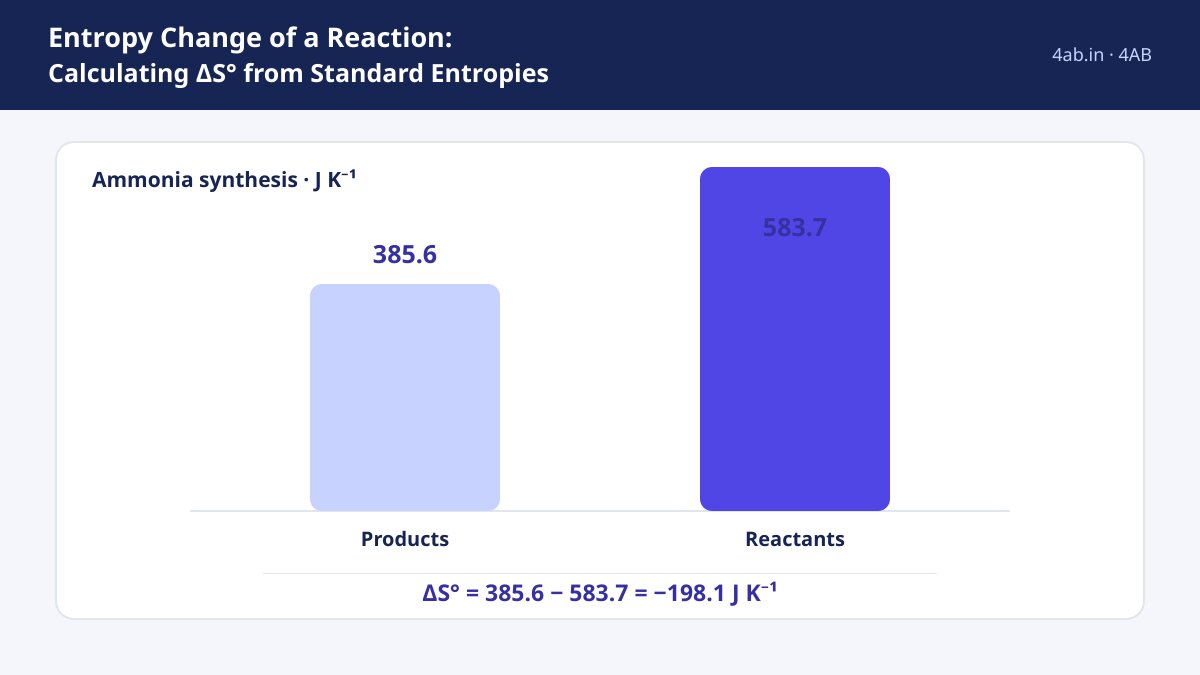
Example 1: ΔS° for ammonia synthesis. N₂(g) + 3H₂(g) → 2NH₃(g). Use these common textbook values: S°(N₂) = 191.6, S°(H₂) = 130.7, S°(NH₃) = 192.8 J K⁻¹ mol⁻¹.
Products: 2 × 192.8 = 385.6 J K⁻¹
Reactants: 191.6 + (3 × 130.7) = 191.6 + 392.1 = 583.7 J K⁻¹
ΔS° = 385.6 − 583.7 = −198.1 J K⁻¹ (per mole of reaction as written).
The sign is negative, as predicted: 4 mol of gas became 2 mol. Data tables in different books differ slightly in the last digit, so use the values given in your question.
Example 2: melting and boiling of water. Take ΔH(fusion) = 6.01 kJ mol⁻¹ at 273.15 K and ΔH(vaporisation) = 40.7 kJ mol⁻¹ at 373.15 K.
Melting: ΔS = 6010 J mol⁻¹ ÷ 273.15 K = 22.0 J K⁻¹ mol⁻¹.
Boiling: ΔS = 40700 J mol⁻¹ ÷ 373.15 K = 109.1 J K⁻¹ mol⁻¹.
Boiling gives a much bigger increase than melting. That matches the idea: going to a gas spreads the molecules out far more than going from solid to liquid. Both values are positive because heat is absorbed at constant temperature.
Example 3: will ammonia synthesis go at 298 K? For the reaction in Example 1, ΔH° = −92.2 kJ for the equation as written (2 mol NH₃, using −46.1 kJ mol⁻¹ for each NH₃). Find ΔG° at 298 K.
Convert ΔS° to kJ: −198.1 J K⁻¹ = −0.1981 kJ K⁻¹.
TΔS° = 298 × (−0.1981) = −59.0 kJ.
ΔG° = ΔH° − TΔS° = −92.2 − (−59.0) = −33.2 kJ.
ΔG° is negative, so the reaction is spontaneous at 298 K (rate is a separate question, see kinetics).
Example 4: at what temperature does it stop being spontaneous? Same reaction. ΔH is negative and ΔS is negative, so ΔG becomes zero at some temperature and positive above it.
Set ΔG = 0: T = ΔH / ΔS = (−92200 J) ÷ (−198.1 J K⁻¹) = 465 K (about 192 °C).
Check at 600 K: ΔG = −92200 − 600 × (−198.1) = −92200 + 118860 = +26660 J = +26.7 kJ. Positive, so the forward reaction is not favoured at 600 K under standard conditions, which agrees with the answer above. This is why the entropy term “wins” at high temperature for reactions that lose gas moles.
The four sign combinations
| ΔH | ΔS | ΔG = ΔH − TΔS | Result |
|---|---|---|---|
| negative | positive | always negative | spontaneous at all T |
| positive | negative | always positive | non-spontaneous at all T |
| negative | negative | negative at low T | spontaneous at low T only |
| positive | positive | negative at high T | spontaneous at high T only |
Common mistakes
- Mixing joules and kilojoules. S° is in J K⁻¹ mol⁻¹; ΔH is in kJ. Convert one of them before subtracting.
- Forgetting the coefficients. S° of H₂ is multiplied by 3 in Example 1, not used once.
- Writing S° = 0 for elements. That is the rule for the enthalpy of formation of elements, not for entropy.
- Subtracting the wrong way. It is always products minus reactants.
- Using °C in ΔH/T. The temperature must be in kelvin.
- Saying “ΔG negative means a fast reaction”. ΔG tells you about spontaneity, not speed.
Exam relevance
| Where | What to expect |
|---|---|
| Class 11 thermodynamics | Sign of ΔS, ΔS from tabulated S°, and ΔG = ΔH − TΔS numericals. Check the latest syllabus of your board for the exact scope. |
| Class 12 board and entrance exams | Spontaneity questions that combine ΔH and ΔS and ask for a threshold temperature. |
After you find ΔH and ΔS, use the Gibbs tool to check ΔG at any temperature.
Open the Gibbs Free Energy Calculator →Reaction mechanisms stick only with practice: attempt previous-year CSIR-NET questions and a timed quiz.
More Organic articles