Formal Charge and Lewis Structures: How to Choose the Best Structure
After you draw a Lewis structure, a natural question follows: is this the best structure, or only one possible way to draw it? Formal charge gives a simple bookkeeping method to compare structures. It is a Class 11 chemical bonding skill and the idea comes back in organic chemistry when you study charged atoms.

The formula
V = valence electrons of the free atom · N = non-bonding (lone-pair) electrons on the atom · B = electrons in bonds around the atom
What each term means
- V – the group number's valence electrons: H = 1, C = 4, N = 5, O = 6, S = 6, Cl = 7.
- N – count the dots (lone-pair electrons) drawn on that atom. Each lone pair counts as 2.
- B/2 – the number of bonds the atom makes. A single bond is 1, a double bond 2, a triple bond 3.
So the formula can also be written as: Formal charge = V − (lone-pair electrons) − (number of bonds). The sum of the formal charges of all atoms must equal the total charge on the molecule or ion. This is your check.
Worked examples
Example 1: ozone (O₃). The structure is O=O–O with the central oxygen attached to two others.
Terminal O with a double bond (2 lone pairs, 2 bonds): 6 − 4 − 2 = 0.
Central O (1 lone pair, 3 bonds: one double and one single): 6 − 2 − 3 = +1.
Terminal O with a single bond (3 lone pairs, 1 bond): 6 − 6 − 1 = −1.
Sum = 0 + 1 − 1 = 0, which matches the neutral molecule. ✓ Ozone has two resonance forms, and in the other form the double bond is on the other side.
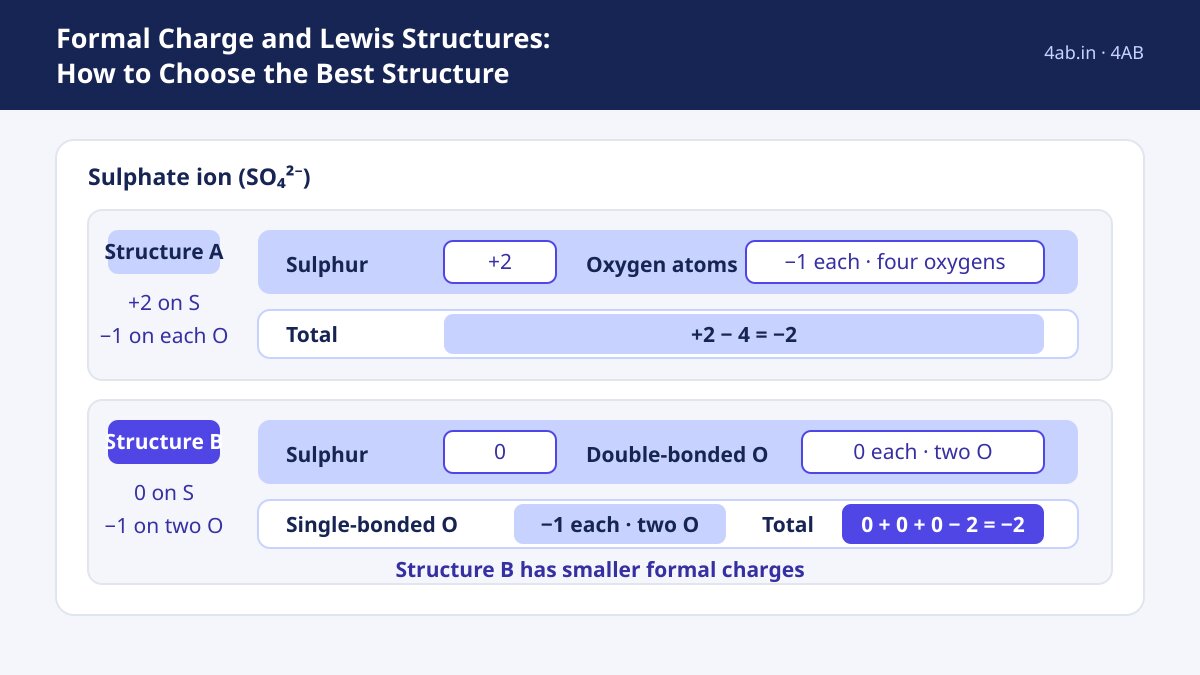
Example 2: sulphate ion (SO₄²⁻), two ways to draw it.
Structure A: four single bonds, all atoms obey the octet. S (0 lone pairs, 4 bonds): 6 − 0 − 4 = +2. Each O (3 lone pairs, 1 bond): 6 − 6 − 1 = −1, four oxygens = −4. Sum = +2 − 4 = −2. ✓
Structure B: two S=O double bonds and two S–O⁻ single bonds. S (0 lone pairs, 6 bonds): 6 − 0 − 6 = 0. Each double-bonded O (2 lone pairs, 2 bonds): 6 − 4 − 2 = 0. Each single-bonded O: −1, two of them = −2. Sum = 0 + 0 + 0 − 2 = −2. ✓
Structure B has smaller formal charges, so many school textbooks draw sulphate this way, with an expanded octet on sulphur. Structure A obeys the octet rule strictly but carries +2 on sulphur. Textbooks and teachers differ in which one they prefer; draw the one your course asks for, and know both.
Example 3: ammonium ion (NH₄⁺).
N (0 lone pairs, 4 bonds): 5 − 0 − 4 = +1. Each H (0 lone pairs, 1 bond): 1 − 0 − 1 = 0. Sum = +1, which matches the ion. ✓ The charge sits formally on nitrogen even though the physical charge is shared over the ion.
Example 4: carbon monoxide (CO), triple bond.
C (1 lone pair, 3 bonds): 4 − 2 − 3 = −1. O (1 lone pair, 3 bonds): 6 − 2 − 3 = +1. Sum = 0. ✓
The negative formal charge is on carbon, the less electronegative atom, which looks odd. This is a well-known case where formal charge alone does not predict where the real charge sits, because oxygen is more electronegative. It is also why carbon, not oxygen, is the donor atom in metal carbonyls.
Example 5: nitrate ion (NO₃⁻).
Draw N in the centre with one N=O double bond and two N–O⁻ single bonds. N (0 lone pairs, 4 bonds): 5 − 0 − 4 = +1. Double-bonded O (2 lone pairs, 2 bonds): 6 − 4 − 2 = 0. Each single-bonded O (3 lone pairs, 1 bond): 6 − 6 − 1 = −1, two of them = −2. Sum = +1 + 0 − 2 = −1, which matches NO₃⁻. ✓ The double bond can be placed on any of the three oxygens, so there are three equivalent resonance structures. The real ion is a hybrid in which all three N–O bonds are equal in length, and each oxygen carries about one third of the extra negative charge on average over the three structures.
Rules for choosing the best Lewis structure
| Rule | Meaning |
|---|---|
| Smaller formal charges are better | Prefer a structure where most atoms have formal charge 0. |
| Avoid like charges on adjacent atoms | Two neighbouring +1 atoms is a poor structure. |
| Negative charge on the more electronegative atom | A negative charge on O is better than on C in the same structure. |
| Sum must equal the overall charge | If it does not, a lone pair or bond was miscounted. |
Common mistakes
- Counting B (all bonding electrons) instead of B/2. A single bond has 2 electrons, but the atom "owns" only 1 of them.
- Forgetting the lone pairs on the central atom, or the negative charge on the ion when checking the sum.
- Confusing formal charge with oxidation number. Formal charge shares bonding electrons equally; oxidation number gives them all to the more electronegative atom. In CO, the formal charges are −1 and +1, while the oxidation numbers are +2 and −2.
- Treating formal charge as the real charge on the atom. It is a counting tool only.
Where this appears
| Where | Typical use |
|---|---|
| CBSE and ICSE Class 11 chemical bonding | Calculate formal charges for O₃, NH₄⁺, SO₄²⁻, CO; check your textbook for how many structures it asks. |
| Class 11 organic basics, Class 12 coordination compounds | Charged atoms in carbocations, carbanions and dative bonds. |
This topic is done with pencil and paper, so there is no single tool for it. For related calculation practice, the full calculator suite is one tap away.
Open the Chemistry Calculator Suite →Previous-year CSIR-NET questions and timed quizzes to check what you just read.
More Concepts articles