Gas Volume Stoichiometry: Combining Volumes of Gases
Many board questions ask: “How many litres of oxygen are needed to burn 4 litres of propane?” You do not need to convert to moles or grams at all. For gases measured at the same temperature and pressure, the balanced equation already tells you the volume ratio. This page shows when this shortcut works, and what to do when the question gives masses or different conditions.

The idea
Avogadro’s law: V ∝ n (at constant T and P)
When T or P is not the same: use PV = nRT, V = nRT/P
Gay-Lussac found by experiment that gases combine in small whole-number ratios of volume. Avogadro’s law explains why: equal volumes of gases at the same temperature and pressure contain the same number of molecules. So if the equation says 2 mol of H2 reacts with 1 mol of O2, then 2 litres of H2 reacts with 1 litre of O2, or 20 L with 10 L.
What the symbols mean
- V is the volume of the gas, in litres (L) or mL. Use the same unit for every gas.
- n is the amount of gas in moles.
- P and T are pressure and temperature. T must be in kelvin (K = °C + 273.15) whenever you use PV = nRT.
- R = 0.08206 L atm mol−1 K−1 (or 8.314 J mol−1 K−1).
The shortcut applies only to gases. Solids and liquids in the equation (for example water as a liquid, or CaCO3) do not take part in the volume ratio.
Worked example 1: hydrogen and oxygen
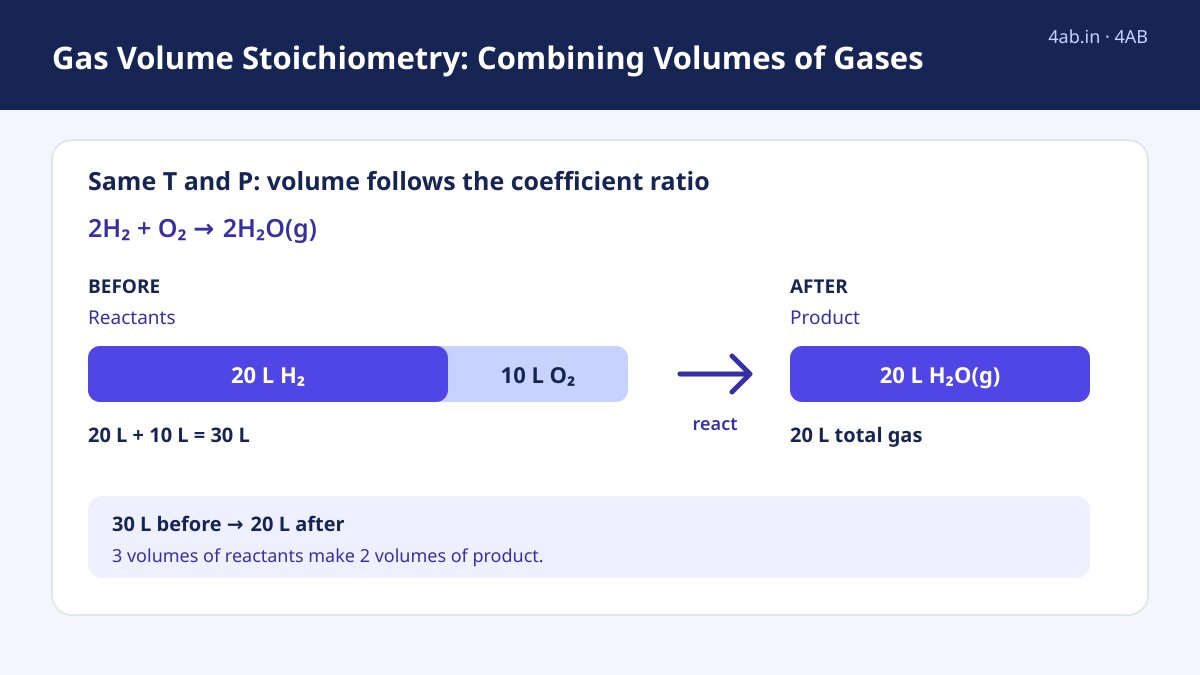
2H2(g) + O2(g) → 2H2O(g). How much oxygen reacts with 20 L of hydrogen, and how much steam forms? All volumes are measured at the same T and P.
Ratio H2 : O2 : H2O = 2 : 1 : 2.
O2 needed = 20 × (1/2) = 10 L. Steam formed = 20 × (2/2) = 20 L.
Check: before the reaction there were 20 + 10 = 30 L of gas, after it there are 20 L. The volume falls because 3 volumes of reactants make 2 volumes of product. (If the water is cooled to a liquid, almost no gas volume remains for it.)
Worked example 2: burning propane in air
C3H8(g) + 5O2(g) → 3CO2(g) + 4H2O(g). Find the volumes of O2 and CO2 for 4.0 L of propane, and the volume of air that supplies this oxygen if air is about 21% oxygen by volume.
O2 = 4.0 × 5 = 20 L. CO2 = 4.0 × 3 = 12 L. Steam (if kept above 100°C) = 4.0 × 4 = 16 L.
Air = 20 / 0.21 = 95.2 L, so about 95 L of air.
Check: oxygen in 95.2 L of air = 0.21 × 95.2 = 20.0 L. Correct.
Worked example 3: from mass of a solid to volume of gas
CaCO3(s) → CaO(s) + CO2(g). How much CO2 forms from 5.00 g of CaCO3?
Molar mass of CaCO3 = 40.078 + 12.011 + 3(15.999) = 100.086 g/mol.
Moles of CaCO3 = 5.00 / 100.086 = 0.04996 mol. The ratio is 1 : 1, so n(CO2) = 0.04996 mol.
Volume at 273.15 K and 1 atm (older textbook STP): molar volume 22.4 L/mol, so V = 0.04996 × 22.4 = 1.119 L.
Volume at 273.15 K and 1 bar (current IUPAC STP): molar volume 22.7 L/mol (more exactly 22.711), so V = 0.04996 × 22.711 = 1.135 L.
Volume at 300 K and 1 atm, by PV = nRT: V = nRT/P = 0.04996 × 0.08206 × 300 / 1 = 1.230 L.
Your textbook decides which STP value to use. Always read the conditions in the question. The same moles give 1.12 L, 1.13 L or 1.23 L depending on T and P.
Worked example 4: which gas is limiting?
N2 + 3H2 → 2NH3. Mix 30 L of N2 with 60 L of H2 (same T and P). Find the volume of NH3 formed and the gas left over.
N2 needs 3 times its volume of H2. For 30 L N2 we would need 90 L H2, but only 60 L is present, so H2 is limiting.
NH3 formed = 60 × (2/3) = 40 L. N2 used = 60 / 3 = 20 L, so N2 left = 30 − 20 = 10 L.
Final gas = 40 + 10 = 50 L (the starting 90 L has contracted).
Common mistakes
- Using the shortcut for liquids and solids. Only gases follow the volume ratio.
- Different conditions. If one gas is measured at 27°C and another at 127°C, you cannot compare the volumes directly. Convert with PV = nRT first.
- Treating steam as a liquid, or the reverse. Water is a gas only above its boiling point. The question usually states which.
- Using Celsius in PV = nRT. Always convert to kelvin.
- Forgetting the limiting reagent when both gas volumes are given, as in Example 4.
Exam relevance
| Question type | Method |
|---|---|
| Volume of one gas from volume of another, same T and P | Coefficient ratio, no moles needed |
| Volume of air needed | Find O2 volume, then divide by the oxygen fraction given in the question |
| Mass of a solid to volume of gas | Mass → moles → ratio → V = nRT/P or molar volume |
| Both gas volumes given | Find the limiting gas first |
| Contraction in volume | Compare total volumes before and after |
Check the value of molar volume and the oxygen percentage that your own textbook or question paper gives, and use that.
Use the Ideal Gas Law panel to check any of the volume calculations above when T and P are not the same.
Open the Ideal Gas Law Calculator →