Hückel Molecular Orbital Theory: Allyl and Butadiene Worked Out
Hückel molecular orbital (HMO) theory is the simplest quantum model of the π electrons in conjugated molecules. It ignores everything except the p orbitals on the carbon atoms and still predicts energy levels, bond orders, charge distribution and the extra stability of delocalisation. For IIT-JAM, GATE, CSIR-NET and CUET-PG, HMO problems are really linear algebra problems: build a small matrix, find its eigenvalues, fill electrons. This article does that step by step for allyl and butadiene.

The assumptions
Each carbon contributes one p orbital χi. The π orbitals are written as combinations ψ = Σ ciχi. The Hückel approximations are:
- The Coulomb integral of every carbon is the same: Hii = α.
- The resonance integral between bonded neighbours is Hij = β. For atoms that are not bonded, Hij = 0.
- Overlap between different orbitals is neglected: Sij = 0 for i ≠ j, and Sii = 1.
Both α and β are negative energies, so β < 0. A lower (more negative) energy means a more stable orbital. Defining x = (α − E) ÷ β turns the secular determinant into a matrix whose off-diagonal entries are 1 for bonded neighbours.
x = eigenvalue of the adjacency matrix A (Aij = 1 if i and j are bonded, otherwise 0)
Largest x gives the lowest energy (because β < 0)
E is the orbital energy, α the energy of an isolated carbon p electron, β the stabilising interaction between neighbours, and x the number multiplying β. The eigenvector for each x gives the coefficients ci.
Worked example 1: the allyl system (three carbons)
Matrix. Carbons 1–2 and 2–3 are bonded:
A = [[0, 1, 0], [1, 0, 1], [0, 1, 0]]
Secular equation. det(A − xI) = 0 expands to −x3 + 2x = 0, so x(x2 − 2) = 0.
Roots. x = +√2 = 1.414, x = 0, x = −√2 = −1.414.
Energies. E1 = α + 1.414β (bonding), E2 = α (non-bonding), E3 = α − 1.414β (antibonding).
Coefficients. ψ1 = 0.500 χ1 + 0.707 χ2 + 0.500 χ3; ψ2 = 0.707 χ1 + 0 χ2 − 0.707 χ3; ψ3 = 0.500 χ1 − 0.707 χ2 + 0.500 χ3. The squares of the coefficients in each orbital add to 1 (0.25 + 0.50 + 0.25).
Worked example 2: allyl cation, radical and anion
Total π energy. The allyl cation has 2 π electrons (both in ψ1), the radical has 3 (the third goes to ψ2), and the anion has 4.
Cation: Eπ = 2(α + 1.414β) = 2α + 2.828β.
Radical: add one electron at α: 3α + 2.828β. Anion: 4α + 2.828β.
Reference. One localised C=C π bond (ethene) has E = 2(α + β) = 2α + 2β.
Delocalisation energy. For each of the three species, the β part is 2.828β compared with 2β for a localised double bond, so the gain is (2.828 − 2)β = 0.828β. The extra electrons in the non-bonding ψ2 add nothing in β terms.
Charge densities. qi = Σ (electrons in orbital) × ci2. In the cation, q1 = 2 × 0.25 = 0.5, q2 = 2 × 0.5 = 1.0, q3 = 0.5. Each end carbon holds only 0.5 π electron, so the positive charge sits on the two ends equally (+0.5 each). For the radical, q1 = 0.5 + 1 × 0.5 = 1.0, so every carbon has a charge density of 1, and the unpaired electron lives in ψ2 on carbons 1 and 3.
Worked example 3: butadiene, using symmetry to reach 2×2 matrices
Matrix. Carbons 1–2, 2–3 and 3–4 are bonded, which is a 4×4 matrix. It can be split by mirror symmetry (carbon 1 ↔ 4, carbon 2 ↔ 3).
Symmetric combinations ψ = a(χ1 + χ4) + b(χ2 + χ3). The two equations are xa = b and xb = a + b. Eliminating a: x2 − x − 1 = 0, giving x = (1 ± √5) ÷ 2 = 1.618 and −0.618. In matrix form this is the 2×2 matrix [[0, 1], [1, 1]].
Antisymmetric combinations ψ = a(χ1 − χ4) + b(χ2 − χ3). Now xa = b and xb = a − b, so x2 + x − 1 = 0, giving x = 0.618 and −1.618. The matrix is [[0, 1], [1, −1]].
Orbital energies, lowest first.
| Orbital | x | Energy | Coefficients (c1, c2, c3, c4) |
|---|---|---|---|
| ψ1 | 1.618 | α + 1.618β | 0.372, 0.602, 0.602, 0.372 |
| ψ2 | 0.618 | α + 0.618β | 0.602, 0.372, −0.372, −0.602 |
| ψ3 | −0.618 | α − 0.618β | 0.602, −0.372, −0.372, 0.602 |
| ψ4 | −1.618 | α − 1.618β | 0.372, −0.602, 0.602, −0.372 |
The four values of x are the same as the eigenvalues of the full 4×4 matrix. The 2×2 blocks are a convenient way to get them by hand, and the suite's matrix tool handles 2×2 and 3×3 matrices, so both blocks can be checked there.
Worked example 4: butadiene energy, bond orders and the gap
Filling. Butadiene has 4 π electrons, so ψ1 and ψ2 are doubly occupied. Eπ = 2(α + 1.618β) + 2(α + 0.618β) = 4α + 4.472β.
Delocalisation energy. Two isolated ethene units give 4α + 4β. The gain is (4.472 − 4)β = 0.472β.
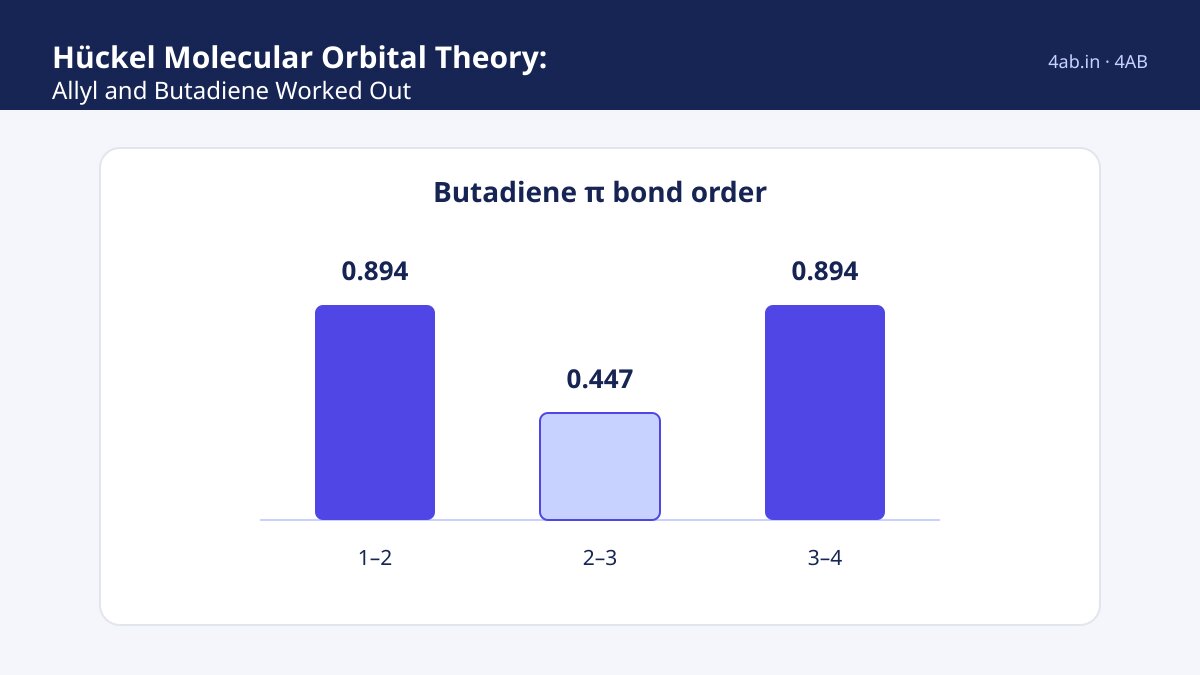
π bond order. pij = Σ n cicj over occupied orbitals. For bond 1–2: 2(0.372 × 0.602) + 2(0.602 × 0.372) = 0.447 + 0.447 = 0.894. For bond 2–3: 2(0.602 × 0.602) + 2(0.372 × −0.372) = 0.725 − 0.277 = 0.447.
The terminal bonds (order 0.894) keep more double-bond character than the middle bond (0.447), which matches the idea that the central C–C bond is shorter than a pure single bond but longer than the end bonds.
HOMO–LUMO gap. HOMO is ψ2 and LUMO is ψ3. The gap is (α − 0.618β) − (α + 0.618β) = −1.236β, which is 1.236|β|. In ethene the gap is 2|β|. A smaller gap means the lowest π → π* absorption of butadiene lies at longer wavelength than ethene's.
Comparison of small π systems
| System | π electrons | Eπ (β part) | Delocalisation energy |
|---|---|---|---|
| Ethene | 2 | 2.000β | 0 |
| Allyl (cation, radical or anion) | 2, 3 or 4 | 2.828β | 0.828β relative to ethene |
| Butadiene | 4 | 4.472β | 0.472β |
| Cyclobutadiene (square) | 4 | 4.000β | 0 |
| Benzene | 6 | 8.000β | 2.000β |
Cyclobutadiene has x values 2, 0, 0, −2; its four electrons fill the lowest orbital and one each in the two degenerate non-bonding orbitals, so there is no gain over two localised double bonds. Benzene has x values 2, 1, 1, −1, −1, −2 and a large gain, which is the Hückel explanation of aromatic stability.
Common mistakes
- Forgetting that β is negative. The largest x is the lowest energy. Writing E = α − xβ for the bonding orbital reverses the order.
- Counting the wrong number of electrons. Only π electrons are filled: one per carbon in a neutral chain, minus one for a cation, plus one for an anion.
- Including non-bonded pairs in the matrix. Only bonded neighbours get 1. In a chain, atoms 1 and 3 are not neighbours.
- Normalising wrongly. The squares of the coefficients in one orbital must add to 1.
- Taking the delocalisation energy as an absolute energy. It is the energy relative to localised double bonds, expressed in units of β.
- Comparing β across different books. Some books write the secular determinant with x = (α − E) ÷ β and others use E = α + xβ. These are the same thing, but sign slips are common.
Exam relevance
| Task | Method |
|---|---|
| Orbital energies | Eigenvalues x of the adjacency matrix; E = α + xβ |
| Total π energy | Sum of occupancy × energy |
| Delocalisation energy | Eπ minus (number of C=C units × 2β) |
| Bond order | Σ n cicj |
| Charge density | Σ n ci2 |
Syllabus depth varies by exam. Check the current official notification to see whether HMO theory is expected, and how many carbon atoms the problems may involve.
For allyl, or for the two 2×2 symmetry blocks of butadiene, the matrix tool computes the eigenvalues directly, so you can check the values of x. The tool handles 2×2 and 3×3 matrices.
Open the Matrix Eigenvalue Calculator →