Hydrogen Spectrum: Rydberg Equation and Spectral Series
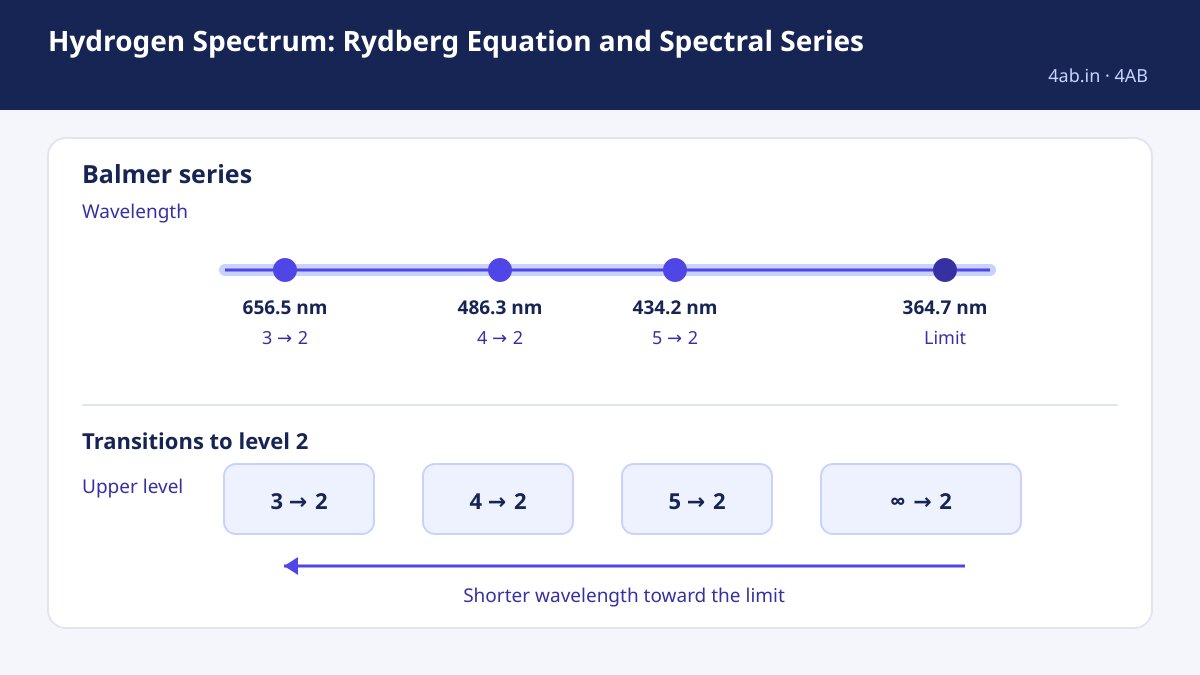
The line spectrum of hydrogen is the experiment that forced physicists to accept quantised energy levels. In IIT-JAM, GATE and CSIR-NET, questions ask for the wavelength of a given transition, the limit of a series, the number of lines possible, or the same quantities for a hydrogen-like ion such as He+ or Li2+. All of them use one formula, the Rydberg equation. This page shows how to use it quickly and without sign errors.

The Rydberg equation
RH = 1.09678 × 10⁷ m−1 (hydrogen), R∞ = 1.09737 × 10⁷ m−1
En = −13.6 Z2 ÷ n2 eV ΔE = 13.6 Z2 (1/n12 − 1/n22) eV
Number of lines from level n down to the ground state: n(n − 1) ÷ 2
n1 is the lower level (where the electron lands in emission) and n2 is the upper level (where it starts). Z is the atomic number, 1 for hydrogen, 2 for He+, 3 for Li2+. The constant RH uses the reduced mass of the electron and the proton. R∞ assumes an infinitely heavy nucleus. The difference is small (about 0.05 %), and the question normally states which value to use. The ionisation energy of hydrogen, 13.6 eV, is the energy to remove the electron from n = 1. You can also use hc = 1240 eV nm to switch between energy and wavelength.
The spectral series
| Series | Lower level n1 | Upper levels n2 | Region |
|---|---|---|---|
| Lyman | 1 | 2, 3, 4 … | Ultraviolet |
| Balmer | 2 | 3, 4, 5 … | Mostly visible |
| Paschen | 3 | 4, 5, 6 … | Infrared |
| Brackett | 4 | 5, 6, 7 … | Infrared |
| Pfund | 5 | 6, 7, 8 … | Infrared |
Worked example 1: the H-alpha line
Question. Find the wavelength and photon energy of the n = 3 → n = 2 line of hydrogen.
Bracket. 1/4 − 1/9 = 9/36 − 4/36 = 5/36 = 0.13889.
Wavenumber. 1/λ = 1.09678 × 107 × 0.13889 = 1.5233 × 10⁶ m−1.
Wavelength. λ = 1 ÷ 1.5233 × 106 = 6.565 × 10⁻⁷ m = 656.5 nm (red). Measured in air this line is quoted near 656.3 nm; the difference comes from the refractive index of air.
Energy. ΔE = 13.6 × 5/36 = 1.889 eV. Cross-check with hc: 1240 ÷ 1.889 = 656.4 nm, in agreement.
Worked example 2: series limit of Balmer
Question. Find the shortest wavelength (series limit) of the Balmer series and the longest wavelength of the Lyman series.
Balmer limit. n2 → ∞, so 1/λ = RH × (1/4) = 2.74195 × 10⁶ m−1. λ = 364.7 nm.
Lyman longest (2 → 1). 1/λ = RH × (1 − 1/4) = RH × 0.75 = 8.2259 × 10⁶ m−1. λ = 121.57 nm.
The longest wavelength of a series comes from the smallest step (n2 = n1 + 1). The shortest comes from n2 = ∞.
Worked example 3: more Balmer lines
Question. Calculate the wavelengths of the n = 4 → 2 and n = 5 → 2 transitions.
4 → 2. 1/4 − 1/16 = 3/16 = 0.1875. 1/λ = 1.09678 × 107 × 0.1875 = 2.0565 × 10⁶ m−1. λ = 486.3 nm.
5 → 2. 1/4 − 1/25 = 21/100 = 0.21. 1/λ = 2.3032 × 10⁶ m−1. λ = 434.2 nm.
As n2 increases the lines move to shorter wavelength and crowd together towards the series limit at 364.7 nm.
Worked example 4: a hydrogen-like ion
Question. Find the wavelength of the n = 4 → 3 transition in He+.
Bracket. 1/9 − 1/16 = 7/144 = 0.048611.
Equation. Z2 = 4, so 1/λ = 1.09678 × 107 × 4 × 0.048611 = 2.1325 × 10⁶ m−1.
Wavelength. λ = 468.9 nm.
Useful link. The same wavelength as a hydrogen line appears in He+ when 4(1/n12 − 1/n22) matches the hydrogen bracket. For example, He+ 4 → 2 equals 4(1/4 − 1/16) = 3/4, the same as hydrogen 2 → 1, so the wavelength is 121.57 nm.
Worked example 5: counting lines
Question. Hydrogen atoms are excited to n = 5. How many different spectral lines can appear when they return to the ground state?
Count. n(n − 1) ÷ 2 = 5 × 4 ÷ 2 = 10 lines.
This counts every possible jump. If a question says a single atom falls, the maximum number of lines is n − 1 = 4, because one atom follows one path.
Common mistakes
- Swapping n1 and n2. The larger number goes with the smaller fraction. Always check that the bracket is positive.
- Forgetting Z2 for ions. For He+ the bracket is multiplied by 4, for Li2+ by 9.
- Reporting 1/λ as the wavelength. Take the reciprocal last and convert metres into nanometres (multiply by 109).
- Mixing R in different units. RH = 1.09678 × 10⁷ m−1 is the same as 109678 cm−1. Keep one unit.
- Believing all Balmer lines are visible. Only the first four fall in the visible region. The series limit at 364.7 nm is in the ultraviolet.
Exam summary
| Task | Method |
|---|---|
| Wavelength of one transition | Rydberg bracket × RH Z2, then take the reciprocal |
| Series limit | Set n2 = ∞, giving 1/λ = RH Z2 ÷ n12 |
| Longest wavelength in a series | n2 = n1 + 1 |
| Photon energy | 13.6 Z2 (1/n12 − 1/n22) eV |
| Possible lines from level n | n(n − 1) ÷ 2 |
Check the current official syllabus of your exam, since some papers expect only the Bohr model and others also ask about fine structure.
The Bohr Model tool in the physics section works with the same hydrogen-like energy levels. Use it to check the energy and radius for a level before you compute the wavelength of a transition.
Open the Bohr Model Calculator →