Joule-Thomson Effect and Inversion Temperature
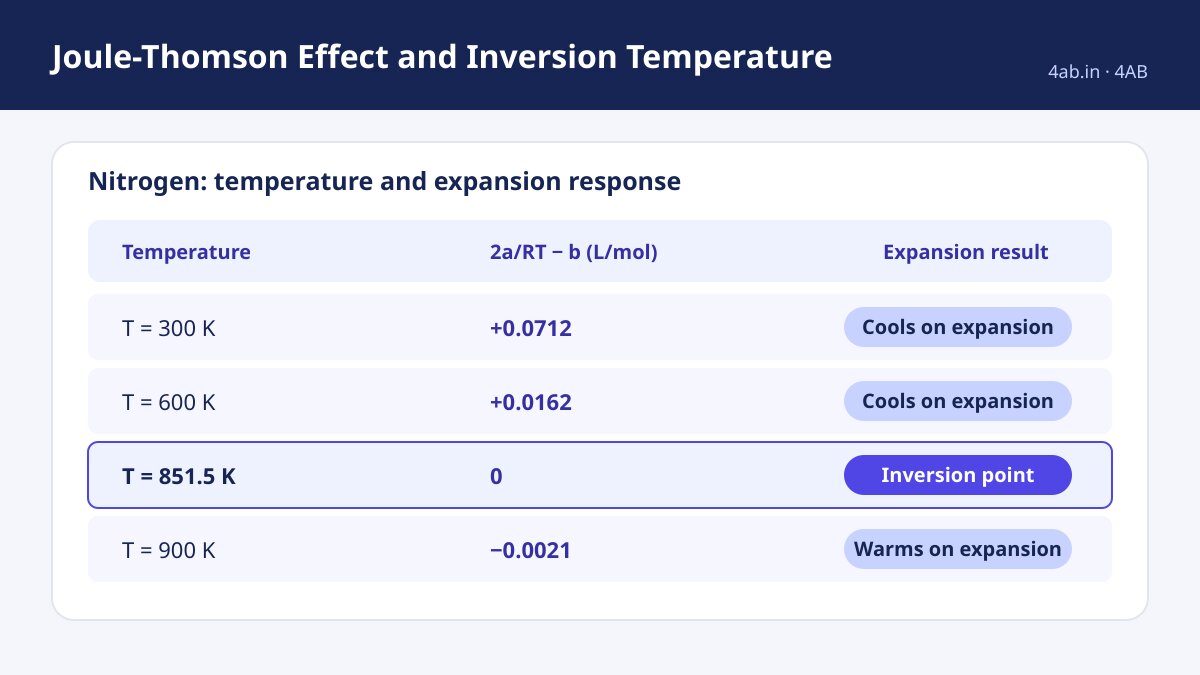
When a compressed gas leaks through a valve, it sometimes turns cold and sometimes turns warm, and the same gas can do either depending on its starting temperature. This is the Joule-Thomson effect. It is the working principle behind gas liquefaction by the Linde process, and it appears in IIT-JAM, GATE and CSIR-NET physical chemistry as a derivation, a van der Waals calculation and a conceptual question on the inversion temperature. This page builds the idea from the thermodynamic definition and works through the numbers.

What the experiment does
A gas is forced through a porous plug or a narrow valve from a high-pressure side to a low-pressure side, and the whole apparatus is thermally insulated. No heat enters or leaves (q = 0). The work done on the gas on the high-pressure side and by the gas on the low-pressure side combine so that the enthalpy stays constant. So the Joule-Thomson expansion is an isenthalpic process: H1 = H2. This is different from the free (Joule) expansion into vacuum, where the internal energy U stays constant.
The coefficient
For a van der Waals gas at low pressure: μJT ≈ (1 ÷ Cp) × ( 2a ÷ RT − b )
Inversion temperature (low-pressure limit): Ti = 2a ÷ (Rb) = (27 ÷ 4) Tc
μJT is the change of temperature per unit change of pressure at constant enthalpy, in K/Pa or K/bar. Cp is the molar heat capacity at constant pressure. V is the molar volume, T the temperature, and a and b are the van der Waals constants. A gas cools on expansion when μJT is positive, because the pressure falls (dP is negative) and the temperature falls with it. It warms when μJT is negative. At the inversion temperature, μJT = 0 and the sign changes.
Why the sign changes
Two effects compete. The attractive forces between molecules (the a term) mean the gas must do internal work to pull molecules apart during expansion, and that work is paid for from kinetic energy, so the gas cools. The finite size of molecules (the b term) works the other way: at high temperature, molecular size dominates, and the gas warms on expansion. At low temperature, 2a/RT is large, so attraction wins and the gas cools. At high temperature, 2a/RT becomes smaller than b, and the gas warms.
For an ideal gas there are no attractions and no size, so μJT = 0 always. You can check this: for one mole, V = RT/P, so (∂V/∂T)P = R/P and T(∂V/∂T)P = RT/P = V. Then T(∂V/∂T)P − V = 0.
Worked example 1: inversion temperature of nitrogen
Question. For nitrogen, a = 1.370 bar L2 mol−2 and b = 0.0387 L mol−1. Estimate the upper inversion temperature from the van der Waals model. Use R = 0.083145 L bar K−1 mol−1.
Formula. Ti = 2a ÷ (Rb).
Calculation. Denominator: 0.083145 × 0.0387 = 3.2177 × 10⁻³. Numerator: 2 × 1.370 = 2.740. Ti = 2.740 ÷ 3.2177 × 10−3 = 851.5 K.
Cross-check through Tc. Tc = 8a ÷ (27Rb) = 126.2 K. Then (27/4) × 126.2 = 851.5 K. Both routes agree.
Meaning. The van der Waals equation gives only a rough estimate of this temperature, and measured inversion temperatures of real gases differ from it. The model is useful for the trend, not for the exact value. Nitrogen at room temperature is well below Ti, so it cools on expansion.
Worked example 2: size of the cooling for nitrogen
Question. Estimate μJT for nitrogen at 300 K, taking Cp = 29.1 J K−1 mol−1. Then estimate the temperature drop if the pressure falls by 50 bar.
Step 1: bracket term. 2a ÷ RT = 2.740 ÷ (0.083145 × 300) = 2.740 ÷ 24.9435 = 0.10985 L/mol. Subtract b: 0.10985 − 0.0387 = 0.07115 L/mol.
Step 2: convert litres to m3. 0.07115 L = 7.115 × 10⁻⁵ m3. So the bracket is 7.115 × 10⁻⁵ m3/mol.
Step 3: divide by Cp. μJT = 7.115 × 10⁻⁵ ÷ 29.1 = 2.445 × 10⁻⁶ K/Pa (units: m3 divided by J equals K per Pa). In K/bar: 2.445 × 10−6 × 105 = 0.244 K/bar.
Step 4: temperature change. For a pressure drop of 50 bar, ΔT ≈ 0.244 × (−50) = −12.2 K. The gas cools by about 12 K.
Caution. μJT changes with T and P, so this is only an estimate for a modest pressure drop. It is a low-pressure approximation, and over a large drop the true change differs.
Worked example 3: hydrogen warms at room temperature
Question. For hydrogen, a = 0.2476 bar L2 mol−2 and b = 0.02661 L mol−1. Predict the sign of μJT at 300 K and estimate Ti.
Bracket term. 2a ÷ RT = 0.4952 ÷ 24.9435 = 0.01985 L/mol. Then 0.01985 − 0.02661 = −0.00676 L/mol, which is negative.
Sign. μJT is negative, so hydrogen at 300 K warms on expansion.
Inversion temperature. Ti = 0.4952 ÷ (0.083145 × 0.02661) = 0.4952 ÷ 2.2125 × 10−3 = 223.8 K. Since 300 K is above this value, the gas is on the warming side. This is why hydrogen is usually pre-cooled before the Linde process is applied to it.
Size. Take Cp as 28.8 J K−1 mol−1. The bracket is −0.00676 L/mol = −6.76 × 10⁻⁶ m3/mol. Then μJT = −6.76 × 10⁻⁶ ÷ 28.8 = −2.35 × 10⁻⁷ K/Pa = −0.023 K/bar. A 50 bar drop warms the gas by roughly 1.2 K.
Sign of the coefficient at different temperatures
| Condition (nitrogen, van der Waals) | 2a/RT − b (L/mol) | Result |
|---|---|---|
| T = 300 K | +0.0712 | Cools on expansion |
| T = 600 K | +0.0162 | Cools, but only a little |
| T = 851.5 K | 0 | Inversion point |
| T = 900 K | −0.0021 | Warms on expansion |
Common mistakes
- Calling the process adiabatic reversible. The Joule-Thomson expansion is irreversible and isenthalpic. Entropy rises.
- Mixing it up with free expansion. In free expansion into vacuum, U is constant. In Joule-Thomson, H is constant.
- Forgetting the unit conversion. If a is in bar L2/mol2, the bracket is in L/mol. Convert litres to m3 (divide by 1000) before dividing by Cp in joules.
- Saying a negative μJT means cooling. Cooling on pressure drop needs a positive μJT.
- Using Ti = 2a/Rb for an ideal gas. It needs a and b. An ideal gas has no inversion temperature because μJT is always zero.
Exam relevance
| Question type | What to remember |
|---|---|
| Which quantity is constant? | Enthalpy H |
| Sign of μJT for an ideal gas | Zero |
| Inversion temperature from a and b | Ti = 2a/(Rb) |
| Link with critical temperature | Ti = (27/4) Tc in the van der Waals model |
| Why gases are pre-cooled before liquefaction | Start below Ti so that μJT is positive |
Exam papers use different forms of the equation, with a in different units, so read the data and the form asked for carefully. For the weightage and exact syllabus, check the current official notification of your exam.
This topic uses van der Waals constants, which have no dedicated tool in the suite, so the calculator is useful for the arithmetic only.
Open the Chemistry Calculator Suite →Previous-year CSIR-NET questions and timed quizzes to check what you just read.
More Concepts articles