Kinetic Isotope Effect: C-H versus C-D Bond Breaking
If a C–H bond breaks in the slowest step of a reaction, replacing that hydrogen with deuterium makes the reaction slower. The ratio of the two rate constants, kH ÷ kD, is the kinetic isotope effect (KIE). It is one of the cleanest experimental tools for deciding whether a bond to hydrogen is broken in the rate-determining step, and it is a standard topic in IIT-JAM, GATE, CSIR-NET and CUET-PG physical and organic chemistry. This page explains where the effect comes from, derives its size from zero-point energy, and works through numbers.

The idea: zero-point energy
A bond never sits at the bottom of its potential energy well. Even at absolute zero it vibrates with a minimum energy, the zero-point energy (ZPE). For a harmonic oscillator, ZPE = ½ hν, where ν is the vibration frequency. The frequency depends on the reduced mass μ of the two atoms: ν = (1 ÷ 2π) √(kf ÷ μ), where kf is the force constant of the bond.
Deuterium has about twice the mass of hydrogen, so a C–D bond has a larger reduced mass, a lower frequency and a lower ZPE than a C–H bond. The two bonds have almost the same electronic potential curve and the same force constant, so the C–D bond sits deeper in the well. It therefore needs more energy to reach the transition state, in which the bond is (mostly) broken, and the reaction is slower.
ΔZPE = ½ NA h c [ ν̃(C–H) − ν̃(C–D) ]
Maximum primary KIE: kH ÷ kD ≈ exp( ΔZPE ÷ RT )
Here ν̃ is the wavenumber in cm−1, c is the speed of light in cm/s, NA is Avogadro's number, R is the gas constant and T the temperature in kelvin. The last line assumes that the stretching vibration of the bond is lost completely in the transition state (so that it has no zero-point energy there) and that the pre-exponential factors are the same for H and D. This gives an upper estimate for the primary effect at a given temperature. Real values are often smaller, because the bond is only partly broken in the transition state or the transition state is bent.
Primary and secondary effects
| Type | Where is the isotope? | What it tells you |
|---|---|---|
| Primary KIE | On the bond that breaks in the rate-determining step | Clearly greater than 1 (kH/kD well above 1). The C–H bond is being broken in that step. |
| Secondary KIE | On an atom next to the reacting centre; its bond is not broken | Close to 1. Small normal or inverse values reflect a change of hybridisation or vibration at that atom. |
| No KIE | Bond to H breaks, but after the slow step | kH/kD ≈ 1. The C–H bond is not broken in the rate-determining step. |
Worked example 1: the maximum KIE at 298 K
Question. Estimate the maximum primary KIE for a C–H bond at 298.15 K. Take the C–H stretching wavenumber as 2900 cm−1 (a typical value, used here for illustration), and the atomic masses C = 12.000, H = 1.00783 and D = 2.01410.
Step 1: reduced masses. μCH = (12.000 × 1.00783) ÷ (12.000 + 1.00783) = 12.0940 ÷ 13.00783 = 0.9297. μCD = (12.000 × 2.01410) ÷ (12.000 + 2.01410) = 24.1692 ÷ 14.0141 = 1.7246.
Step 2: C–D wavenumber. μCD ÷ μCH = 1.7246 ÷ 0.9297 = 1.855. Its square root is 1.362. So ν̃(C–D) = 2900 ÷ 1.362 = 2129 cm−1.
Step 3: ΔZPE. The difference in wavenumber is 2900 − 2129 = 771 cm−1. One cm−1 corresponds to 11.963 J/mol. So ΔZPE = ½ × 771 × 11.963 = 4612 J/mol, or about 4.61 kJ/mol. (Direct use of h, c and NA gives 4.610 kJ/mol; the two routes agree.)
Step 4: the ratio. kH/kD = exp(4610 ÷ (8.3145 × 298.15)) = exp(1.860) = 6.4.
Meaning. The maximum primary effect for this model is about 6 to 7 at room temperature. A measured value near this size says that the C–H bond is largely broken in the rate-determining step.
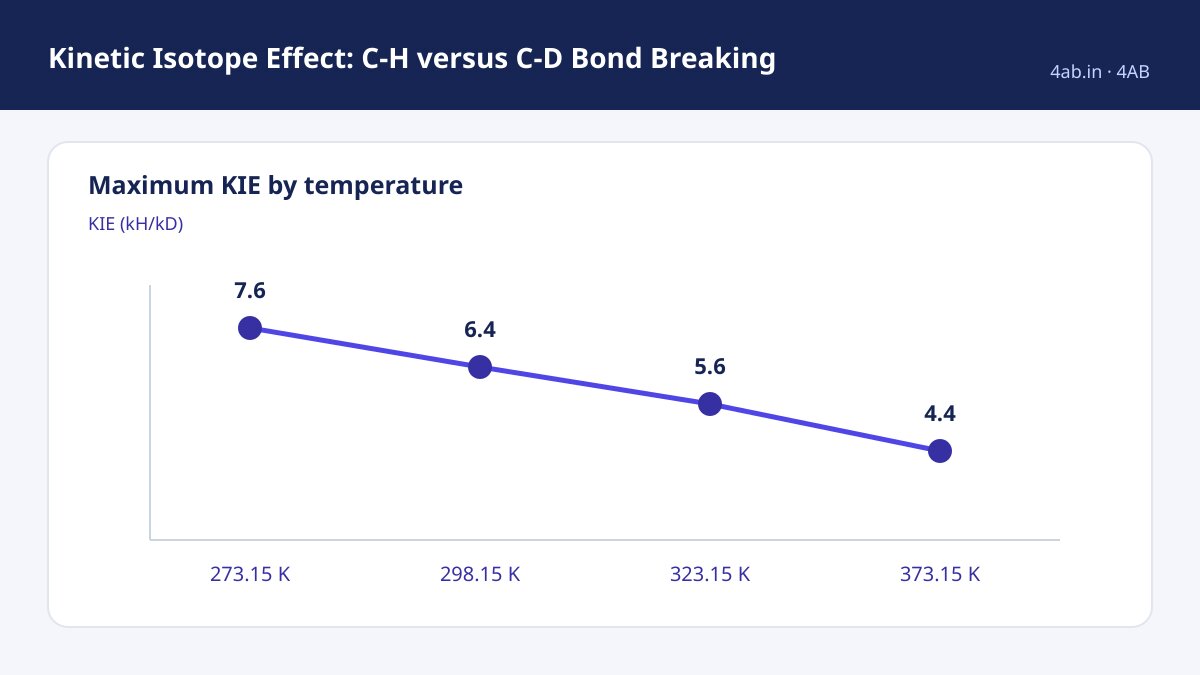
Worked example 2: how temperature changes the KIE
Question. Use ΔZPE = 4.61 kJ/mol from example 1 and find the maximum KIE at 273.15 K, 323.15 K and 373.15 K.
Calculation. The exponent is 4610 ÷ (8.3145 T).
| T (K) | Exponent | kH/kD (maximum) |
|---|---|---|
| 273.15 | 2.030 | 7.6 |
| 298.15 | 1.860 | 6.4 |
| 323.15 | 1.716 | 5.6 |
| 373.15 | 1.486 | 4.4 |
Meaning. The effect falls as the temperature rises, because the difference of 4.61 kJ/mol matters less when thermal energy RT is larger. A KIE that is measured at one temperature should not be compared with one measured at another without correction.
Worked example 3: reading experimental data
Question. At 298.15 K, the first-order rate constant for the oxidation of a substrate is kH = 3.5 × 10⁻³ s−1. For the same substrate with the C–H bond replaced by C–D, kD = 5.0 × 10⁻⁴ s−1. What do these numbers say?
KIE. kH ÷ kD = 3.5 × 10⁻³ ÷ 5.0 × 10−4 = 7.0.
Difference in activation energy. If the pre-exponential factors are equal, then ln(kH/kD) = (Ea,D − Ea,H) ÷ RT. So Ea,D − Ea,H = 8.3145 × 298.15 × ln 7.0 = 2479 × 1.946 = 4824 J/mol, about 4.8 kJ/mol.
Interpretation. This is close to the whole ΔZPE of 4.6 kJ/mol from example 1. The C–H bond is almost fully broken in the transition state of the slow step, so the data support a mechanism in which C–H cleavage is rate determining. The observed value is slightly above the model maximum of 6.4, which may mean that the pre-exponential factors differ or that quantum tunnelling of hydrogen contributes. The model is a guide, not a proof, and the experiment must be read together with other evidence.
Why it matters in mechanism problems
Suppose a reaction is suspected to go in two steps: slow removal of H, then fast reaction of an intermediate. If kH/kD is clearly above 1, the removal of H is the slow step. If kH/kD is close to 1 for a substitution on an aromatic ring, the loss of H is a fast step after the rate-determining attack, which fits electrophilic aromatic substitution through a sigma complex. This kind of inference is a favourite in mechanism questions in advanced papers.
Common mistakes
- Writing kD/kH. The convention is kH/kD, which is greater than 1 for a normal effect.
- Using atomic mass instead of reduced mass. The vibration depends on the reduced mass of the pair.
- Mixing cm−1 with J/mol. Convert with 1 cm−1 = 11.963 J/mol, and remember the factor ½ for zero-point energy.
- Assuming a large KIE for every reaction involving H. A bond that is not broken in the rate-determining step gives a value near 1.
- Comparing values at different temperatures without noting that the effect falls as T rises.
Exam relevance
| Question type | Approach |
|---|---|
| Why is a C–D bond harder to break? | Lower zero-point energy because of larger reduced mass |
| Calculate ν̃(C–D) from ν̃(C–H) | Divide by the square root of the reduced mass ratio |
| Estimate kH/kD | exp(ΔZPE/RT) with equal pre-exponential factors |
| Decide the rate-determining step | Large primary KIE means the C–H bond breaks in that step |
Papers may give a different stretching wavenumber or ignore tunnelling, so use the data provided in the question. For the current syllabus of your exam, check the official notification.
Use the Arrhenius tool to explore how a difference in activation energy changes the ratio of two rate constants.
Open the Arrhenius Equation Calculator →Turn this concept into marks: solve previous-year CSIR-NET questions and take a timed quiz.
More Kinetics articles