Kirchhoff’s Law: Reaction Enthalpy at Different Temperatures
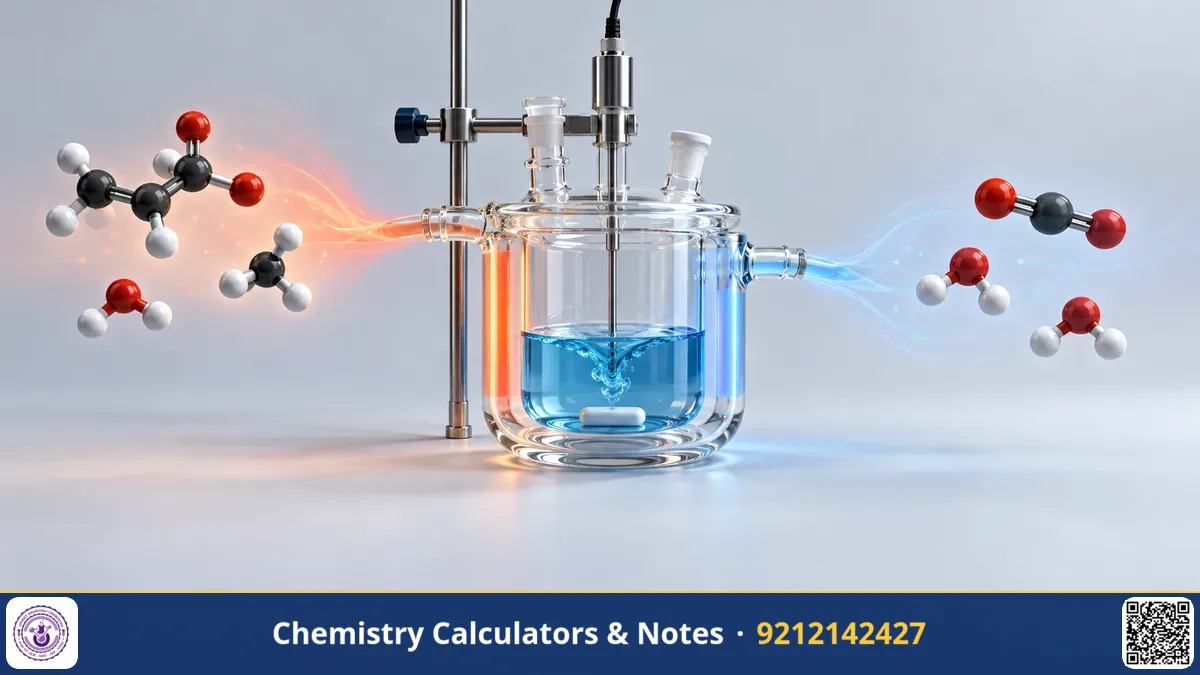
Tables give the enthalpy of a reaction at 298 K. But industrial reactors, engines and furnaces work at other temperatures, and a question may ask for ΔH at 500 K or at 263 K. Kirchhoff’s law lets you shift ΔH from one temperature to another using heat capacities. It is a standard numerical in physical chemistry for IIT-JAM, GATE, CSIR-NET and CUET-PG. It is also the reason why reaction data must always come with a temperature.
The formula
ΔH(T2) = ΔH(T1) + ∫ΔCP dT
If ΔCP is constant: ΔH(T2) = ΔH(T1) + ΔCP(T2 − T1)
ΔCP = ΣνCP(products) − ΣνCP(reactants)
ΔCP is the molar heat capacity (at constant pressure) of the products added up with their stoichiometric coefficients, minus that of the reactants. T1 is the temperature where ΔH is known and T2 is the new temperature. Use J/(mol·K) for CP and then convert the result to kJ at the end. The same law applies to ΔU with CV, and to a phase change such as melting or vaporisation.
Where it comes from
Enthalpy is a state function, so Hproducts(T) − Hreactants(T) is ΔH at T. Differentiate each enthalpy with respect to temperature at constant pressure and you get its CP. So the temperature derivative of ΔH is the difference of heat capacities, ΔCP. A different way to see the same result is a thermodynamic cycle: cool the reactants from T2 to T1, react at T1, then heat the products back to T2. The two routes must give the same ΔH.
Worked example 1: ammonia synthesis at 500 K
Question. For N2 + 3H2 → 2NH3, ΔH(298.15 K) = −92.2 kJ. Take the heat capacities as constant: CP(N2) = 29.12, CP(H2) = 28.82, CP(NH3) = 35.06 J/(mol·K). Find ΔH at 500 K.
Step 1. ΔCP = 2(35.06) − [29.12 + 3(28.82)] = 70.12 − 115.58 = −45.46 J/K.
Step 2. T2 − T1 = 500 − 298.15 = 201.85 K.
Step 3. ΔH(500 K) = −92200 + (−45.46)(201.85) = −92200 − 9176 = −101376 J = −101.4 kJ.
Check by cycle. Heating the reactants from 298.15 K to 500 K absorbs 115.58 × 201.85 = 23330 J. Heating the products over the same range absorbs 70.12 × 201.85 = 14154 J. So ΔH(500 K) = ΔH(298 K) + 14154 − 23330 = −92200 − 9176 = −101376 J. Same answer.
The reaction is more exothermic at 500 K, because the products have the smaller total heat capacity.
Worked example 2: when ΔCP depends on temperature
Question. For a reaction, ΔH(298 K) = −50.0 kJ and ΔCP = −20.0 + 0.0300 T J/K. Find ΔH at 398 K. (This is practice data, in the style of a typical exam question.)
Step 1. ∫ΔCP dT from 298 to 398 = −20.0(398 − 298) + (0.0300/2)(3982 − 2982).
Step 2. First term = −20.0 × 100 = −2000 J.
Step 3. 3982 = 158404 and 2982 = 88804, difference = 69600. Second term = 0.0150 × 69600 = +1044 J.
Step 4. Sum = −2000 + 1044 = −956 J. ΔH(398) = −50000 − 956 = −50956 J = −50.96 kJ.
Worked example 3: melting of ice below 0°C
Question. The enthalpy of fusion of ice at 273.15 K is 6010 J/mol. Take CP(liquid water) = 75.3 and CP(ice) = 37.7 J/(mol·K). Find the enthalpy of fusion at 263.15 K (−10°C), for supercooled water freezing back to ice.
Step 1. Process: ice → water. ΔCP = 75.3 − 37.7 = +37.6 J/(mol·K).
Step 2. ΔT = 263.15 − 273.15 = −10.00 K.
Step 3. ΔH(263.15 K) = 6010 + 37.6 × (−10.00) = 6010 − 376 = 5634 J/mol.
Answer. About 5.63 kJ/mol. The positive ΔCP means that ΔH falls as temperature falls. This is a useful sign check: when ΔCP is positive, ΔH rises with T.
Common mistakes
- Reversing the subtraction. ΔCP is products minus reactants, the same order as ΔH.
- Forgetting stoichiometric coefficients. The 3 in front of H2 multiplies its CP.
- Mixing kJ and J. CP is in J/(mol·K) while ΔH is often in kJ. Convert before adding.
- Using the constant-ΔCP formula over a large range. When CP changes noticeably with T, integrate the full expression, as in example 2.
- Using CP for ΔU. For ΔU use CV.
- Ignoring a phase change in the range. If a substance melts or boils between T1 and T2, add its latent heat in the path.
Why it matters beyond the exam
Reaction enthalpy is the starting point for heat-balance design in chemical plants and for combustion analysis. Process engineers rarely work at 298 K, so they use heat-capacity data to move ΔH to the operating temperature. The same idea is used for equilibrium constants, where the van’t Hoff equation needs ΔH at the right temperature. For large ranges of temperature, the temperature dependence of ΔH feeds into ΔG and the equilibrium constant. This article avoids quoting any specific plant or published value, and the data above are the kind a question supplies.
Exam relevance
| Question | Step |
|---|---|
| ΔH at a new temperature, CP constant | ΔH1 + ΔCP(T2 − T1) |
| CP given as a + bT | Integrate Δa and Δb separately |
| Sign prediction | ΔCP > 0 means ΔH rises with T |
| ΔU at a new temperature | Use ΔCV |
| Phase change at a non-standard T | Same law with the heat capacities of the two phases |
Check the current official syllabus and notification of your exam for the depth expected.
This is a hand calculation with heat capacities, and the suite has no tool for it. The Scientific Calculator handles the arithmetic.
Open the Chemistry Calculator Suite →