KMnO4 vs Oxalic Acid: Redox Titration Calculations
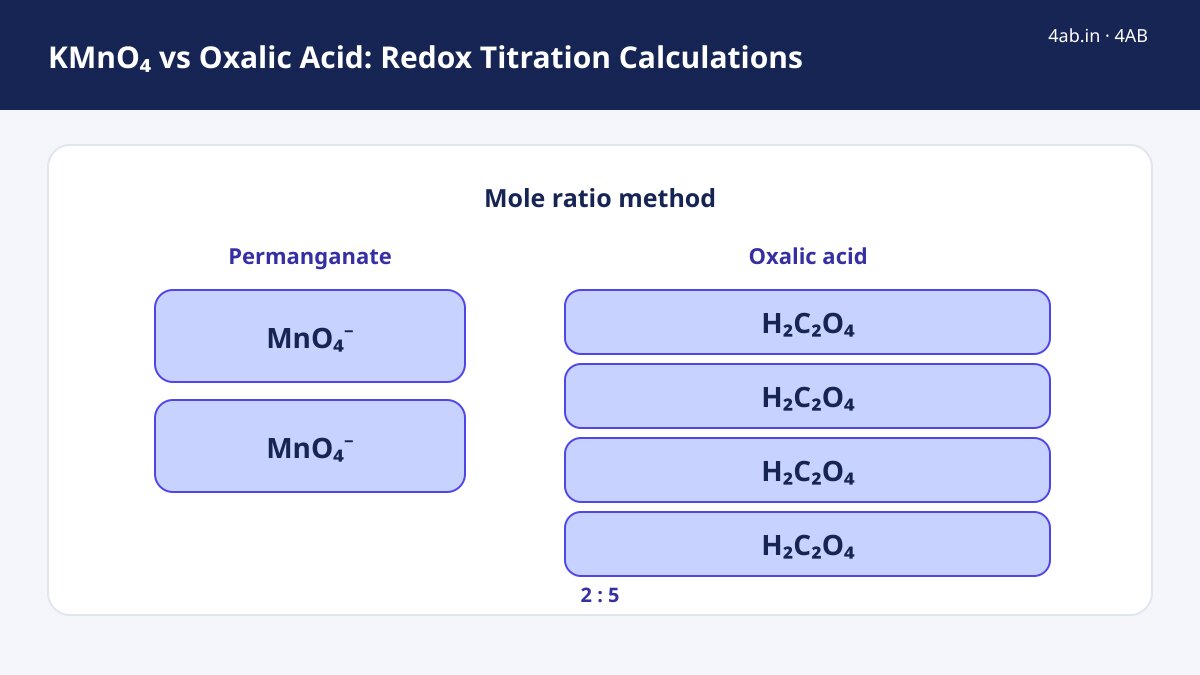
The titration of oxalic acid or Mohr's salt against potassium permanganate is the most common redox titration in the Class 12 practical and in theory numericals. The arithmetic is short, but students lose marks because they use the wrong number of electrons, the wrong equivalent mass, or the wrong acid in the flask. This page gives the equations, the method and three fully worked examples.

The two reactions
Permanganate with Fe2+ (Mohr's salt): MnO4− + 5Fe2+ + 8H+ → Mn2+ + 5Fe3+ + 4H2O
In acid solution, MnO4− gains 5 electrons (Mn goes from +7 to +2). Oxalic acid loses 2 electrons per molecule (two C atoms go from +3 to +4, one electron each). Fe2+ loses 1 electron. These numbers decide everything else.
Two ways to calculate
Mole ratio method. Use the balanced equation. For oxalic acid, 2 mol MnO4− reacts with 5 mol H2C2O4, so mol MnO4− = (2/5) × mol H2C2O4. For Mohr's salt, mol MnO4− = (1/5) × mol Fe2+.
Normality method. N = M × (electrons exchanged per formula unit). At the end point, N1V1 = N2V2. For KMnO4 in acid, N = 5M. For oxalic acid, N = 2M. For Mohr's salt, N = M.
| Substance | Molar mass (g/mol) | Electrons per formula unit | Equivalent mass (g/eq) |
|---|---|---|---|
| KMnO4 (acidic medium) | 158.03 | 5 | 31.61 |
| H2C2O4 (anhydrous) | 90.03 | 2 | 45.02 |
| H2C2O4·2H2O (crystals) | 126.07 | 2 | 63.03 |
| FeSO4·(NH4)2SO4·6H2O (Mohr's salt) | 392.13 | 1 | 392.13 |
Worked example 1: find the molarity of KMnO4
Question. 20.0 mL of 0.0500 M oxalic acid needs 25.0 mL of KMnO4 solution at the end point. Find the molarity of KMnO4.
Step 1 (moles of oxalic acid). 0.0500 mol/L × 20.0 mL = 1.00 mmol.
Step 2 (moles of permanganate). From 2 : 5, mmol MnO4− = 1.00 × 2/5 = 0.400 mmol.
Step 3. M = 0.400 mmol ÷ 25.0 mL = 0.0160 M.
Check by normality. N of oxalic acid = 2 × 0.0500 = 0.100 N. Then 0.100 × 20.0 = NKMnO4 × 25.0, so N = 0.0800 N. M = N ÷ 5 = 0.0160 M. Both methods agree.
Worked example 2: how much KMnO4 will Mohr's salt need?
Question. 9.80 g of Mohr's salt is dissolved in dilute H2SO4 and made up to 250 mL. A 25.0 mL portion is titrated with 0.0200 M KMnO4. Find the volume needed.
Step 1. Moles of Mohr's salt = 9.80 ÷ 392.13 = 0.02499 mol in 250 mL. Molarity = 0.02499 ÷ 0.250 = 0.0999 M, so about 0.100 M.
Step 2. In 25.0 mL: 0.02499 × (25.0 ÷ 250) = 2.499 × 10⁻³ mol, or 2.50 mmol Fe2+.
Step 3. MnO4− needed = 2.50 ÷ 5 = 0.500 mmol.
Step 4. Volume = 0.500 mmol ÷ 0.0200 mmol/mL = 25.0 mL (more exactly 24.99 mL).
Worked example 3: from weighed crystals to molarity
Question. 1.575 g of oxalic acid crystals (H2C2O4·2H2O) is dissolved in water and made up to 250 mL. A 10.0 mL portion needs 12.5 mL of KMnO4. Find the molarity of KMnO4.
Step 1. Moles of crystals = 1.575 ÷ 126.07 = 0.012494 mol. Molarity = 0.012494 ÷ 0.250 = 0.04997 M, so about 0.0500 M.
Step 2. In 10.0 mL: 0.04997 × 10.0 = 0.4997 mmol, so about 0.500 mmol oxalic acid.
Step 3. MnO4− = 0.4997 × 2/5 = 0.1999 mmol, about 0.200 mmol.
Step 4. M = 0.1999 ÷ 12.5 = 0.0160 M.
Check by equivalents. Equivalents of oxalic acid in 10.0 mL = (1.575 ÷ 63.03) × (10.0 ÷ 250) = 0.9995 meq. Dividing by 12.5 mL gives 0.0800 N, and 0.0800 ÷ 5 = 0.0160 M.
Practical points that decide the answer
- Use dilute H2SO4 only. Hydrochloric acid is wrong because MnO4− oxidises Cl− to chlorine and the reading is too high. Nitric acid is itself an oxidising agent and interferes.
- KMnO4 is its own indicator. The end point is the first permanent very light pink colour that stays for about 30 seconds.
- Read the burette from the top of the meniscus for the dark purple solution, because the bottom of the meniscus cannot be seen clearly.
- Oxalic acid titrations are done warm (the usual practical instruction is about 60–70 °C), because the reaction is slow at the start. Once a little Mn2+ forms it speeds the reaction up, so the colour disappears faster after the first few drops. Mohr's salt titrations are done at room temperature.
- KMnO4 is not a primary standard. Its solution is standardised against oxalic acid or Mohr's salt, which can be weighed exactly.
Common mistakes
- Using 1 : 1 for oxalic acid. The ratio is 2 MnO4− : 5 H2C2O4. A 1 : 1 assumption makes the answer wrong by a factor of 2.5.
- Taking the equivalent mass of oxalic acid crystals as 45. That is for the anhydrous acid. Crystals include 2 H2O, so the equivalent mass is 63.
- Mixing M and N. N1V1 = N2V2 works only if both sides are in normality. Convert KMnO4 with N = 5M.
- Forgetting the aliquot fraction. If only 10 mL of a 250 mL solution is titrated, take only 10/250 of the weighed amount.
- Using 6 or 7 electrons for KMnO4. In acid, Mn changes from +7 to +2, which is 5 electrons. In neutral medium the product is MnO2 and the figure becomes 3.
Exam summary
| Titration | Mole ratio | Normality link | Temperature |
|---|---|---|---|
| KMnO4 with oxalic acid | 2 MnO4− : 5 H2C2O4 | N(KMnO4) = 5M; N(oxalic) = 2M | Warm, 60–70 °C |
| KMnO4 with Mohr's salt | 1 MnO4− : 5 Fe2+ | N(Mohr's salt) = M | Room temperature |
For practical marking schemes and the exact procedure, follow your own board's current practical syllabus and your teacher's instructions.
The equivalent weight tool shows the equivalent mass for a given substance and number of electrons. Use it to check the values in the table above before you start a titration numerical.
Open the Equivalent Weight Calculator →Turn this concept into marks: solve previous-year CSIR-NET questions and take a timed quiz.
More Equilibrium articles