Mean Free Path and Collision Frequency of Gas Molecules
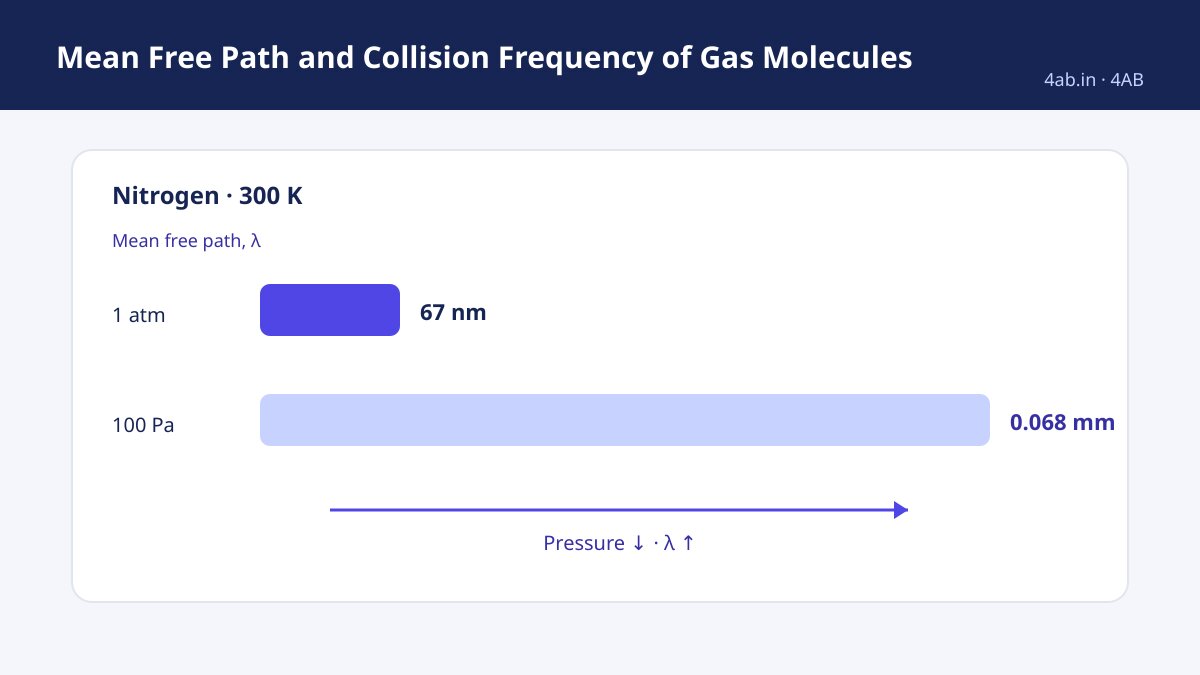
In a gas at normal pressure each molecule hits another molecule billions of times every second. The mean free path is the average distance it travels between two such collisions. Questions on this topic appear in the gaseous-state and kinetic-theory units of IIT-JAM, GATE, CSIR-NET and CUET-PG. The formulas are short, but unit mistakes are common, so every step is shown below.

The key relations
c̄ = √(8RT / πM)
Z₁ = c̄ / λ (collisions per second by one molecule)
What each symbol means
- λ – mean free path, in metres.
- d – collision diameter of the molecule in metres. 1 nm = 10⁻⁹ m, 1 Å = 10⁻¹⁰ m. Values are tabulated in your book or given in the question.
- p – pressure in pascal. 1 atm = 101325 Pa. Many mistakes come from using atm or bar here.
- T – temperature in kelvin. kB = 1.380649 × 10⁻²³ J K⁻¹.
- c̄ – mean speed. M must be in kg mol⁻¹ (28.014 g mol⁻¹ = 0.028014 kg mol⁻¹ for N₂).
- The √2 in the denominator comes from the fact that other molecules are also moving, so the average relative speed is √2 times c̄.
Since p = nkBT for an ideal gas, you can also write λ = 1/(√2 π d² n), where n is the number density (molecules per m³). The mean free path depends on how crowded the gas is, and on the size of the molecule, not on the speed.
Worked examples
Example 1: nitrogen at 300 K and 1 atm. Take d = 3.7 × 10⁻¹⁰ m (a typical textbook value for N₂; use the value given in your question).
p = 101325 Pa. d² = (3.7 × 10⁻¹⁰)² = 1.369 × 10⁻¹⁹ m².
Numerator: kBT = 1.380649 × 10⁻²³ × 300 = 4.142 × 10⁻²¹ J.
Denominator: √2 × π × 1.369 × 10⁻¹⁹ × 101325 = 1.4142 × 3.1416 × 1.369 × 10⁻¹⁹ × 101325 = 6.163 × 10⁻¹⁴.
λ = 4.142 × 10⁻²¹ / 6.163 × 10⁻¹⁴ = 6.72 × 10⁻⁸ m = 67 nm.
This is about 180 times the molecular diameter (67.2 nm / 0.37 nm ≈ 182). Molecules are small compared with the gaps between them.
Example 2: collision frequency for the same gas.
c̄ = √(8 × 8.314 × 300 / (π × 0.028014)) = √(19954 / 0.08801) = √226,725 = 476 m s⁻¹.
Z₁ = c̄/λ = 476.2 / 6.72 × 10⁻⁸ = 7.1 × 10⁹ s⁻¹.
Each molecule collides about seven billion times per second.
Second route: number density n = p/(kBT) = 101325 / 4.142 × 10⁻²¹ = 2.45 × 10²⁵ m⁻³. Z₁ = √2 π d² c̄ n = 4.4429 × 1.369 × 10⁻¹⁹ × 476.2 × 2.446 × 10²⁵ = 7.1 × 10⁹ s⁻¹. ✓ Both routes agree.
Example 3: effect of pressure. Same gas, same 300 K, but p = 100 Pa.
λ is inversely proportional to p. The pressure fell by a factor of 101325/100 = 1013.25, so λ rises by the same factor: 6.72 × 10⁻⁸ × 1013.25 = 6.81 × 10⁻⁵ m = 0.068 mm. Direct calculation: 4.142 × 10⁻²¹ / (√2 π × 1.369 × 10⁻¹⁹ × 100) = 6.81 × 10⁻⁵ m. ✓
At 1 × 10⁻³ Pa (a good laboratory vacuum) the same formula gives λ = 6.8 m, longer than a typical vacuum chamber. A molecule then travels from wall to wall without hitting another molecule, and the gas no longer behaves like a continuous fluid.
Example 4: effect of temperature at constant pressure. Double T from 300 K to 600 K at 1 atm.
λ ∝ T at constant p, so λ doubles: 2 × 6.72 × 10⁻⁸ = 1.34 × 10⁻⁷ m. Reason: at constant pressure, heating makes the gas expand, so n falls and molecules are farther apart. At constant volume, n is fixed and λ does not change with T.
Dependence summary
| Change | Effect on λ | Effect on Z₁ |
|---|---|---|
| Pressure ↑ (T constant) | λ ↓ (λ ∝ 1/p) | Z₁ ↑ (Z₁ ∝ p) |
| Temperature ↑ (p constant) | λ ↑ (λ ∝ T) | Z₁ ↓ (Z₁ ∝ 1/√T) |
| Temperature ↑ (V constant) | λ unchanged | Z₁ ↑ (Z₁ ∝ √T) |
| Larger molecule (d ↑) | λ ↓ (λ ∝ 1/d²) | Z₁ ↑ |
Common mistakes
- Using pressure in atm or bar. The formula with kB needs pascal; convert first.
- Using d in Å or nm without converting to metres. A factor of 10¹⁰ is lost this way.
- Forgetting the √2, or putting it in the numerator.
- Using M in g mol⁻¹ inside the c̄ formula. With R = 8.314 J K⁻¹ mol⁻¹, M must be in kg mol⁻¹.
- Saying λ depends on the speed of molecules. At fixed p and T it depends on d only; a faster molecule travels farther per second, but the distance between collisions is fixed by crowding.
- Confusing the three speeds. c̄ (mean) is used here, not crms or cmp.
Where this appears
| Exam | Typical use |
|---|---|
| IIT-JAM, CUET-PG | Numerical on λ and Z₁ from d, p and T; proportionality statements. Check the latest syllabus for the exact scope. |
| GATE, CSIR-NET | Collision theory of reaction rates builds on the same collision frequency. Check the current official notification. |
You can use the ideal gas tool to find the number density n = NAp/(RT) behind these numbers; the rest is a short calculation on any scientific calculator.
Open the Ideal Gas Law Calculator →Turn this concept into marks: solve previous-year CSIR-NET questions and take a timed quiz.
More Solutions articles