Moles to Number of Particles: Using the Avogadro Constant
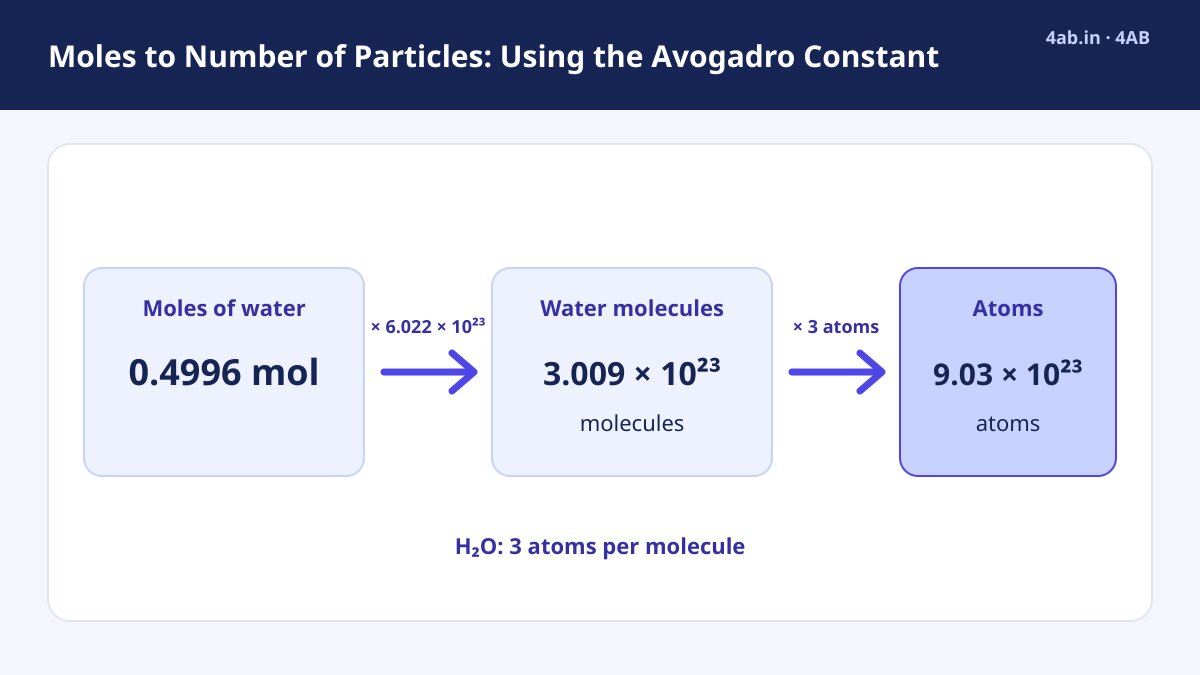
The mole is a counting unit, like a dozen, but much larger. Almost every Class 11 numerical on the mole concept ends with a question such as "how many molecules?" or "how many atoms?". The bridge between the mole and the actual number of particles is the Avogadro constant. This page shows how to cross that bridge in both directions and how to count atoms and ions inside a molecule or formula unit.

The formula
n = m ÷ M
N = (m ÷ M) × NA
N is the number of particles (atoms, molecules or ions). n is the amount in moles. NA is the Avogadro constant, which is exactly 6.02214076 × 10²³ mol−1 in the present SI system. Most textbooks round it to 6.022 × 10²³, and some use 6.02 × 10²³. m is the mass in grams and M is the molar mass in g mol−1. Use the number of significant figures your question allows, and use the same value of NA throughout the question.
Note the particle you are counting. One mole of water has 6.022 × 10²³ molecules, but 3 × 6.022 × 1023 atoms, because each H2O has three atoms. Always write the particle after the number.
Worked example 1: molecules and atoms in water
Question. How many molecules and how many atoms are present in 9.0 g of water?
Moles. M(H2O) = 18.015 g mol−1, so n = 9.0 ÷ 18.015 = 0.4996 mol.
Molecules. N = 0.4996 × 6.022 × 1023 = 3.009 × 10²³ molecules (with the exact NA the answer is 3.0086 × 10²³).
Atoms. Each molecule has 3 atoms: 3.009 × 1023 × 3 = 9.03 × 10²³ atoms, of which 6.02 × 10²³ are hydrogen and 3.01 × 10²³ are oxygen.
Worked example 2: atoms in carbon dioxide
Question. How many atoms are there in 5.00 g of CO2?
Molar mass. 12.011 + 2(15.999) = 44.009 g mol−1.
Moles. 5.00 ÷ 44.009 = 0.11361 mol.
Molecules. 0.11361 × 6.02214 × 1023 = 6.842 × 10²² molecules.
Atoms. 3 atoms per molecule: 6.842 × 1022 × 3 = 2.053 × 10²³ atoms.
Worked example 3: mass of one molecule
Question. Find the mass of a single molecule of water in grams.
Idea. One mole weighs 18.015 g and contains 6.02214 × 10²³ molecules, so one molecule weighs M ÷ NA.
Calculation. 18.015 ÷ 6.02214 × 1023 = 2.991 × 10⁻²³ g.
This is why we never count molecules directly. The number is far too small to weigh one at a time.
Worked example 4: ions in sodium chloride
Question. How many Na+ and Cl− ions are present in 11.7 g of NaCl?
Molar mass. 22.990 + 35.45 = 58.44 g mol−1.
Moles. 11.7 ÷ 58.44 = 0.2002 mol of NaCl.
Formula units. 0.2002 × 6.022 × 1023 = 1.206 × 10²³.
Ions. Each formula unit gives one Na+ and one Cl−, so there are 1.206 × 10²³ Na+ ions, 1.206 × 10²³ Cl− ions and 2.411 × 10²³ ions in total. NaCl has no separate molecules, so say "formula units", not "molecules".
Worked example 5: electrons in a sample
Question. How many electrons are present in 1.8 g of water?
Moles. 1.8 ÷ 18.015 = 0.09992 mol.
Molecules. 0.09992 × 6.022 × 1023 = 6.017 × 10²².
Electrons. One H2O has 2(1) + 8 = 10 electrons, so the total is 6.017 × 10²³ electrons.
Common mistakes
- Multiplying mass directly by NA. Mass must be changed to moles first (n = m ÷ M). Only moles multiply NA.
- Mixing molecules and atoms. 0.5 mol of O2 has 0.5 × NA molecules but 1.0 × NA atoms. Read what the question counts.
- Forgetting that some elements are molecular. Hydrogen is H2, chlorine is Cl2, and so on. The mass of 1 mol of H2 is 2.016 g, not 1.008 g.
- Errors in powers of ten. When you multiply 0.4996 by 6.022 × 1023, the answer is 3.009 × 10²³, not 3.009 × 10²². Put the answer in standard form and check the exponent.
- Using "molecules" for ionic solids. NaCl, MgO and K2SO4 are counted as formula units.
Quick reference
| You are given | Step 1 | Step 2 |
|---|---|---|
| Mass of a substance | n = m ÷ M | N = n × NA |
| Number of particles | n = N ÷ NA | m = n × M |
| Volume of a gas at STP | n = V ÷ molar volume | N = n × NA |
| Atoms per molecule known | Find molecules first | Multiply by atoms per molecule |
For gases at STP the molar volume is 22.4 L mol−1 in older books (0 °C and 1 atm) and 22.7 L mol−1 in books that use 1 bar. Use the one your textbook uses.
There is no dedicated Avogadro-number tool in the suite. For the molar mass step, the calculator suite can still help you check M before you multiply by NA.
Open the Chemistry Calculator Suite →Turn this concept into marks: solve previous-year CSIR-NET questions and take a timed quiz.
More Solutions articles