Nernst Equation for Ion Membrane Potentials
Every living cell keeps a different mix of ions inside and outside its membrane. Because the membrane lets some ions pass more easily than others, an electric potential develops across it. The Nernst equation, which you meet in electrochemistry for cells with electrodes, gives the equilibrium potential of a single ion across a membrane. This page shows how the same equation is used in cell physiology and in the design of ion-selective electrodes, with the arithmetic worked out.

From the cell equation to the membrane equation
For one ion that can cross a membrane, the equilibrium (Nernst) potential is the membrane potential at which the electrical force on the ion exactly cancels its tendency to diffuse down the concentration gradient. At that potential there is no net movement of that ion.
At 310.15 K (37 °C): Eion = (61.54 mV ÷ z) × log10([ion]out ÷ [ion]in)
Here E is the potential inside the cell relative to the outside, z is the signed charge of the ion (+1 for K+ and Na+, +2 for Ca2+, −1 for Cl−), R = 8.314 J mol−1 K−1, F = 96485 C mol−1, and T is in kelvin. The number 61.54 mV comes from 2.303RT/F at 310.15 K. At 298.15 K the equivalent number is 59.16 mV.
The concentrations used in the examples below are round, illustrative values of the kind found in textbooks. Real cells and tissues differ, so use the numbers given in your question.
Worked example 1: potassium
Question. [K+]out = 5 mM and [K+]in = 140 mM at 37 °C. Find EK.
Step 1. Ratio out ÷ in = 5 ÷ 140 = 0.03571.
Step 2. log10(0.03571) = −1.4472.
Step 3. EK = 61.54 × (−1.4472) ÷ 1 = −89.05 mV.
Cross-check with ln. RT ÷ F = 8.314 × 310.15 ÷ 96485 = 0.026725 V. ln(0.03571) = −3.3322. Product = −0.08905 V. The two routes agree.
The inside is negative because K+ tends to leave the cell, and it stops leaving when the inside is about 89 mV more negative than the outside.
Worked example 2: sodium and chloride
Sodium. [Na+]out = 145 mM, [Na+]in = 12 mM, z = +1. Ratio = 12.083, log10 = 1.0822. ENa = 61.54 × 1.0822 = +66.6 mV.
Chloride. [Cl−]out = 110 mM, [Cl−]in = 10 mM, z = −1. Ratio = 11, log10 = 1.0414. ECl = (61.54 ÷ −1) × 1.0414 = −64.1 mV.
The sign of z matters. An anion with more outside than inside has a negative equilibrium potential, while a cation with the same gradient has a positive one.
Worked example 3: effect of changing the outside concentration
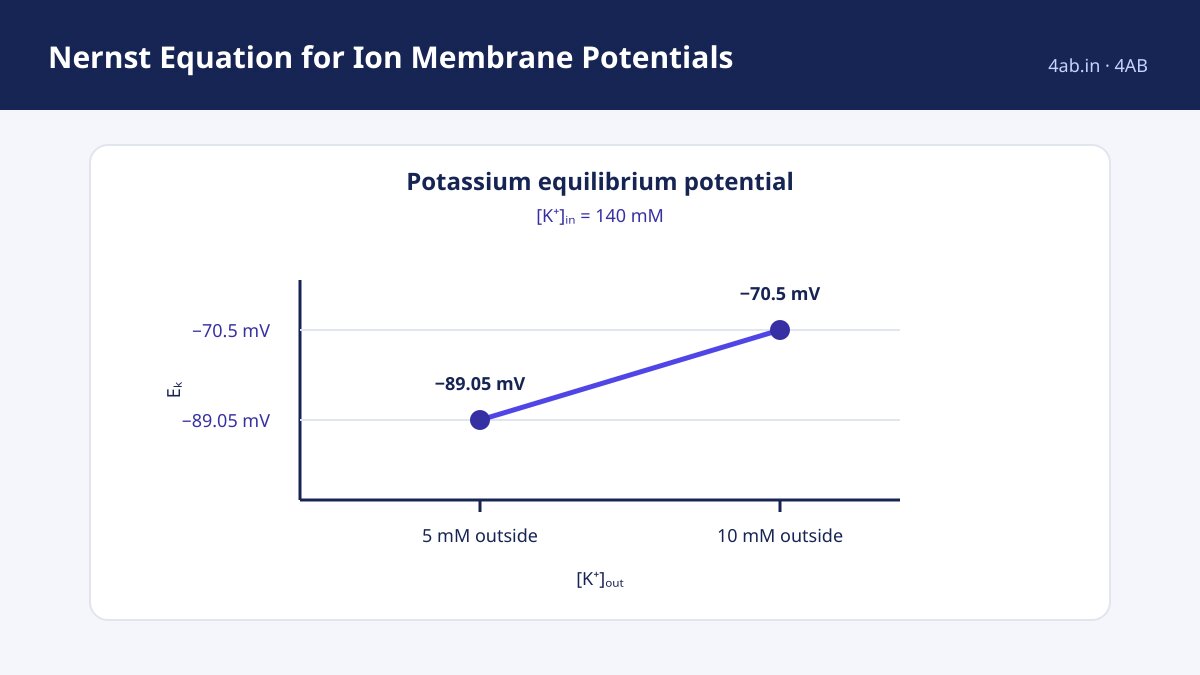
Question. Keep [K+]in = 140 mM, and raise [K+]out from 5 mM to 10 mM. What is the new EK?
Step 1. New ratio = 10 ÷ 140 = 0.07143, log10 = −1.1461.
Step 2. EK = 61.54 × (−1.1461) = −70.5 mV.
Shortcut. Doubling the outside concentration changes E by 61.54 × log102 = 18.5 mV. So −89.05 + 18.52 = −70.5 mV. The potential becomes less negative (closer to zero) when the outside concentration rises.
Worked example 4: finding the ratio from a measured potential
Question. A potassium-selective electrode shows an equilibrium potential of −90.5 mV at 37 °C. Find [K+]out ÷ [K+]in.
Step 1. log10(ratio) = −90.5 ÷ 61.54 = −1.4706.
Step 2. Ratio = 10−1.4706 = 0.0338, which means the inside concentration is about 29.6 times the outside.
This idea of reading a concentration from a potential is the working principle of ion-selective electrodes. The electrode gives a potential that changes by about 61.5 mV per tenfold change in concentration for a singly charged ion at 37 °C (59.2 mV at 25 °C). That slope is a useful check on whether the electrode is working properly.
Why the resting potential is not simply EK
A real membrane is permeable to several ions at once. The resting membrane potential therefore lies between the individual Nernst potentials, closer to the ion with the highest permeability. The Goldman–Hodgkin–Katz equation extends the Nernst equation by weighting each ion by its permeability. The Nernst equation is the single-ion limit. This page keeps to the Nernst equation, and the full permeability-weighted equation is a topic for a physical chemistry or biophysics course.
Common mistakes
- Using the ratio upside down. This page uses [out] ÷ [in] with E meaning inside relative to outside. If your textbook uses the opposite convention, the sign changes. Check the convention first.
- Forgetting the sign of z. For Cl−, z = −1. For Ca2+, z = +2, which halves the slope.
- Using 25 °C in a body-temperature problem. RT/F depends on T. Convert °C to K by adding 273.15.
- Mixing ln and log10. Use RT/zF with ln, or 2.303RT/zF with log10.
- Using concentrations in different units. The ratio is unitless, but both concentrations must use the same unit.
- Treating Eion as the actual membrane potential. It is the potential at which that one ion is at equilibrium.
Exam summary
| Item | Value at 310.15 K | Value at 298.15 K |
|---|---|---|
| RT/F | 26.73 mV | 25.69 mV |
| 2.303RT/F (slope per decade, z = 1) | 61.54 mV | 59.16 mV |
| z = 2 slope per decade | 30.77 mV | 29.58 mV |
| Anion (z = −1) | Sign of E reverses compared with a cation | |
Check the current official syllabus for your exam to see whether membrane potentials are expected.
The Nernst tool takes E°, n and the reaction quotient. For a single-ion membrane potential, enter E° = 0, set n to the ion's charge magnitude, and use Q = [ion]in ÷ [ion]out for a cation (the tool's formula is E = E° − (RT/nF) ln Q), and compare the result with your hand calculation. Check the temperature the tool assumes, because the examples above use 37 °C.
Open the Nernst Equation Calculator →Turn this concept into marks: solve previous-year CSIR-NET questions and take a timed quiz.
More Electrochemistry articles