Net Ionic Equations and Spectator Ions
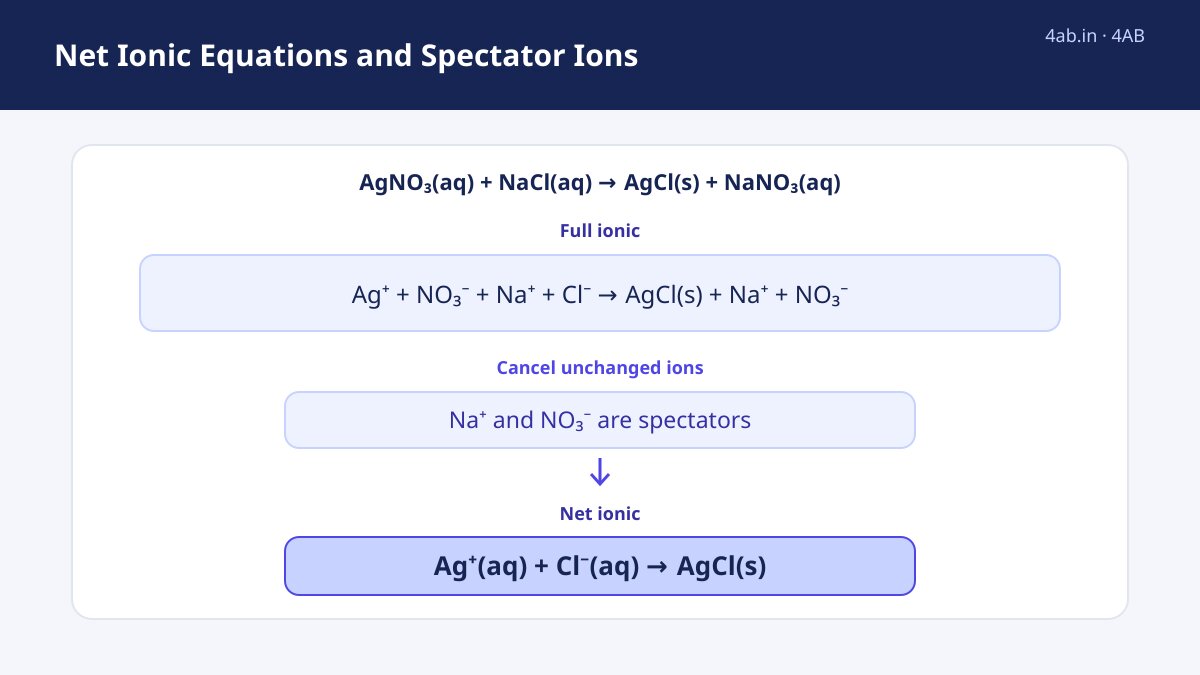
A full chemical equation shows every compound, but in water many compounds exist as separate ions. Board exams, especially Class 11 and ICSE papers, often ask you to write the net ionic equation: the equation that shows only the particles that actually change. This page gives a simple three-step method and four worked examples.

The method
2. Split every strong electrolyte that is dissolved (aq) into ions. Keep solids (s), liquids (l), gases (g) and weak electrolytes whole.
3. Cancel the ions that are the same on both sides (spectator ions). What remains is the net ionic equation.
Two checks at the end: atoms must balance, and total charge must balance too.
Key words
- Spectator ions are ions that are present before and after the reaction without changing. They are like spectators at a match who watch but do not play.
- Strong electrolytes (strong acids, strong bases and soluble salts) are written as separate ions when dissolved.
- Weak electrolytes (weak acids such as CH3COOH, weak bases such as NH3) and water are written as whole molecules.
- Precipitates are insoluble solids. They are written whole with (s). To decide what is insoluble, use the solubility rules in your textbook. In general, all nitrates are soluble; most chlorides are soluble except those of silver, lead and mercury(I); most sulphates are soluble except those of barium and lead.
Worked example 1: silver chloride
AgNO3(aq) + NaCl(aq) → AgCl(s) + NaNO3(aq)
Full ionic: Ag+ + NO3− + Na+ + Cl− → AgCl(s) + Na+ + NO3−
Spectators: Na+ and NO3−.
Net ionic: Ag+(aq) + Cl−(aq) → AgCl(s)
Charge check: left +1 −1 = 0, right 0. Good.
Use of the equation: 100 mL of 0.100 M AgNO3 is added to excess NaCl solution. Moles of Ag+ = 0.100 L × 0.100 mol/L = 0.0100 mol. The ratio is 1 : 1, so 0.0100 mol AgCl forms. Molar mass of AgCl = 107.868 + 35.45 = 143.32 g/mol. Mass = 0.0100 × 143.32 = 1.43 g.
Worked example 2: barium sulphate
BaCl2(aq) + Na2SO4(aq) → BaSO4(s) + 2NaCl(aq)
Full ionic: Ba2+ + 2Cl− + 2Na+ + SO42− → BaSO4(s) + 2Na+ + 2Cl−
Spectators: 2Na+ and 2Cl−.
Net ionic: Ba2+(aq) + SO42−(aq) → BaSO4(s)
Charge check: left +2 −2 = 0, right 0.
Use of the equation: 50.0 mL of 0.400 M BaCl2 is mixed with excess Na2SO4. Moles of Ba2+ = 0.0500 L × 0.400 = 0.0200 mol, so 0.0200 mol BaSO4 forms. Molar mass = 137.327 + 32.06 + 4(15.999) = 233.38 g/mol. Mass = 0.0200 × 233.38 = 4.67 g.
Worked example 3: acid and base
Strong acid + strong base. HCl(aq) + NaOH(aq) → NaCl(aq) + H2O(l)
Full ionic: H+ + Cl− + Na+ + OH− → Na+ + Cl− + H2O(l)
Net ionic: H+(aq) + OH−(aq) → H2O(l)
Weak acid + strong base. CH3COOH(aq) + NaOH(aq) → CH3COONa(aq) + H2O(l)
Acetic acid is weak, so it stays as a molecule. Only Na+ is a spectator.
Net ionic: CH3COOH(aq) + OH−(aq) → CH3COO−(aq) + H2O(l)
Charge check: left −1, right −1. Good. Notice the net equation is different for a weak acid, even though the molecular equation looks the same.
Worked example 4: a metal displacing another
Zn(s) + CuSO4(aq) → ZnSO4(aq) + Cu(s)
Full ionic: Zn(s) + Cu2+ + SO42− → Zn2+ + SO42− + Cu(s)
Net ionic: Zn(s) + Cu2+(aq) → Zn2+(aq) + Cu(s). The spectator is SO42−. Charge: left +2, right +2.
A case where charge needs balancing: Al(s) + Cu2+(aq) → Al3+(aq) + Cu(s). Atoms already balance, but charge does not (+2 on the left, +3 on the right). Use 2 Al and 3 Cu2+: 2Al(s) + 3Cu2+(aq) → 2Al3+(aq) + 3Cu(s). Charge: left 3 × (+2) = +6, right 2 × (+3) = +6. Balanced.
Common mistakes
- Splitting a precipitate, gas or water into ions. AgCl(s), CO2(g) and H2O(l) are written whole.
- Splitting a weak acid or weak base. CH3COOH and NH3 stay whole.
- Cancelling only part of an ion. SO42− is one ion. Do not cancel the S and O separately.
- Balancing atoms but not charge. Always add up the charges on both sides.
- Dropping the coefficients. If 2Na+ appears on both sides, cancel exactly 2, not 1.
Exam relevance
| Question type | What to do |
|---|---|
| Write the net ionic equation | Split strong electrolytes, cancel spectators |
| Name the spectator ions | List the ions that are unchanged on both sides |
| Will a precipitate form? | Combine each cation with the other anion and use the solubility rules |
| Mass of precipitate | Use the net equation for the mole ratio, then multiply by molar mass |
| Redox net equation | Balance atoms and charge; see the redox pages |
Solubility rules differ slightly between textbooks. Follow the table in your own book.
Check that your molecular equation is balanced before you write the ionic form, using the Chemical Equation Balancer.
Open the Chemical Equation Balancer →Previous-year CSIR-NET questions and timed quizzes to check what you just read.
More Exam guides articles