NMR Spin-Spin Splitting: The n+1 Rule, Pascal Triangle and J
Chemical shift tells you where a proton signal appears. Spin–spin splitting tells you how many neighbouring protons it has. In IIT-JAM, GATE, CSIR-NET and CUET-PG, a typical NMR question gives you a formula and a few signals with their shape, and asks for the structure. If you read the splitting pattern correctly, the answer follows quickly. This article explains the n + 1 rule, intensity ratios, the coupling constant J, and what to do when a proton has two different sets of neighbours.

The n + 1 rule
n = number of equivalent neighbouring protons, on atoms next to the one carrying the observed proton (three bonds away, H–C–C–H).
The intensities of the lines follow Pascal's triangle. Each row is made by adding the two numbers above it:
| n | Lines | Name | Intensity ratio |
|---|---|---|---|
| 0 | 1 | singlet (s) | 1 |
| 1 | 2 | doublet (d) | 1 : 1 |
| 2 | 3 | triplet (t) | 1 : 2 : 1 |
| 3 | 4 | quartet (q) | 1 : 3 : 3 : 1 |
| 4 | 5 | quintet | 1 : 4 : 6 : 4 : 1 |
| 5 | 6 | sextet | 1 : 5 : 10 : 10 : 5 : 1 |
| 6 | 7 | septet | 1 : 6 : 15 : 20 : 15 : 6 : 1 |
The reason is simple. Each neighbouring proton can have its spin aligned with the field or against it. One neighbour gives two arrangements, two neighbours give four arrangements, grouped as 1 + 2 + 1, and so on. The number of ways to reach each total gives the line intensities. The total intensity of a multiplet is proportional to the number of protons that produce it, and the lines are centred on the chemical shift of those protons.
Important rules and limits
- Protons that are equivalent do not split each other. The three H of a CH3 group show one signal, not a pattern from their mutual coupling.
- Normal splitting needs three bonds between the protons (H–C–C–H). Protons on the two sides of an oxygen, as in CH3–O–CH2–, are four bonds apart (H–C–O–C–H) and usually do not split each other.
- O–H and N–H protons usually appear as broad singlets because of fast exchange, and generally do not split their neighbours. Check the conditions given in the question.
- The simple n + 1 rule works when the coupling constants to all the neighbours are similar, and when the shift difference between the coupled protons (in Hz) is much larger than J (a first-order spectrum).
The coupling constant J
The distance between neighbouring lines in a multiplet is the coupling constant J. It is measured in hertz, not ppm, and it does not change with the spectrometer field. Chemical shift in Hz, on the other hand, does change with the field:
So a given J takes up fewer ppm on a stronger magnet, and the multiplets become better separated. This is why higher-field instruments give clearer spectra.
Worked examples
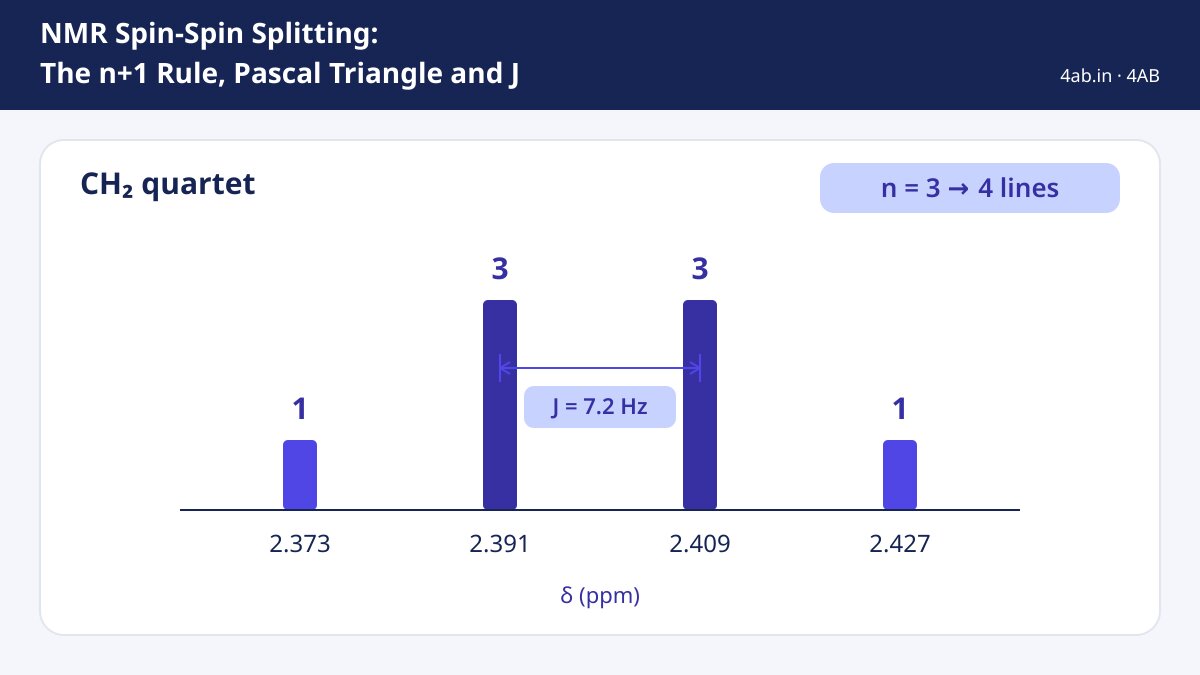
Example 1: ethyl group, line positions. In an ethyl group CH3CH2–X at 400 MHz, the CH2 appears at δ 2.40 and the CH3 at δ 1.20, with J = 7.2 Hz. Describe both signals.
CH2 has 3 equivalent neighbours (the CH3), so n + 1 = 4: a quartet, intensity 1 : 3 : 3 : 1.
CH3 has 2 equivalent neighbours (the CH2), so n + 1 = 3: a triplet, intensity 1 : 2 : 1.
Frequencies: 2.40 ppm × 400 MHz = 960 Hz; 1.20 ppm × 400 = 480 Hz.
Quartet lines sit at −1.5 J, −0.5 J, +0.5 J, +1.5 J from the centre, which is −10.8, −3.6, +3.6, +10.8 Hz. In ppm (divide by 400): δ 2.373, 2.391, 2.409, 2.427.
Triplet lines sit at −J, 0, +J, i.e. −7.2, 0, +7.2 Hz, or δ 1.182, 1.200, 1.218.
The same J (7.2 Hz) appears in both multiplets, which proves the two groups are coupled to each other. Integration gives the ratio CH2 : CH3 = 2 : 3.
Example 2: identify an isomer. A compound C3H7Cl shows a doublet (6H), a septet (1H) and nothing else. Find the structure.
A 6H doublet means six equivalent protons with one neighbour (n = 1), which fits two CH3 groups on a CH. The septet (n + 1 = 7, so n = 6) means one proton with six equivalent neighbours, the same CH. So the compound is (CH3)2CHCl, 2-chloropropane.
Its isomer 1-chloropropane would show a triplet (3H), a sextet (2H, five neighbours) and a triplet (2H), so the two isomers are easy to tell apart by splitting alone.
Example 3: two different neighbours. In CH3CH2CH2Cl, the middle CH2 is next to a CH3 (3 H) and another CH2 (2 H). If the two J values are nearly equal, the n + 1 rule gives (3 + 2) + 1 = 6 lines, a sextet.
If the J values are different, say Ja = 7.2 Hz to the CH3 and Jb = 6.5 Hz to the CH2, the pattern is a quartet of triplets: 4 × 3 = 12 lines. Count it as (3 + 1) × (2 + 1). In most textbook problems the J values are taken as equal, so the sextet is the usual answer; always read the question to see which is wanted.
Example 4: counting lines. A proton has 1 neighbour of one type and 2 neighbours of another type, with clearly different J. How many lines?
(1 + 1) × (2 + 1) = 2 × 3 = 6 lines, called a doublet of triplets (dt). The order in the name goes from the largest J to the smallest.
Common mistakes
- Counting the protons on the same carbon. Splitting comes from the neighbours, not from the group itself.
- Saying that J is given in ppm, or that J changes when the magnet is changed.
- Forgetting that equivalent protons (like those in a CH3) do not split each other.
- Expecting splitting from O–H protons in an exchanging solvent.
- Using n + 1 with n = number of lines. The rule uses the number of neighbouring protons.
- Forgetting that the intensity ratio must match Pascal's triangle; a quartet is 1 : 3 : 3 : 1, not 1 : 2 : 2 : 1.
Quick summary
| Fragment | Signal of the first group | Signal of the second group |
|---|---|---|
| CH3–CH2– | CH3: triplet (3H) | CH2: quartet (2H) |
| (CH3)2CH– | CH3: doublet (6H) | CH: septet (1H) |
| CH3–CH< | CH3: doublet (3H) | CH: quartet (1H) |
| –CH2–CH2– (different ends) | each: triplet (2H) | each: triplet (2H) |
| CH3 on a carbon with no H neighbour | singlet (3H) | — |
How NMR is tested differs between exams and between years, so check the current official syllabus and past papers of the exam you are preparing for.
There is no NMR tool in the suite, but the Scientific Calculator on the home page helps with the Hz and ppm conversions used above.
Open the Chemistry Calculator Suite →Turn this concept into marks: solve previous-year CSIR-NET questions and take a timed quiz.
More Quantum & structure articles