Parallel and Consecutive First-Order Reactions
Most textbook kinetics problems follow a single reaction A → P. Real systems are often more complex. A reactant may split into two products at the same time (a parallel reaction), or it may pass through an intermediate on the way to the final product (a consecutive reaction). IIT-JAM, GATE and CSIR-NET questions on these two cases are usually first-order and are solved with a few standard results. This page gives those results and checks them with numbers.

Parallel first-order reactions
Here one reactant A forms two products, B and C, by two first-order paths with rate constants k1 and k2:
−d[A]/dt = (k1 + k2)[A] so [A] = [A]0 e−(k1+k2)t
ktotal = k1 + k2 t½ = 0.693 ÷ (k1 + k2)
[B] ÷ [C] = k1 ÷ k2 (at every time, if both start from zero)
Fraction to B = k1 ÷ (k1 + k2)
The key point: A disappears with the sum of the two constants, so the overall half-life is shorter than the half-life of either path alone. The product ratio stays fixed, because both products are formed from the same [A] and both rates contain [A] to the same power. If the two paths have different activation energies, the ratio k1/k2 changes with temperature, so temperature can be used to favour one product.
Worked example 1: parallel reaction
Question. A decomposes by two first-order paths, k1 = 0.030 min−1 (to B) and k2 = 0.010 min−1 (to C). Start with [A]0 = 0.80 M. Find the half-life of A, and [A], [B] and [C] after 30 min.
Total constant. 0.030 + 0.010 = 0.040 min−1.
Half-life. 0.6931 ÷ 0.040 = 17.33 min.
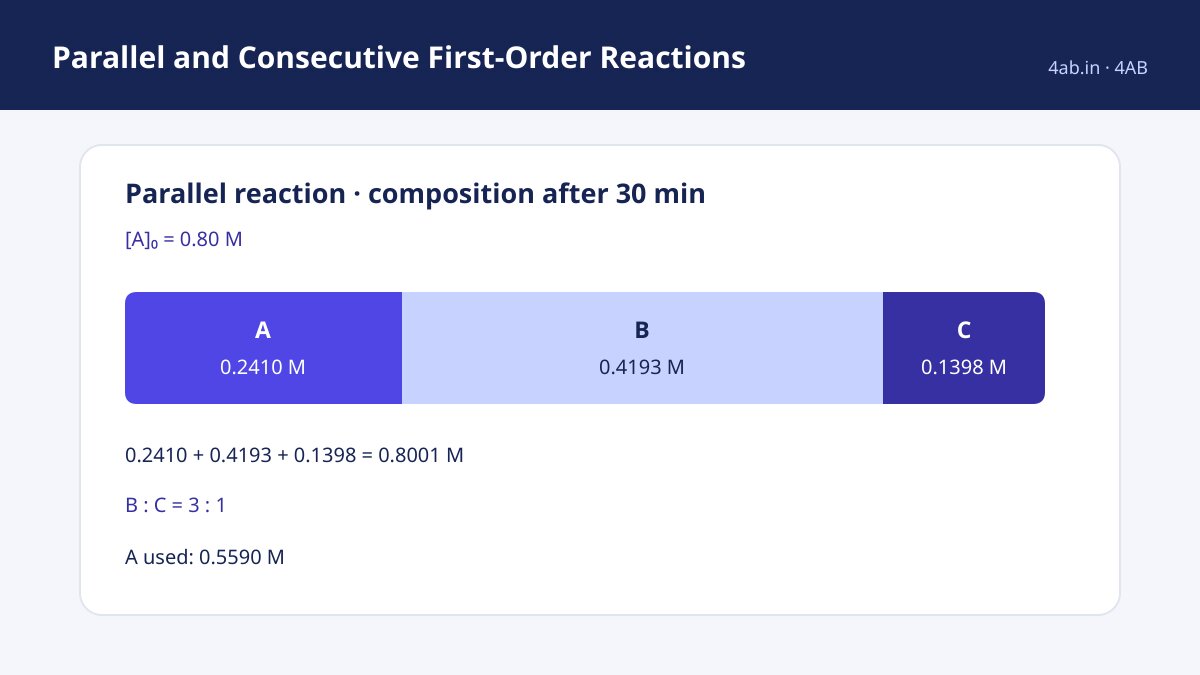
[A] at 30 min. ktotal t = 0.040 × 30 = 1.20. e−1.20 = 0.3012. [A] = 0.80 × 0.3012 = 0.2410 M.
A used. 0.80 − 0.2410 = 0.5590 M. It divides in the ratio 3 : 1.
[B] and [C]. [B] = 0.75 × 0.5590 = 0.4193 M. [C] = 0.25 × 0.5590 = 0.1398 M. Check: 0.2410 + 0.4193 + 0.1398 = 0.8001 M, equal to [A]0 within rounding.
Worked example 2: from product ratio to constants
Question. In a parallel reaction, the half-life of A is 17.33 min and the products B and C are always formed in the ratio 3 : 1. Find k1 and k2.
Total constant. ktotal = 0.6931 ÷ 17.33 = 0.0400 min−1.
Split. k1 ÷ k2 = 3, so k1 = 3k2 and 4k2 = 0.0400. Hence k2 = 0.0100 min−1 and k1 = 0.0300 min−1.
Time for 90 % of A to react. t = ln 10 ÷ 0.0400 = 2.3026 ÷ 0.0400 = 57.6 min.
Consecutive first-order reactions
Now A forms an intermediate B, which then forms C: A → B (k1), B → C (k2). Take [B]0 = [C]0 = 0.
[B] = [A]0 k1 ÷ (k2 − k1) × (e−k1t − e−k2t)
[C] = [A]0 − [A] − [B]
tmax = ln(k1/k2) ÷ (k1 − k2)
[B]max = [A]0 (k1/k2)−k2/(k1−k2)
The intermediate B rises, reaches a maximum at tmax, and then falls. At that moment its rate of formation equals its rate of removal, k1[A] = k2[B]. If k1 = k2 = k the formulas above have a zero denominator, and the limiting results are [B] = [A]0 k t e−kt, tmax = 1/k and [B]max = [A]0/e.
Worked example 3: the intermediate peak
Question. For A → B → C with k1 = 0.10 s−1 and k2 = 0.040 s−1, [A]0 = 1.00 M, find tmax, [B]max and the composition at that time.
tmax. k1/k2 = 2.5, ln 2.5 = 0.9163. k1 − k2 = 0.060. tmax = 0.9163 ÷ 0.060 = 15.27 s.
[A] at tmax. e−0.10×15.27 = e−1.527 = 0.2172 M.
[B]max. Exponent: −k2/(k1 − k2) = −0.040/0.060 = −0.6667. 2.5−0.6667 = 0.5429, so [B]max = 0.543 M.
Cross-check with the full expression. Using e−k2t = e−0.6109 = 0.5428 and the factor k1 ÷ (k1 − k2) = 1.6667 for k1 > k2, the value is 1.6667 × (0.5428 − 0.2172) = 0.5427 M, which matches.
[C]. 1.00 − 0.2172 − 0.5429 = 0.2400 M.
Worked example 4: B at a later time
Question. For the same system find [B] at 30 s.
Exponentials. e−0.10×30 = e−3 = 0.04979. e−0.040×30 = e−1.2 = 0.30119.
[B]. 1.6667 × (0.30119 − 0.04979) = 1.6667 × 0.25140 = 0.419 M.
B has fallen from its peak of 0.543 M because it is now being consumed faster than it forms.
Common mistakes
- Taking the half-life of a parallel reaction as 0.693/k1. The half-life of A uses the sum k1 + k2.
- Assuming the product ratio changes with time. For parallel first-order paths from the same reactant, [B]/[C] = k1/k2 at all times.
- Using the plain first-order formula for B in a consecutive reaction. B is both formed and removed, so its concentration follows the two-exponential expression.
- Confusing tmax with the half-life. The peak of the intermediate depends on both constants, through the log of their ratio.
- Applying the steady-state approximation blindly. It works only when the intermediate is much more reactive than the reactant (k2 ≫ k1), so that [B] stays small. In the example above k2 is smaller than k1, and B builds up to a large value.
Exam summary
| Type | Key result |
|---|---|
| Parallel, first order | ktotal = k1 + k2; [B]/[C] = k1/k2 |
| Parallel, product yield | Fraction to B = k1/(k1 + k2) |
| Consecutive, peak time | tmax = ln(k1/k2) ÷ (k1 − k2) |
| Consecutive, slow second step | B accumulates, then decays |
| Consecutive, slow first step | Overall rate is controlled by k1 |
Check the current official syllabus of your exam for the depth expected. Questions on reversible and opposing reactions are a separate topic.
The half-life tool converts between a first-order rate constant and its half-life. Use it to check t½ = 0.693 ÷ k, for example with k = k1 + k2 in a parallel reaction.
Open the Half-Life Calculator →Reaction mechanisms stick only with practice: attempt previous-year CSIR-NET questions and a timed quiz.
More Organic articles