Planck's Equation: Photon Energy from Frequency and Wavelength
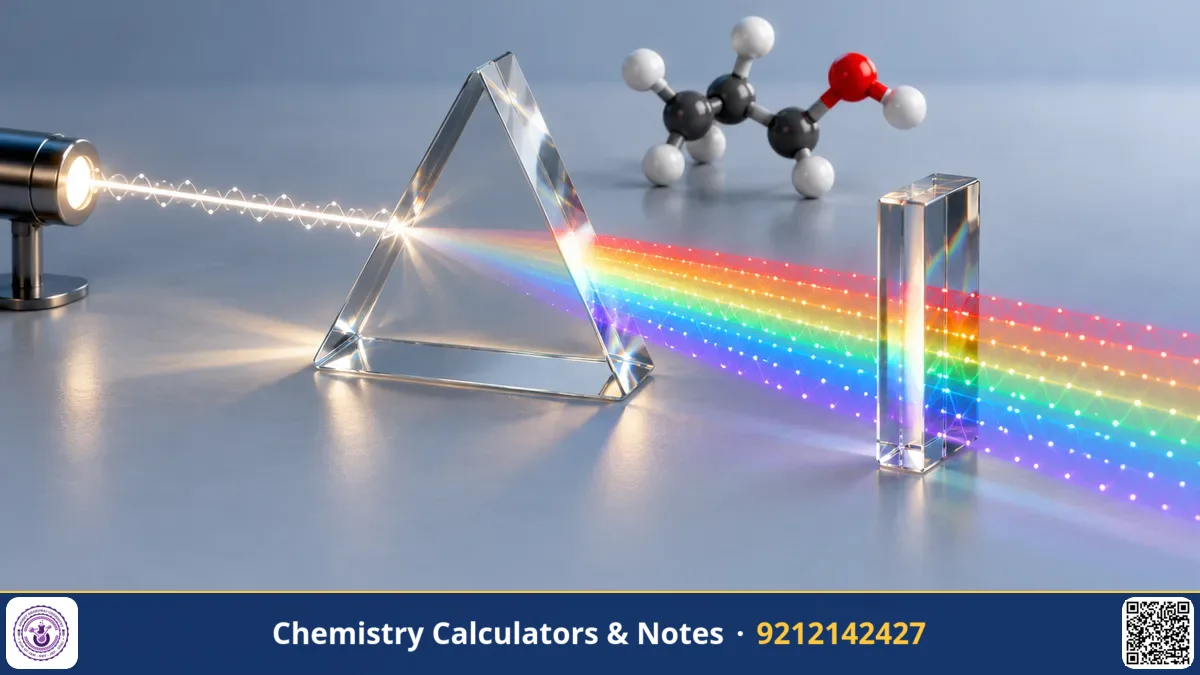
Light behaves like a wave, but it also delivers its energy in small packets called photons. Planck's equation tells you how much energy one photon carries. It is the first formula of the "structure of the atom" chapter in Class 11, and it feeds directly into the photoelectric effect, the Bohr model and atomic spectra. Most numericals on it need only two steps, yet students lose marks on units. This page shows every step with the arithmetic done fully.
The formulas
c = νλ
E = hc ÷ λ
E is the energy of one photon in joules (J). h is the Planck constant, exactly 6.62607015 × 10⁻³⁴ J s in the present SI system; textbooks usually round it to 6.626 × 10⁻³⁴ J s. ν (nu) is the frequency in hertz (Hz = s−1). c is the speed of light in vacuum, 2.998 × 10⁸ m s−1, often written as 3.00 × 10⁸ m s−1. λ (lambda) is the wavelength in metres.
The key idea is the inverse link: a short wavelength means a high frequency and a high energy. Blue or ultraviolet light has more energy per photon than red light, whatever the brightness. Brightness only changes how many photons arrive each second.
Units that must be converted first
Wavelengths are given in nanometres (nm), picometres (pm) or Ångströms (Å). Convert to metres before you use c = νλ.
| Unit | In metres |
|---|---|
| 1 nm | 10−9 m |
| 1 pm | 10−12 m |
| 1 Å | 10−10 m |
Energy can be asked per photon (J), per mole of photons (kJ mol−1) or in electronvolts (eV). To go from one photon to one mole, multiply by the Avogadro constant, NA = 6.022 × 10²³ mol−1. To go from joules to eV, divide by 1.602 × 10⁻¹⁹ J per eV.
Worked example 1: energy from frequency
Question. Find the energy of one photon of frequency 5.0 × 10¹⁴ Hz, and the energy of one mole of such photons.
One photon. E = hν = 6.626 × 10−34 × 5.0 × 1014 = 3.313 × 10⁻¹⁹ J.
One mole. E = 3.313 × 10−19 × 6.022 × 1023 = 1.995 × 10⁵ J mol−1 = 199.5 kJ mol−1.
Worked example 2: energy from wavelength
Question. Green light has a wavelength of 500 nm. Find its frequency, the energy of one photon, and the energy in kJ mol−1 and in eV.
Wavelength in metres. 500 nm = 500 × 10−9 m = 5.00 × 10⁻⁷ m.
Frequency. ν = c ÷ λ = 2.998 × 10⁸ ÷ 5.00 × 10−7 = 5.996 × 10¹⁴ Hz. (With c = 3.00 × 10⁸ you get exactly 6.00 × 10¹⁴ Hz. Use the value your textbook uses.)
One photon. E = hν = 6.626 × 10−34 × 5.996 × 1014 = 3.973 × 10⁻¹⁹ J.
Per mole. 3.973 × 10−19 × 6.022 × 1023 = 2.393 × 10⁵ J mol−1 = 239.3 kJ mol−1.
In eV. 3.973 × 10⁻¹⁹ ÷ 1.602 × 10−19 = 2.48 eV.
Worked example 3: number of photons per second
Question. A lamp gives out 1.0 W of light of wavelength 600 nm (all of the power in this one colour). How many photons leave it every second?
Idea. Power is energy per second, so 1.0 W = 1.0 J s−1. Divide the energy per second by the energy of one photon.
Energy of one photon. E = hc ÷ λ = (6.626 × 10−34 × 2.998 × 108) ÷ (6.00 × 10⁻⁷) = 3.311 × 10⁻¹⁹ J.
Photons per second. 1.0 ÷ 3.311 × 10−19 = 3.02 × 10¹⁸ photons per second.
The number is huge, which is why a beam of light looks smooth and not grainy to our eyes.
Worked example 4: wavelength from energy
Question. One photon has an energy of 3.31 × 10⁻¹⁹ J. Find its wavelength.
Rearrange. λ = hc ÷ E.
Calculation. λ = (6.626 × 10−34 × 2.998 × 108) ÷ (3.31 × 10⁻¹⁹) = 6.00 × 10⁻⁷ m = 600 nm.
This agrees with example 1 in spirit: a frequency of about 5 × 10¹⁴ Hz corresponds to about 600 nm, because 2.998 × 10⁸ ÷ 5.0 × 1014 = 6.0 × 10⁻⁷ m.
Worked example 5: ultraviolet against visible
Question. Compare the energy of one photon of 400 nm light with that of one photon of 600 nm light.
400 nm. E = (6.626 × 10−34 × 2.998 × 108) ÷ (4.00 × 10⁻⁷) = 4.966 × 10⁻¹⁹ J, which is 3.10 eV.
600 nm. E = 3.311 × 10⁻¹⁹ J (from example 3).
Ratio. 4.966 ÷ 3.311 = 1.50. This equals 600 ÷ 400, as it must, because E is inversely proportional to λ. A quick check like this catches many errors.
Common mistakes
- Using nanometres directly. If you put 500 in place of 5.00 × 10⁻⁷ m, the answer is wrong by a factor of 109.
- Mixing J per photon and kJ per mole. The first is about 10−19; the second is about 102. If your per-photon answer has a positive power of ten, something is wrong.
- Confusing brightness with energy. A brighter lamp of the same colour sends more photons, but each photon has the same energy.
- Writing frequency in the wrong place. Frequency goes in E = hν. Wavelength goes in E = hc ÷ λ. Do not put wavelength in hν.
- Forgetting NA. Energy of "1 mole of photons" needs the Avogadro constant; energy of "a photon" does not.
Exam relevance
| Chapter or topic | How this formula is used |
|---|---|
| Photoelectric effect | Photon energy is compared with the work function of a metal. |
| Bohr model and spectra | The energy gap between two levels equals the photon energy emitted or absorbed. |
| Photochemistry | Energy per mole of photons is compared with bond energies. |
| Numerical problems | Conversion between ν, λ, E (J), E (kJ mol−1) and E (eV). |
Check your own board or entrance syllabus for the exact constants and rounding your exam expects.
Check your answers with the photon and de Broglie tool.
Open the Photon and de Broglie Calculator →Free physics calculators for mechanics, optics, electricity and waves.
More Concepts articles