Radius Ratio Rule: Predicting Coordination Number and Crystal Structure of Ionic Solids
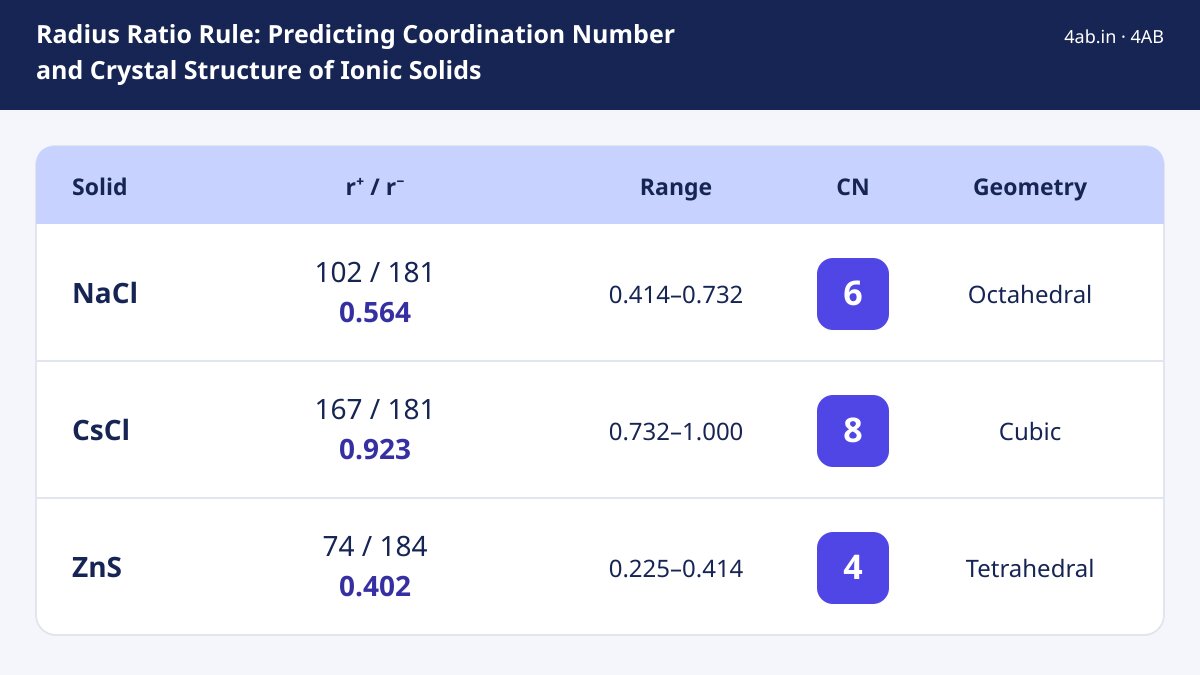
Why does NaCl have six chloride ions around each sodium, while CsCl has eight? The simplest answer in solid-state chemistry is the radius ratio rule. It treats ions as hard spheres and asks: how many anions can touch a cation without the anions touching each other too tightly? This is a standard topic for IIT-JAM, GATE and CSIR NET, and the geometry behind the limits is a favourite derivation.

The rule
A larger cation can fit more anions around it. Each limiting value corresponds to the point where the anions just touch one another while also touching the cation.
| r+/r− | Coordination number | Geometry | Example |
|---|---|---|---|
| 0.155 – 0.225 | 3 | Trigonal planar | B2O3 |
| 0.225 – 0.414 | 4 | Tetrahedral | ZnS (zinc blende) |
| 0.414 – 0.732 | 6 | Octahedral | NaCl |
| 0.732 – 1.000 | 8 | Cubic | CsCl |
Where the limits come from
Octahedral limit. Look at the square plane of four anions around a cation. Anions of radius R touch along the square’s side, and the cation of radius r touches them along the diagonal. Side = 2R, so diagonal = 2R√2 = 2R + 2r. Hence r/R = √2 − 1 = 0.414.
Cubic limit. Eight anions at the corners of a cube of edge 2R, with the cation in the centre. The body diagonal is 2R√3 = 2R + 2r, so r/R = √3 − 1 = 0.732.
Tetrahedral limit. Four anions on alternate corners of a cube. The anions touch along the face diagonal, so the cube edge is a = 2R/√2 = R√2. The body diagonal a√3 = R√6 equals 2R + 2r, so r/R = √6/2 − 1 = 0.225.
Worked examples
The radii below are commonly tabulated ionic radii (in pm); different books use different tables, so use the ones in your question.
Example 1: NaCl. r(Na+) = 102 pm, r(Cl−) = 181 pm.
Ratio = 102 / 181 = 0.564, which lies between 0.414 and 0.732. Predicted: coordination number 6, octahedral. This matches the rock-salt structure.
Example 2: CsCl and ZnS. CsCl: r(Cs+) = 167 pm, r(Cl−) = 181 pm → ratio = 167 / 181 = 0.923, in the range 0.732–1.0, so coordination number 8. ✓
ZnS: r(Zn2+) = 74 pm, r(S2−) = 184 pm → ratio = 74 / 184 = 0.402, in the range 0.225–0.414, so coordination number 4, tetrahedral. ✓
Example 3: checking the geometry with density. In NaCl, the cation and anion touch along the cube edge, so edge a = 2(r+ + r−) = 2(102 + 181) = 566 pm = 5.66 × 10⁻⁸ cm. The unit cell has Z = 4 formula units. Molar mass = 22.990 + 35.45 = 58.44 g mol−1.
Density = Z M / (NA a³) = 4 × 58.44 / (6.022 × 1023 × (5.66 × 10−8)³).
a³ = 1.813 × 10⁻²² cm³; denominator = 6.022 × 1023 × 1.813 × 10−22 = 109.2; density = 233.76 / 109.2 = 2.14 g cm−3.
Measured densities of rock salt are close to this value, which supports the hard-sphere picture for NaCl. Check your textbook for the experimental figure rather than relying on memory.
Example 4: what if the cation is too big? A cation with r+/r− = 0.30 is predicted tetrahedral (CN 4). If it were forced into octahedral coordination, the anions would not touch the cation properly (the cation “rattles”), which is unstable. At the other extreme, if the ratio drops below the limit, anion–anion repulsion pushes the structure to a lower coordination number.
Common mistakes
- Inverting the ratio (r−/r+). It is always smaller radius over larger, so the value is below 1.
- Mixing ionic radii from different tables. The ratio is only meaningful with radii from the same source.
- Treating the rule as a law. It fails for compounds with strongly covalent character (many sulphides and iodides), and for some real structures such as LiCl-type or CsCl at certain conditions, where polarisation matters.
- Forgetting that radii depend on coordination number; the radius of Cs+ in 8-fold coordination is larger than in 6-fold.
- Using the radius ratio to predict the number of formula units in a cell. That is a separate calculation based on the unit cell type.
Exam-relevance table
| Task | Quick method |
|---|---|
| Predict coordination number | Compute r+/r− and read from the table |
| Derive a limiting value | Use geometry of touching spheres (√2 − 1, √3 − 1, √6/2 − 1) |
| Cell edge in rock-salt type | a = 2(r+ + r−) |
| Cell edge in CsCl type | a√3 = 2(r+ + r−) |
Check the exact limits and any syllabus notes in the official material for your exam.
Use the molar mass calculator for the formula mass that goes into the density check.
Open the Molar Mass & Composition Calculator →Explore real crystal structures in the Crystal Lab, then test yourself on previous-year questions.
More Inorganic articles