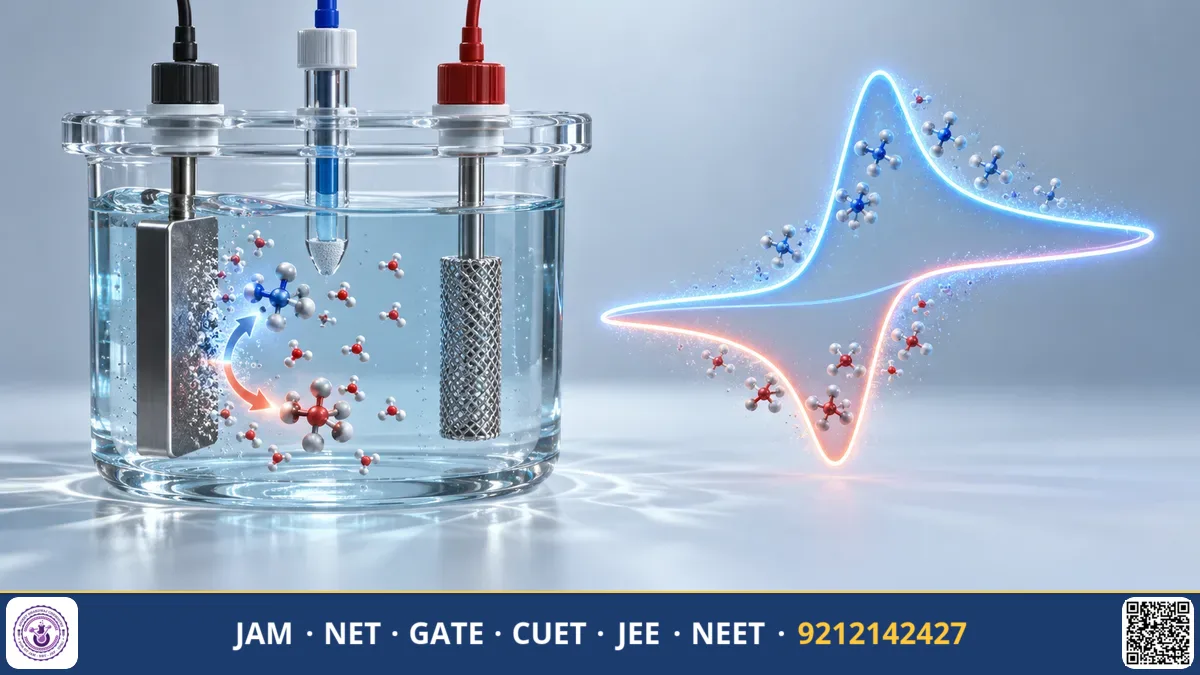
Randles-Sevcik Equation: Cyclic Voltammetry Peak Current
Cyclic voltammetry is a major electroanalytical technique tested in CSIR NET, GATE, and IIT JAM. The peak current of a diffusion-controlled reversible redox process is governed by the Randles-Sevcik equation. This guide provides the core theory, working formulas, step-by-step numerical examples, and key exam strategies.
Origin of the Voltammetric Peak Current
When a planar working electrode is placed in an unstirred solution of an electroactive species, applying a linear potential sweep drives oxidation or reduction. As the potential reaches the formal redox potential, rapid electron transfer begins. This consumes reactant molecules at the electrode surface, creating a concentration gradient that drives fresh analyte toward the surface by semi-infinite linear diffusion.
Increasing the overpotential accelerates the reaction rate, causing current to rise. However, as the diffusion layer extends into solution, mass transport cannot replenish reactant as fast as it is consumed. The surface concentration drops to zero, and the current reaches a maximum before decaying in a diffusion tail. This maximum is the peak current, denoted as cathodic peak current for reduction or anodic peak current for oxidation.
The Randles-Sevcik Equation and Variables
Solving Fick's second law of linear diffusion with the Nernst boundary condition gives the peak current for a reversible redox process at 298.15 K.
Working Equation at 298.15 K:
ip = (2.69 × 10⁵) × n3/2 × A × D1/2 × C × v1/2
Variables and Standard Units:
- ip = Peak current in Amperes (A)
- n = Number of electrons transferred in the redox step
- A = Working electrode area (cm2 in CGS, or m2 in SI)
- D = Diffusion coefficient (cm2 s-1 in CGS, or m2 s-1 in SI)
- C = Bulk concentration (mol cm-3 in CGS, or mol m-3 in SI; 1 mM = 10-6 mol cm-3)
- v = Potential scan rate in Volts per second (V s-1)
The equation establishes that peak current is proportional to bulk concentration C and to the square root of scan rate (v1/2). A linear plot of ip versus v1/2 passing through the origin is the standard diagnostic proof of a diffusion-controlled reversible process.
Exam details
- Source: practice problem written for this article (not a past-paper question)
- Relevant exams: CSIR NET Chemical Sciences, GATE Chemistry, IIT JAM Chemistry, CUET PG Chemistry
- Topic: Electrochemistry and Voltammetric Techniques
- Difficulty: Advanced
Worked Numerical Examples
Question: A planar electrode of area 0.0700 cm2 is immersed in a 1.00 mM solution of a reversible one-electron species (n = 1) at 298 K. The diffusion coefficient is 7.60 × 10⁻⁶ cm2 s-1. If cyclic voltammetry is recorded at 100 mV s-1, calculate the cathodic peak current in microamperes (μA).
Solution:
Step 1: Identify given quantities in CGS units: n = 1, A = 0.0700 cm2, D = 7.60 × 10⁻⁶ cm2 s-1, v = 0.100 V s-1, C = 1.00 mM = 1.00 × 10⁻⁶ mol cm-3.
Step 2: Calculate square root values: D1/2 = 2.7568 × 10⁻³ cm s-1/2; v1/2 = 0.31623 V1/2 s-1/2; n3/2 = 1.00.
Step 3: Primary route calculation: ip = (2.69 × 105) × 1.00 × 0.0700 × (2.7568 × 10-3) × (1.00 × 10-6) × 0.31623 = 1.6416 × 10⁻⁵ A = 16.42 μA.
Step 4: Secondary route verification in SI units: A = 7.00 × 10⁻⁶ m2, D1/2 = 2.7568 × 10⁻⁵ m s-1/2, C = 1.00 mol m-3, v1/2 = 0.31623 V1/2 s-1/2. ip = (2.69 × 105) × (7.00 × 10-6) × (2.7568 × 10-5) × 1.00 × 0.31623 = 1.6416 × 10⁻⁵ A = 16.42 μA. Both routes agree.
Answer: 16.42 μA
Question: For a reversible two-electron reduction (n = 2) at 298 K, an electrode of area 0.0500 cm2 is placed in a 2.00 mM solution of a complex. A plot of peak current ip against v1/2 gives a slope of 1.28 × 10⁻⁴ A s1/2 V-1/2. Calculate the diffusion coefficient D in cm2 s-1.
Solution:
Step 1: Relate slope to Randles-Sevcik parameters: Slope = ip / v1/2 = (2.69 × 10⁵) × n3/2 × A × C × D1/2.
Step 2: Primary calculation: n = 2 ⇒ n3/2 = 2.8284; A = 0.0500 cm2; C = 2.00 × 10⁻⁶ mol cm-3. Group factor K = (2.69 × 105) × 2.8284 × 0.0500 × (2.00 × 10-6) = 0.076084 A s1/2 V-1/2 cm-1. D1/2 = (1.28 × 10⁻⁴) / 0.076084 = 1.6824 × 10⁻³ cm s-1/2. D = (1.6824 × 10⁻³)2 = 2.830 × 10⁻⁶ cm2 s-1.
Step 3: Secondary route verification at v = 0.0400 V s-1: Here v1/2 = 0.200 V1/2 s-1/2 and ip = 2.56 × 10⁻⁵ A. D1/2 = (2.56 × 10⁻⁵) / [ 0.076084 × 0.200 ] = 1.6823 × 10⁻³ cm s-1/2, giving D = 2.83 × 10⁻⁶ cm2 s-1. Both routes match.
Answer: 2.83 × 10⁻⁶ cm2 s-1
Common Mistakes Students Make
- Unit mismatch in concentration: Inserting molarity directly without dividing by 1000 causes an error of 1000 times. In CGS, use mol cm-3 (1 mM = 10-6 mol cm-3).
- Assuming linear scan rate scaling: Peak current scales with v1/2, not linear v. Quadrupling scan rate doubles peak current; it does not quadruple it.
- Incorrect electron count exponent: The electron dependence is n3/2, not n or n2. For a 2-electron process, n3/2 = 2.828, whereas n = 2 and n2 = 4.
- Omitting scan rate unit conversion: When calculating current in Amperes, convert mV s-1 to V s-1 before taking the square root.
Exam Relevance and Format Breakdown
The table below summarizes how the Randles-Sevcik equation is tested across national chemistry examinations.
| Exam | Question Format | Key Concepts Tested | Preparation Strategy |
|---|---|---|---|
| CSIR NET | Multiple choice and numerical problems | Verification of reversibility, diffusion coefficients, n3/2 scaling | Practice finding D from linear slopes and evaluating multi-electron waves |
| GATE Chemistry | Numerical Answer Type (NAT) | Exact numerical calculation of peak currents and unit conversions | Align CGS and SI units and double-check square roots on numeric keypads |
| IIT JAM | Multiple choice and numerical questions | Proportionality with scan rate, concentration dependencies, redox peaks | Master ratio problems involving scan rate changes and square roots |
| CUET PG | Objective questions | Theoretical wave shapes, diagnostic criteria for reversibility | Focus on the direct dependencies of ip on n, A, C, D, and v |
Previous-year CSIR-NET questions and timed quizzes to check what you just read.
More Concepts articles