Rate Law from a Mechanism: Slow Step and Pre-Equilibrium
An experiment gives you a rate law. A proposed mechanism gives you a set of elementary steps. The central skill in mechanism problems is to go from the steps to the rate law, and then to check if it matches the experiment. This page gives the working rules and four numerical examples, as asked in IIT-JAM, GATE and CSIR-NET kinetics.

The rules
Overall rate = rate of the slowest (rate-determining) step
No intermediate may appear in the final rate law
An elementary step is a single molecular event, so its rate law can be written straight from the equation. The overall equation cannot be used this way: its coefficients need not equal the orders. A rate-determining step (RDS) is the slowest step; the steps after it do not affect the rate. An intermediate is formed in one step and used up in a later one. Intermediates are not measured easily, so the rate law must be written only with reactants (and sometimes a catalyst).
Case 1: the slow step comes first
If the first step is slow, its rate law is already the answer, because all reactants in it are real reactants. Later fast steps only consume the intermediate.
Case 2: the slow step comes after a fast equilibrium
If the slow step contains an intermediate, replace it using the fast pre-equilibrium. For a fast step A + B ⇌ I with equilibrium constant K = [I]/([A][B]), you write [I] = K[A][B], and put that into the slow-step rate law. The observed rate constant is then a combination, kobs = kslow × K.
Worked example 1: oxidation of nitric oxide
Overall: 2NO + O2 → 2NO2. Proposed mechanism:
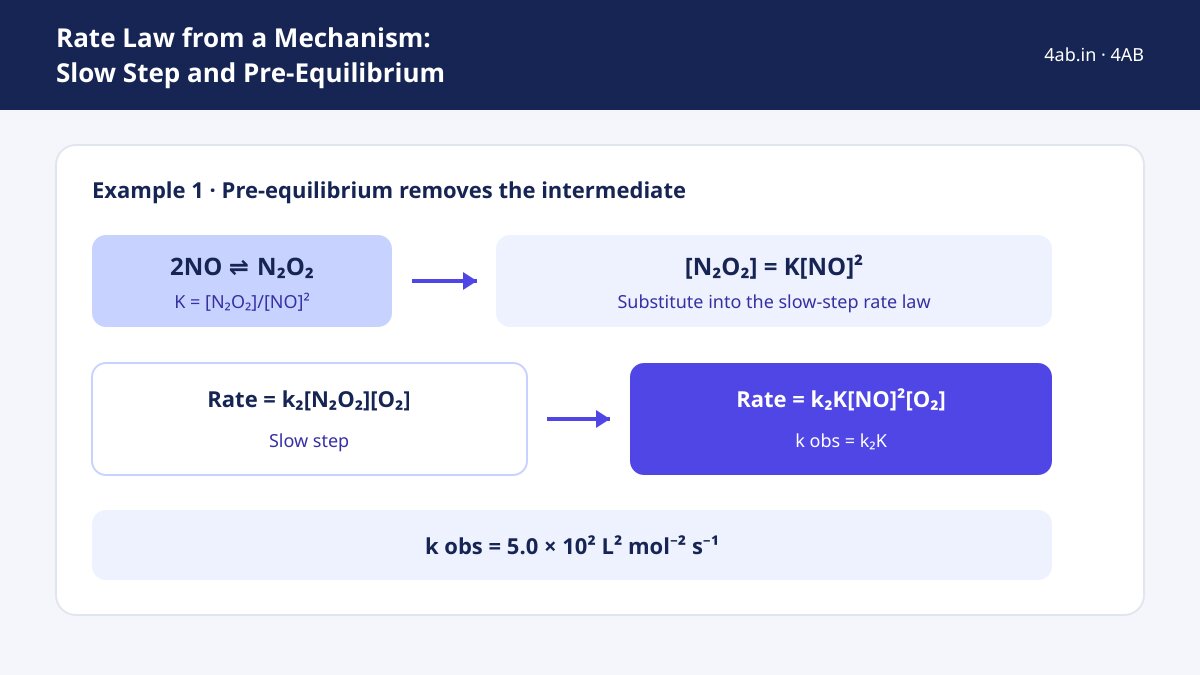
Step 1 (fast, equilibrium): 2NO ⇌ N2O2, K = [N2O2]/[NO]2.
Step 2 (slow): N2O2 + O2 → 2NO2, rate constant k2.
Step A. Rate = k2[N2O2][O2]. N2O2 is an intermediate, so it must go.
Step B. [N2O2] = K[NO]2. So rate = k2K[NO]2[O2] = kobs[NO]2[O2].
Orders. Second order in NO, first in O2, third order overall.
Numbers (invented for practice). Take k2 = 2.0 × 10³ L mol−1 s−1 and K = 0.25 L mol−1. Then kobs = 2.0 × 103 × 0.25 = 5.0 × 10² L2 mol−2 s−1. At [NO] = 0.010 M and [O2] = 0.020 M: rate = 500 × (0.010)2 × 0.020 = 500 × 1.0 × 10−4 × 0.020 = 1.0 × 10⁻³ M/s. The intermediate concentration is K[NO]2 = 0.25 × 1.0 × 10−4 = 2.5 × 10⁻⁵ M, small as an intermediate should be.
Effect of changing concentrations. Doubling [NO] multiplies the rate by 22 = 4. Halving [O2] multiplies it by 0.5. Together: 4 × 0.5 = 2.0 times the original rate.
Worked example 2: slow first step
Overall: NO2 + CO → NO + CO2. Proposed mechanism:
Step 1 (slow): 2NO2 → NO3 + NO.
Step 2 (fast): NO3 + CO → NO2 + CO2.
Check the sum. Add the steps: 2NO2 + NO3 + CO → NO3 + NO + NO2 + CO2. Cancel NO3 and one NO2: NO2 + CO → NO + CO2. It matches the overall reaction.
Rate law. The slow step is first, so rate = k1[NO2]2. CO does not appear: zero order in CO.
Numbers. Tripling [NO2] multiplies the rate by 32 = 9. Doubling [CO] changes the rate by 20 = 1, no change. Here the order in NO2 (2) is not the coefficient of NO2 in the overall equation (1), and CO has coefficient 1 but order 0. So never read orders from the overall equation.
Worked example 3: testing a mechanism against data
Reaction: 2ICl + H2 → I2 + 2HCl. Experiment shows rate = k[ICl][H2].
Proposed mechanism: Step 1 (slow): ICl + H2 → HI + HCl. Step 2 (fast): HI + ICl → I2 + HCl.
Sum: 2ICl + H2 + HI → HI + I2 + 2HCl, which after cancelling HI gives the overall equation. ✓
Rate law from RDS: k1[ICl][H2]. This is first order in each, the same as the experiment. So the mechanism is consistent with the data. Remember that agreement does not prove the mechanism; other mechanisms could give the same rate law. Disagreement, however, can reject a mechanism.
Worked example 4: apparent activation energy
For example 1, kobs = k2K. Taking the temperature dependence, Ea,obs = Ea,2 + ΔH°1, because the Arrhenius form of k2 and the van’t Hoff form of K combine.
Invented numbers. Take Ea,2 = +10 kJ/mol and ΔH°1 = −60 kJ/mol (the pre-equilibrium is exothermic). Then Ea,obs = 10 + (−60) = −50 kJ/mol. A negative apparent activation energy means the overall rate falls as temperature rises, because the intermediate becomes less favoured at higher T. This is not an error; it is a typical sign of a pre-equilibrium step.
Common mistakes
- Reading orders from the overall equation. Orders come from the slow step (after removing intermediates), or from experiment.
- Leaving an intermediate in the rate law. Replace it using the fast equilibrium.
- Forgetting the equilibrium constant. The observed k is kslow × K, not kslow alone.
- Not checking that the steps add up. A valid mechanism must sum to the overall equation.
- Taking “fits the data” as proof. A mechanism can be rejected but not proved by a rate law.
Exam relevance
| Situation | Rate law |
|---|---|
| Slow step is first, only reactants in it | Rate of that step |
| Slow step contains an intermediate formed by a fast equilibrium | Substitute [I] = K × (reactant concentrations) |
| Fast first step is not at equilibrium | Use the steady-state approximation instead |
| Check a proposed mechanism | Steps must add to the overall equation and the derived rate law must match experiment |
Check the official syllabus of your exam for the exact scope. The numbers in this page were chosen for practice and are not measured data.
This topic has no dedicated tool in the suite, but the Scientific Calculator is useful for checking the products and powers in these numericals.
Open the Chemistry Calculator Suite →Reaction mechanisms stick only with practice: attempt previous-year CSIR-NET questions and a timed quiz.
More Organic articles