Second-Order Reactions: Integrated Rate Law and Half-Life
First-order reactions are easy because the half-life never changes. Second-order reactions are different: the half-life grows as the reaction goes on. This one idea is behind many GATE, CSIR-NET and IIT-JAM kinetics questions. If you know the integrated rate law and the straight-line plot, most of these problems take less than two minutes.

The formulas
1/[A] = 1/[A]₀ + kt
t½ = 1 / (k [A]₀)
Plot 1/[A] against t: straight line, slope = k, intercept = 1/[A]₀
Time for fraction f remaining: t = (1/k)(1/(f[A]₀) − 1/[A]₀) = (1/(k[A]₀))(1/f − 1)
Meaning of the terms
- [A]₀ and [A] – concentration of A at the start and at time t, in mol L⁻¹.
- k – the second-order rate constant. Its unit is L mol⁻¹ s⁻¹ (concentration⁻¹ time⁻¹).
- t½ – time for [A] to fall to half. It depends on [A]₀, unlike first order.
- Convention warning: for 2A → products, some books define the rate as −d[A]/dt = k[A]², others as −½ d[A]/dt = k[A]². In the second case the integrated law becomes 1/[A] = 1/[A]₀ + 2kt. Always read how the question defines k.
Worked examples
Example 1: concentration after time t. For a second-order reaction k = 0.025 L mol⁻¹ s⁻¹ and [A]₀ = 0.40 mol L⁻¹. Find t½ and [A] after 300 s.
t½ = 1/(k[A]₀) = 1/(0.025 × 0.40) = 1/0.010 = 100 s.
1/[A] = 1/0.40 + 0.025 × 300 = 2.5 + 7.5 = 10.0 L mol⁻¹.
[A] = 0.100 mol L⁻¹.
Check with other times: at 100 s, 1/[A] = 2.5 + 2.5 = 5.0, so [A] = 0.200 M (half of 0.40, as t½ says). At 200 s, 1/[A] = 7.5, so [A] = 0.133 M. The second half-life (0.20 → 0.10 M) takes 200 s, not 100 s, so the answer at 300 s is 0.100 M. Never count half-lives as if t½ were fixed.
Example 2: finding k from data. [A] falls from 0.50 mol L⁻¹ to 0.125 mol L⁻¹ in 200 s. Assuming second order, find k.
1/[A] = 1/0.125 = 8.0 and 1/[A]₀ = 1/0.50 = 2.0.
k = (8.0 − 2.0)/200 = 6.0/200 = 0.030 L mol⁻¹ s⁻¹.
Cross-check with a second point: at 100 s, 1/[A] = 2.0 + 0.030 × 100 = 5.0, so [A] = 0.200 M. This is a prediction you can test against a data table.
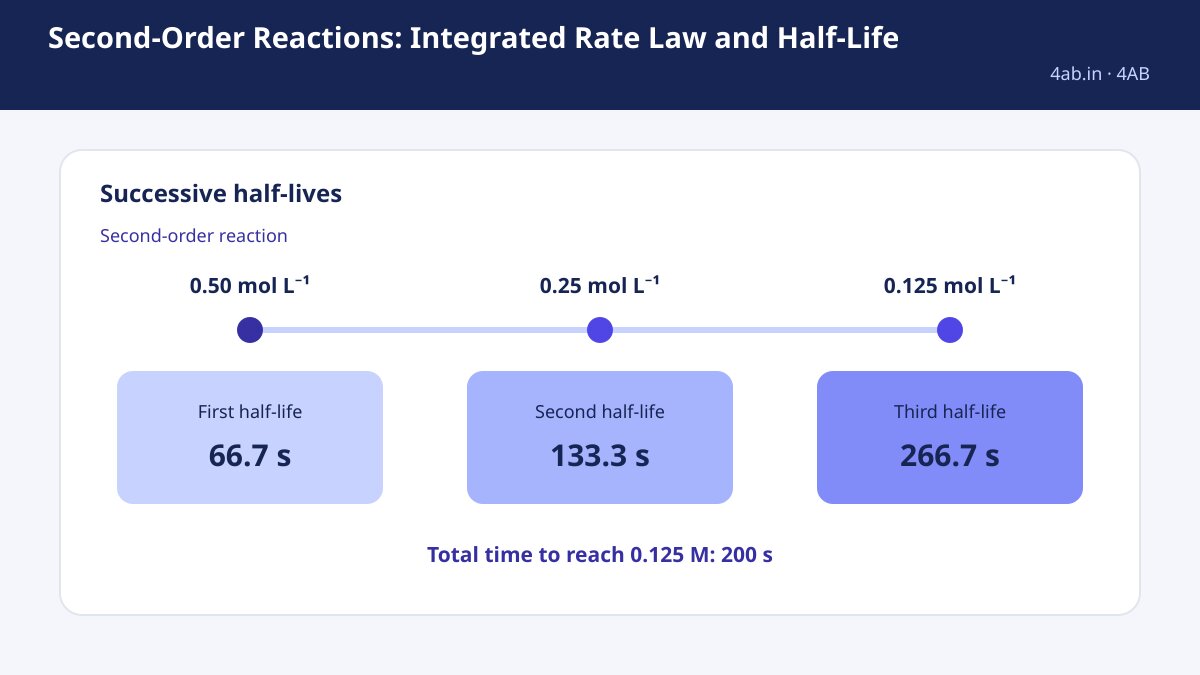
Example 3: successive half-lives. Using k = 0.030 and [A]₀ = 0.50: first t½ = 1/(0.030 × 0.50) = 66.7 s. When [A] = 0.25, t½ = 1/(0.030 × 0.25) = 133.3 s. When [A] = 0.125, t½ = 266.7 s. Each half-life is twice the one before it.
Total time to reach 0.125 M = 66.7 + 133.3 = 200 s. This agrees with Example 2.
Example 4: 90 % completion. Same reaction (k = 0.030, [A]₀ = 0.50). Find the time for 90 % conversion.
f = 0.10, so t = (1/(k[A]₀))(1/f − 1) = 66.67 × (10 − 1) = 66.67 × 9 = 600 s.
Compare a first-order reaction with the same 66.7 s first half-life: k₁ = 0.693/66.7 = 0.01040 s⁻¹ and t(90 %) = 2.303/0.01040 = 221.5 s, because its half-life stays constant. Second-order reactions have a long tail: the last 10 % takes much longer.
First order vs second order
| Property | First order | Second order (one reactant) |
|---|---|---|
| Linear plot | ln[A] vs t | 1/[A] vs t |
| Slope | −k | +k |
| Half-life | 0.693/k (constant) | 1/(k[A]₀) (grows) |
| k unit | s⁻¹ | L mol⁻¹ s⁻¹ |
| Effect of doubling [A]₀ on t½ | None | Halves it |
Typical mistakes
- Using 0.693/k for a second-order half-life. That formula is for first order only.
- Plotting ln[A] vs t and expecting a line for a second-order reaction.
- Forgetting the factor 2 when the rate is defined as −½ d[A]/dt for 2A → products.
- Wrong units for k, or mixing minutes and seconds in t and k.
- Treating t½ as fixed and counting half-lives (see Example 1).
- Assuming order from the stoichiometry. Order comes from experiment, not from the balanced equation.
Exam relevance
| Exam | Typical use |
|---|---|
| IIT-JAM / CUET-PG | Integrated rate law, half-life, order from a straight-line plot. Check the official syllabus for scope. |
| GATE / CSIR-NET | Second-order kinetics combined with Arrhenius or with comparing orders. Read the current notification for the syllabus. |
The half-life tool below is built for the first-order case. Use it as the comparison in Example 4: it shows how a constant half-life differs from the growing half-life of a second-order reaction.
Compare with first-order behaviour using the half-life tool.
Open the Half-Life Calculator →Reaction mechanisms stick only with practice: attempt previous-year CSIR-NET questions and a timed quiz.
More Organic articles