Time Management Inside the Chemistry Exam Hall
Many students know the chapters but still lose marks in the exam hall because the time ran out. They spend 20 minutes on one difficult numerical and then write the last 5-mark answer in two lines. Good time management is not talent. It is a small piece of arithmetic done before the exam, and a few simple habits during it. This page shows how to make a time budget for a chemistry paper, with the calculations done step by step.

The basic formula
Time for a question = Marks of the question × Minutes per mark
What each part means
- Total time – the full duration printed on your question paper, in minutes (for 3 hours, that is 180).
- Reading time – a few minutes at the start to read the whole paper and mark the questions you will do first. If your board gives a separate reading time, use that instead of taking it from the writing time.
- Final-check time – minutes kept at the end for checking units, signs, question numbers and missed parts.
- Total marks – the maximum marks of the paper.
The numbers in the examples below belong to an imaginary paper, chosen to make the arithmetic easy. Your own paper may have a different time, marks and pattern. Always read the latest pattern given by your school or board.
Worked examples
Example 1: a 3-hour, 70-mark paper. Keep 10 minutes for reading and 15 minutes for the final check.
Total time = 3 × 60 = 180 minutes.
Writing time = 180 − 10 − 15 = 155 minutes.
Minutes per mark = 155 ÷ 70 = 2.21.
So a 1-mark question gets about 2.2 minutes, a 2-mark question 4.4 minutes, a 3-mark question 6.6 minutes and a 5-mark question 11.1 minutes.
Check: 70 × 2.2143 = 155.0 minutes. The budget adds up exactly.
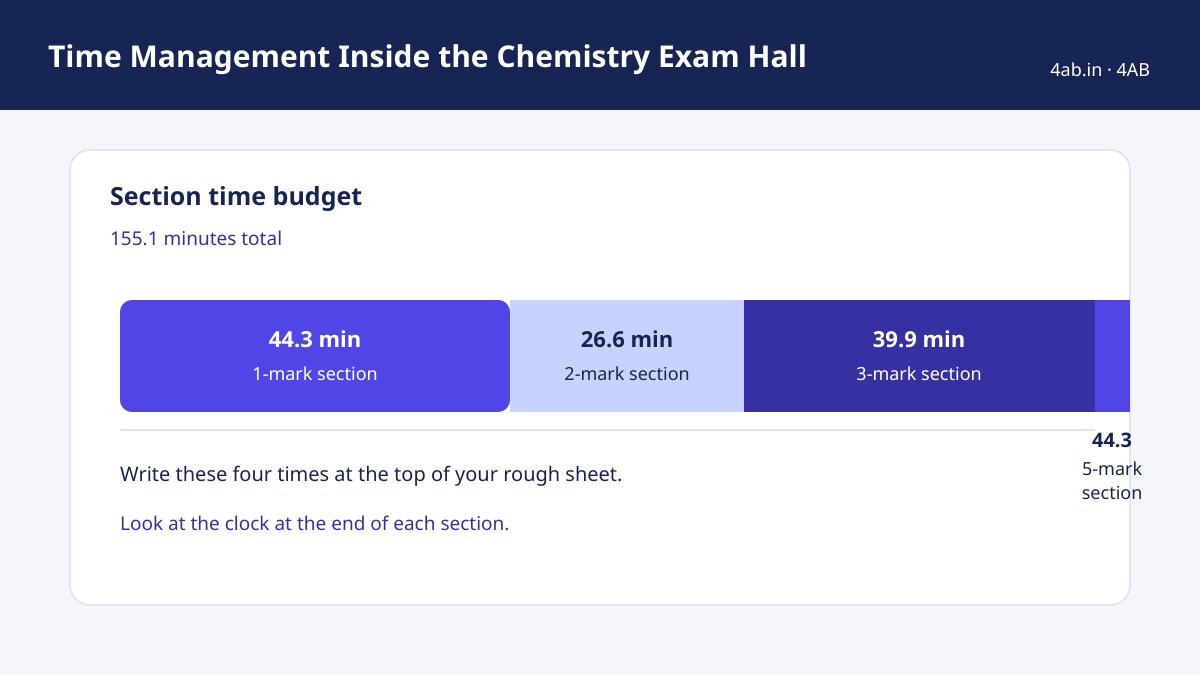
Example 2: budget by section. Suppose the imaginary paper has 20 one-mark questions, 6 two-mark questions, 6 three-mark questions and 4 five-mark questions. Check the marks first: 20 + 12 + 18 + 20 = 70. Good.
Time for each section at 2.2143 minutes per mark:
1-mark section: 20 marks × 2.2143 = 44.3 minutes
2-mark section: 12 marks × 2.2143 = 26.6 minutes
3-mark section: 18 marks × 2.2143 = 39.9 minutes
5-mark section: 20 marks × 2.2143 = 44.3 minutes
Total = 44.3 + 26.6 + 39.9 + 44.3 = 155.1 minutes (the extra 0.1 is only rounding). Write these four numbers at the top of your rough sheet and look at the clock at the end of each section.
Example 3: a shorter 2-hour, 50-mark test. Keep 5 minutes for reading and 10 minutes for the check.
Total = 2 × 60 = 120 minutes. Writing time = 120 − 5 − 10 = 105 minutes.
Minutes per mark = 105 ÷ 50 = 2.1.
A 5-mark question: 5 × 2.1 = 10.5 minutes. A 3-mark question: 6.3 minutes. A 2-mark question: 4.2 minutes. A 1-mark question: 2.1 minutes.
Notice that the minutes per mark are almost the same as in Example 1. For most papers this number stays close to 2, which is an easy figure to remember.
Example 4: the “stuck” rule. You are on a 5-mark numerical in Example 1. Its budget is 11.1 minutes. Set a hard limit of 1.5 times the budget.
Hard limit = 1.5 × 11.07 = 16.6 minutes.
If you reach about 16 minutes and the answer is still not there, write the formula, the substitution and whatever steps are correct, draw a box in the margin, and move on. Many examiners give marks for the correct method and steps even if the final number is wrong. Come back in the check time if minutes remain.
Habits that save minutes
- Do the sure questions first. Secure the marks you are certain about, then use the remaining time on the harder ones.
- Write the data first. In a numerical, write “Given” and “To find”, then the formula. It stops silly mistakes and earns step marks.
- Keep units with numbers. Converting units later, after a mistake, costs far more time than writing them at the start.
- Match the answer length to the marks. A 2-mark theory answer needs two clear points, not a full page.
- Do not erase large pieces. Cross out neatly with one line and keep going.
- Practise with a clock. Do at least a few full papers at home with the exact time. The budget only helps if you have tried it before the real exam.
Common mistakes
- Spending equal time on every question. A 1-mark question should not take five minutes.
- Skipping the final check completely. Even five minutes can catch a missing unit, a wrong sign or an unattempted part.
- Starting with the hardest question because it comes first in the paper. Question order is not a rule you must follow, unless your instructions say so.
- Checking the clock too often. Look at it only at the end of each section, as planned in Example 2.
- Making the budget on the exam day. Make it during practice, so it is automatic.
Practice plan
| Step | What to do |
|---|---|
| 1 | Take a past or sample paper from your school or board. Calculate minutes per mark. |
| 2 | Write section times on the first page of your answer sheet or rough sheet. |
| 3 | Solve the full paper in one sitting, with a timer. |
| 4 | Note where you ran over time. Is it numericals, long answers or MCQs? Practise that type more. |
| 5 | Repeat with a new paper and compare the finishing time. |
Slow calculation is a big time-eater in numericals. Keep the full calculator suite handy while you practise, so you can check answers after you solve them yourself.
Open the Chemistry Calculator Suite →Previous-year CSIR-NET questions and timed quizzes to check what you just read.
More Exam guides articles