Trans Effect: Predicting Substitution in Pt(II) Complexes
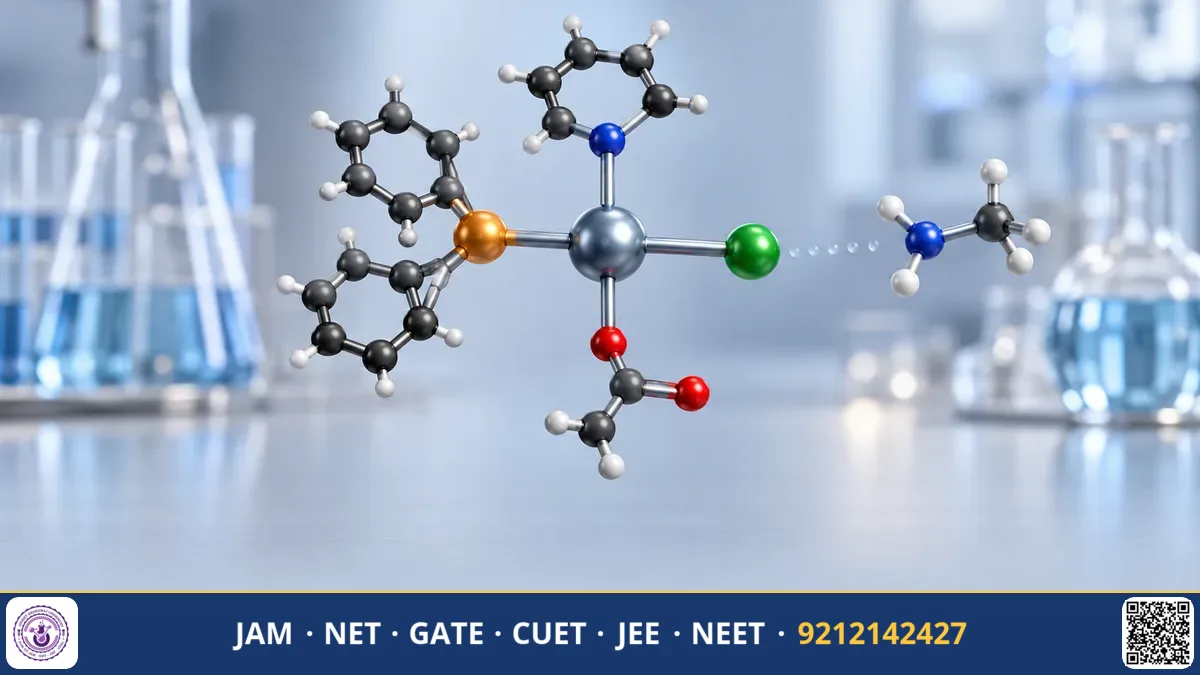
In coordination chemistry, square planar complexes of low-spin d8 metal ions, particularly platinum(II), palladium(II), and rhodium(I), undergo ligand substitution through an associative pathway. When predicting the isomeric outcome of these substitution reactions, the nature of the spectator ligand situated directly opposite (trans) to the leaving group plays a decisive role. This phenomenon is known as the trans effect. Understanding the trans effect is essential for solving synthetic design and reaction mechanism problems in examinations like CSIR-NET, GATE, and IIT-JAM.
Definition: Trans Effect versus Trans Influence
In competitive examinations, candidates must distinguish clearly between the kinetic trans effect and the thermodynamic trans influence:
- Trans Effect (Kinetic Phenomenon): The effect of a coordinated ligand on the rate of substitution of the ligand situated trans to it. It reflects the lowering of activation energy (ΔG‡) during the formation of the five-coordinate trigonal bipyramidal transition state.
- Trans Influence (Thermodynamic Ground-State Phenomenon): The extent to which a ligand weakens and lengthens the metal-ligand bond situated trans to itself in the ground state of the complex. It is directly observed through X-ray crystallographic bond lengths and infrared metal-ligand stretching frequencies ν(M-L).
The Classical Trans Effect Spectrochemical Series:
H− ≈ CH3− ≈ CO ≈ CN− ≈ C2H4 > PR3 ≈ AsR3 > SO3(2−) > NO2− > I− > SCN− > Br− > Cl− > Pyridine > NH3 > OH− > H2O
Key Trend: Strong π-acceptor ligands and strong σ-donors occupy the top of the series, whereas weak σ-donors with no π-bonding capacity reside at the bottom.
Dual Origins of the Trans Effect: σ-Contribution and π-Contribution
The overall kinetic trans effect arises from two distinct electronic mechanisms operating during associative substitution:
1. The Ground-State σ-Donation Effect (Trans Influence)
Square planar platinum(II) uses the metal dx2-y2, px, and py orbitals for σ-bonding. Consider a trans triad L-Pt-X along the x-axis. Both ligand L and leaving group X must share the same metal px and dx2-y2 orbitals. If ligand L is a powerful σ-donor, it donates significant electron density into the shared metal px orbital, polarizing the metal centre and diminishing the covalent overlap available for the leaving group X. As a result, the Pt-X ground-state bond is weakened and lengthened, raising its ground-state energy and facilitating bond cleavage.
2. The Transition-State π-Acceptor Effect
Square planar substitution proceeds via an associative mechanism (A or Ia) involving a five-coordinate 18-electron trigonal bipyramidal (TBP) transition state. In this trigonal bipyramid, the entering ligand (Y), leaving group (X), and the trans-directing ligand (L) occupy the equatorial plane. Ligand L can stabilize the accumulated electron density in this transition state by accepting metal dπ electron density into its empty π* or d orbitals. Strong π-acceptors (such as CO, C2H4, and CN−) drastically lower the energy of the transition state, leading to an enormous acceleration in the substitution rate.
Synthesis Problem 1: Directed Synthesis of Cisplatin and Transplatin
Problem Analysis: How can one selectively synthesize cis-[PtCl2(NH3)2] (Cisplatin) and trans-[PtCl2(NH3)2] (Transplatin) starting from tetrachloroplatinate(II) and tetraammineplatinum(II) respectively?
Pathway A (Synthesis of Cisplatin):
- Starting material: [PtCl4]2−.
- Step 1: Reaction with 1 equivalent of NH3 yields [PtCl3(NH3)]−. All four chloride positions in [PtCl4]2− are identical.
- Step 2: Introduction of the second NH3 molecule. In [PtCl3(NH3)]−, the ligands present are three chlorides and one ammine. From the trans effect series, chloride has a stronger trans effect than ammine: Cl− > NH3.
- The chloride ligand trans to another chloride directs substitution to that trans position faster than the chloride trans to ammine. Therefore, substitution occurs trans to a Cl− ligand, which means the incoming NH3 replaces a Cl situated trans to Cl (and hence cis to NH3).
- Outcome: Pure cis-[PtCl2(NH3)2] (Cisplatin) is formed.
Pathway B (Synthesis of Transplatin):
- Starting material: [Pt(NH3)4]2+.
- Step 1: Reaction with 1 equivalent of Cl− yields [PtCl(NH3)3]+. All four ammine positions are initially equivalent.
- Step 2: Introduction of the second Cl− ion. In [PtCl(NH3)3]+, we compare the trans-directing ability of Cl− versus NH3. Because Cl− > NH3, the chloride ligand directs the incoming nucleophile to the position trans to itself.
- The second chloride ion therefore attacks trans to the existing chloride.
- Outcome: Pure trans-[PtCl2(NH3)2] (Transplatin) is produced.
Synthesis Problem 2: Sequential Synthesis of Three Isomers of [PtClBrI(py)]−
Problem Analysis: Deduce the order of synthetic steps required to prepare the specific geometric isomer of [PtClBrI(py)]− having pyridine trans to iodide, starting from [PtCl4]2−.
Reaction Sequence:
- Relative trans-directing power: I− > Br− > Cl− > py.
- Step 1: Treat [PtCl4]2− with 1 equivalent of I−. Because all four Cl− ligands are equivalent, monosubstitution produces [PtCl3(I)]2−.
- Step 2: We need pyridine trans to iodide in the target product. Because I− has the highest trans effect among all ligands present (I− > Cl−), the next ligand added will be directed exclusively to the position trans to I−.
- Therefore, add pyridine in the second step: [PtCl3(I)]2− + py → trans-[PtCl2(I)(py)]− + Cl−. The pyridine ligand is now positioned trans to iodide.
- Step 3: Finally, treat trans-[PtCl2(I)(py)]− with bromide (Br−). In this complex, the remaining two chloride ligands are mutually trans to each other. Because Cl− directs substitution faster than py, one of the two equivalent chlorides is substituted by Br−.
- Result: The desired isomer with pyridine trans to iodide and chloride trans to bromide is obtained selectively.
Common Mistakes to Avoid:
- Confusing the trans effect series with the spectrochemical series: In the ligand field spectrochemical series based on Δo, ligands are ordered by crystal field splitting energy (CN− > NO2− > en > NH3 > H2O > Cl− > Br− > I−). In contrast, in the trans effect series, heavy halides exhibit greater trans labilization than lighter halides (I− > Br− > Cl− > F−), and H− and CH3− are near the top.
- Assuming trans influence equals trans effect: A ligand with a high ground-state trans influence does not automatically have the highest trans effect. For example, strong π-acceptors like C2H4 and CO have moderate trans influence on ground-state bond length but have the highest kinetic trans effect due to massive transition-state stabilization.
- Forgetting the associative mechanism: Substitution in square planar complexes does not proceed via a dissociative three-coordinate intermediate. Always remember that both entering and leaving groups participate in the trigonal plane of a five-coordinate transition state.
Exam Relevance and Analytical Summary
| Target Examination | Typical Question Focus | Core Concepts Tested |
|---|---|---|
| CSIR-NET Chemical Sciences | Multi-step synthesis of square planar complexes and isomeric ratio prediction | Distinction between σ-donation and π-backbonding components; rate constants |
| GATE Chemistry | Spectroscopic verification of trans influence and reaction pathways | IR ν(Pt-Cl) stretching frequencies, Pt-P coupling constants, and substitution kinetics |
| IIT-JAM Chemistry | Targeted synthesis of Cisplatin vs Transplatin and ranking ligands by trans effect | Standard trans effect series, associative reaction mechanisms, stereochemical retention |
| CUET-PG Chemistry | Direct conceptual identification of trans-directing ability | Ordering halides and common neutral ligands in square planar platinum substitutions |
Trends and exceptions are asked every year: practise previous-year CSIR-NET questions and quizzes.
More Inorganic articles