Valency and Writing Chemical Formulas: The Criss-Cross Method
From Class 9 onwards, every chemistry paper asks you to write the formula of a compound. If the formula is wrong, the equation, the molar mass and the whole numerical that follows are wrong too. The good news is that formula writing follows a short method, called the criss-cross method, that works for most compounds you meet in school. This page shows the method step by step, then connects it to molar mass so you can check your formula by calculation.

Valency and charge
The valency of an element is the number of electrons its atom gives, takes or shares to form a compound. For ions we use the charge directly: Na+ has valency 1, Ca2+ has valency 2, Al3+ has valency 3, Cl− has valency 1, O2− has valency 2. A group of atoms that carries a charge together is called a polyatomic ion, for example SO42−, OH−, NO3−, PO43− and NH4+.
| Positive ion | Valency | Negative ion | Valency |
|---|---|---|---|
| Na+, K+, NH4+ | 1 | Cl−, OH−, NO3− | 1 |
| Mg2+, Ca2+, Zn2+ | 2 | O2−, SO42−, CO32− | 2 |
| Al3+ | 3 | PO43− | 3 |
Some metals show more than one valency, such as iron (Fe2+ and Fe3+) and copper (Cu+ and Cu2+). For these, the name carries the valency in Roman numerals, for example iron(III) oxide. Your textbook list of valencies is the reference for your board.
The criss-cross method
Step 2: write the valency (without sign) above each symbol.
Step 3: cross the numbers: the valency of the first becomes the subscript of the second, and the other way round.
Step 4: divide both subscripts by their common factor, and drop any subscript 1.
Step 5: put brackets around a polyatomic ion if its subscript is more than 1.
The idea behind the crossing is charge balance. The total positive charge must equal the total negative charge, so the compound is electrically neutral. Step 4 is the step students forget most often, and it is explained in the mistakes section below.
Worked example 1: aluminium oxide
Question. Write the formula of aluminium oxide.
Ions. Al3+ and O2−. Valencies: 3 and 2.
Criss-cross. The 3 of aluminium goes to oxygen and the 2 of oxygen goes to aluminium. This gives Al2O3.
Charge check. Positive charge = 2 × (+3) = +6. Negative charge = 3 × (−2) = −6. The total is zero.
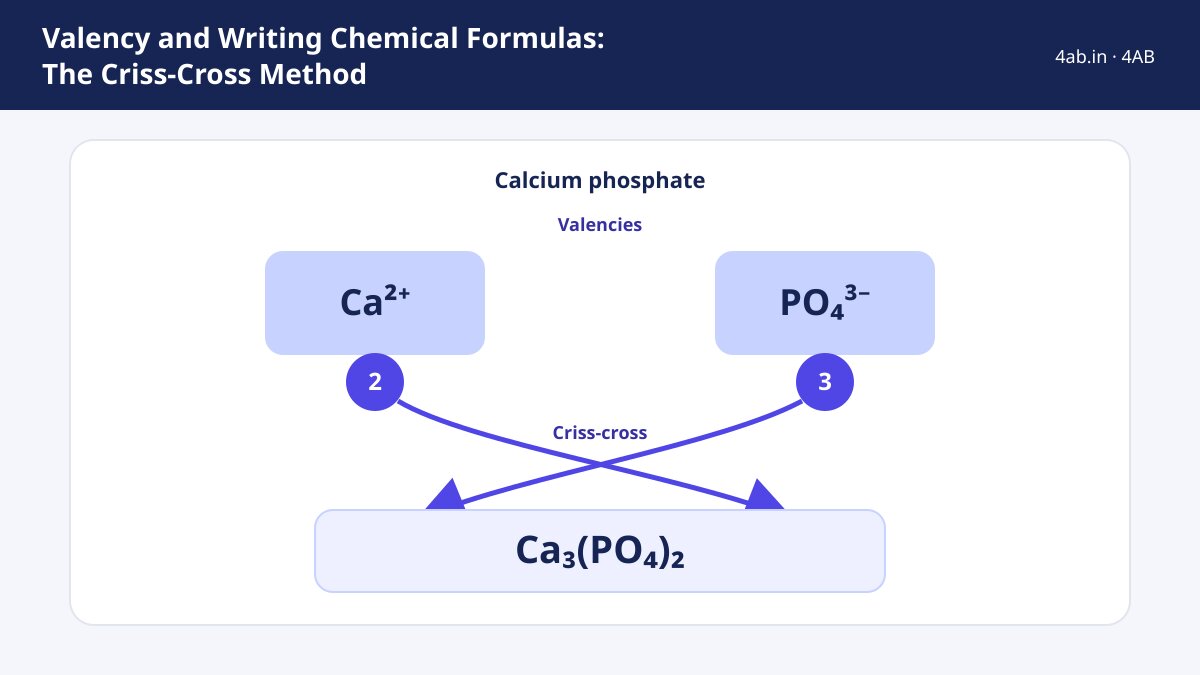
Worked example 2: calcium phosphate, with brackets
Question. Write the formula of calcium phosphate.
Ions. Ca2+ and PO43−. Valencies: 2 and 3.
Criss-cross. Calcium gets subscript 3 and phosphate gets subscript 2. Because PO4 is a group and its subscript is more than 1, it needs brackets: Ca3(PO4)2.
Charge check. 3 × (+2) = +6 and 2 × (−3) = −6. The total is zero.
Worked example 3: when the common factor matters
Question. Write the formula of calcium oxide and of magnesium hydroxide.
Calcium oxide. Ca2+ and O2− have valencies 2 and 2. Criss-cross gives Ca2O2. Both subscripts divide by 2, so the formula is CaO.
Magnesium hydroxide. Mg2+ and OH− have valencies 2 and 1. Criss-cross gives Mg1(OH)2, and with the subscript 1 dropped it is Mg(OH)2. The bracket is needed because the OH group is taken twice.
Why the bracket matters. Mg(OH)2 has 2 oxygen and 2 hydrogen atoms. MgOH2 would mean 2 hydrogen atoms and only 1 oxygen, which is a different and wrong formula.
Check the formula using molar mass
Once the formula is right, the molar mass is the sum of the atomic masses of all atoms in it. Brackets multiply everything inside them. The atomic masses used here are Al 26.98, Ca 40.08, Mg 24.31, P 30.97, S 32.06, O 16.00 and H 1.008 g/mol. Many school books round these to 27, 40, 24, 31, 32, 16 and 1.
Worked example 4: molar mass of aluminium sulphate
Question. Write the formula of aluminium sulphate and find its molar mass.
Formula. Al3+ and SO42−, valencies 3 and 2. Criss-cross gives Al2(SO4)3.
Atoms. 2 Al, 3 S, and 3 × 4 = 12 O.
Calculation. 2 × 26.98 = 53.96. 3 × 32.06 = 96.18. 12 × 16.00 = 192.00. Total = 53.96 + 96.18 + 192.00 = 342.14 g/mol. With the more precise 26.982, 15.999 the answer is 342.13 g/mol; both round to 342.
Cross-check. Group method: one SO4 group = 32.06 + 64.00 = 96.06. Then 3 × 96.06 = 288.18 and 288.18 + 53.96 = 342.14. The two routes agree.
More molar masses for practice
| Compound | Atom count | Molar mass (g/mol) |
|---|---|---|
| Al2O3 | 2 Al, 3 O | 101.96 |
| Mg(OH)2 | 1 Mg, 2 O, 2 H | 58.32 |
| Ca3(PO4)2 | 3 Ca, 2 P, 8 O | 310.17 |
| CaCl2 | 1 Ca, 2 Cl | 110.98 |
| (NH4)2SO4 | 2 N, 8 H, 1 S, 4 O | 132.13 |
Small differences in the last digit come from the atomic masses used. Use the values in your own textbook for exams.
Common mistakes
- Not reducing the subscripts. Ca2O2 is not the formula of calcium oxide; the simplest ratio is CaO. This is true for ionic compounds, where the formula shows the simplest ratio. (For molecules such as H2O2, the subscripts are real and must not be reduced.)
- Changing the formula of the ion while balancing. You may change only the subscripts outside the bracket. Never change the inside of OH, SO4 or NO3.
- Forgetting brackets. Write Ca(OH)2, not CaOH2. The bracket tells you the whole group is repeated.
- Carrying the sign into the subscript. Use the number of the charge only. Cl− gives the number 1, not −1.
- Using one valency for a metal with two. Iron(II) chloride is FeCl2 and iron(III) chloride is FeCl3. The name must tell you which one.
- Counting atoms wrongly in a molar mass. In Al2(SO4)3, there are 12 oxygen atoms, not 4.
How this is tested
| Question | Skill |
|---|---|
| Write the formula of a named compound | Criss-cross, then reduce, then bracket |
| Name a compound from its formula | Read the subscripts back as valencies |
| Find the molar mass or number of moles | Correct atom count, then add up |
| Balance a chemical equation | Formulas must be right before balancing |
Valency lists, rounding rules and naming styles differ slightly between boards, so follow the list printed in your own textbook.
After writing a formula, check its molar mass with the molar mass tool.
Open the Molar Mass & Composition Calculator →Previous-year CSIR-NET questions and timed quizzes to check what you just read.
More Concepts articles