Water of Crystallisation: Finding x in Hydrated Salts
Blue copper sulphate crystals look dry, yet about one-third of their mass is water. This water is part of the crystal, and chemists call it water of crystallisation. Class 11 and Class 12 numericals ask you to find the number of water molecules, written as x in CuSO4·xH2O, or the percentage of water in a hydrated salt. The method is always the same: find moles of water, find moles of anhydrous salt, and take the ratio.

Key ideas and the formula
moles of H2O = (mass of hydrated salt − mass of anhydrous salt) ÷ 18.015
moles of anhydrous salt = mass of anhydrous salt ÷ M(anhydrous)
% water = (x × 18.015 ÷ M(hydrated)) × 100
A hydrated salt is a salt that holds a fixed number of water molecules in its crystal, for example CuSO4·5H2O, MgSO4·7H2O or Na2CO3·10H2O. The dot in the formula is not multiplication. It means the water is attached to the salt in the crystal. The anhydrous salt is what remains after heating drives the water off as steam. The molar mass of water is 2(1.008) + 15.999 = 18.015 g mol−1. In most school problems 18 is accepted, but the answers below use 18.015 so that you can check each step.
The value of x must come out as a whole number (or very close to it) because the water sits in the crystal in a fixed ratio. If you get 4.6, check your arithmetic, or the sample may not have been heated completely.
Worked example 1: copper sulphate
Question. A 2.495 g sample of hydrated copper(II) sulphate is heated until its mass stays constant. The white anhydrous CuSO4 left weighs 1.595 g. Find x.
Mass of water lost. 2.495 − 1.595 = 0.900 g.
Moles of water. 0.900 ÷ 18.015 = 0.04996 mol.
Molar mass of CuSO4. 63.546 + 32.06 + 4(15.999) = 159.602 g mol−1.
Moles of CuSO4. 1.595 ÷ 159.602 = 0.009994 mol.
Ratio. 0.04996 ÷ 0.009994 = 4.999, so x = 5. The salt is CuSO4·5H2O.
Worked example 2: washing soda
Question. 5.72 g of crystals of sodium carbonate, Na2CO3·xH2O, leave 2.12 g of anhydrous Na2CO3 on heating. Find x.
Water lost. 5.72 − 2.12 = 3.60 g, so moles of water = 3.60 ÷ 18.015 = 0.1998 mol.
Molar mass of Na2CO3. 2(22.990) + 12.011 + 3(15.999) = 105.988 g mol−1.
Moles of Na2CO3. 2.12 ÷ 105.988 = 0.02000 mol.
Ratio. 0.1998 ÷ 0.02000 = 9.99, so x = 10. The formula is Na2CO3·10H2O.
Worked example 3: percentage of water in Epsom salt
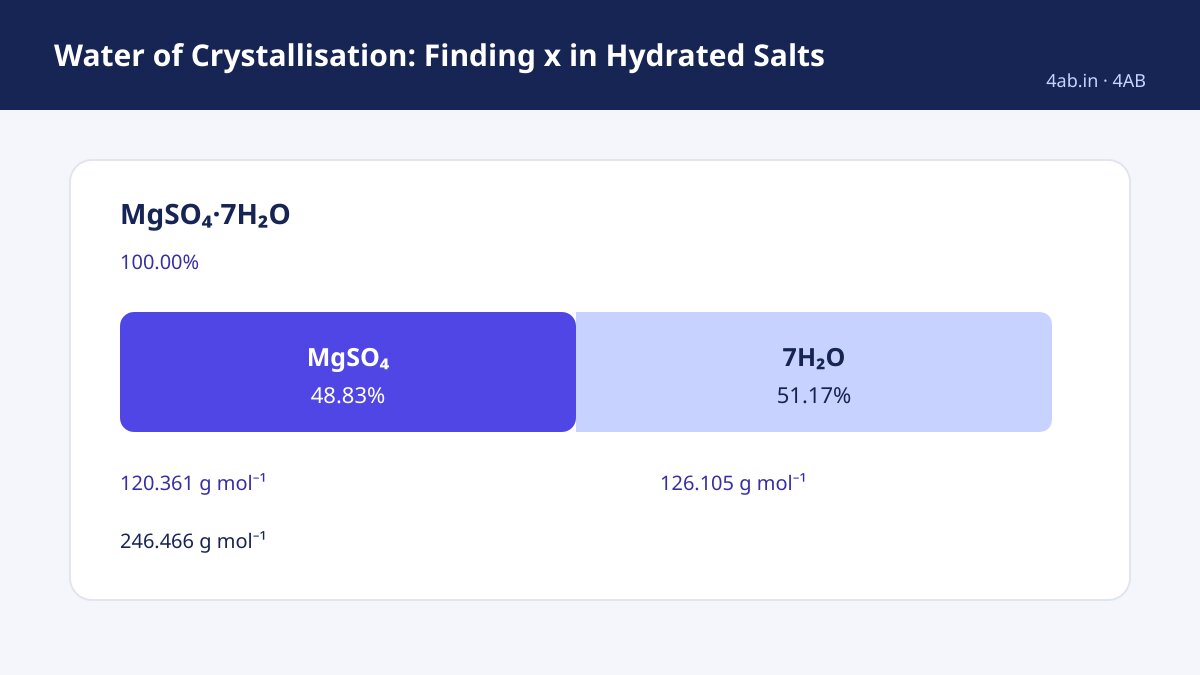
Question. Find the percentage of water in MgSO4·7H2O.
Molar mass of MgSO4. 24.305 + 32.06 + 4(15.999) = 120.361 g mol−1.
Mass of 7H2O. 7 × 18.015 = 126.105 g.
Molar mass of the hydrate. 120.361 + 126.105 = 246.466 g mol−1.
% water. 126.105 ÷ 246.466 × 100 = 51.17 %.
Check. % MgSO4 = 120.361 ÷ 246.466 × 100 = 48.83 %. The two percentages add up to 100.00 %.
Worked example 4: x from percentage composition
Question. A hydrated calcium sulphate, CaSO4·xH2O, contains 20.9 % water by mass. Find x.
Take 100 g. It holds 20.9 g water and 79.1 g CaSO4.
Moles of water. 20.9 ÷ 18.015 = 1.160 mol.
Molar mass of CaSO4. 40.078 + 32.06 + 4(15.999) = 136.134 g mol−1. Moles = 79.1 ÷ 136.134 = 0.5811 mol.
Ratio. 1.160 ÷ 0.5811 = 1.996, so x = 2. The salt is CaSO4·2H2O (gypsum).
Common mistakes
- Dividing the masses instead of the moles. The ratio 0.900 ÷ 1.595 is a mass ratio. The formula needs a ratio of moles, so each mass must first be divided by its own molar mass.
- Using the molar mass of the hydrate for the dry salt. The second mass in the ratio is the dry (anhydrous) mass, so divide it by the molar mass of the anhydrous salt only.
- Treating the dot as multiplication. In CuSO4·5H2O the 5 multiplies only the H2O, giving 5 × 18.015 = 90.075 g of water per mole of salt.
- Rounding x badly. If the ratio is 4.999, write 5. If it is 4.5 or 3.6, recheck the mass readings, because a real crystal has a whole number of water molecules.
- Stopping the heating too soon. In a practical, the crucible is heated, cooled and weighed again until two readings agree. A single weighing may still include water.
Where this appears
| Question type | What to find first | Final step |
|---|---|---|
| Mass before and after heating | Mass of water lost | Moles of water ÷ moles of dry salt |
| Percentage of water given | Assume 100 g sample | Moles of water ÷ moles of dry salt |
| Percentage of water asked | Molar mass of the hydrate | x × 18.015 ÷ M(hydrate) × 100 |
| Mass of dry salt from a hydrate | Moles of hydrate | Moles × M(anhydrous) |
These questions appear in mole-concept chapters and in the practical component of school chemistry. Check your own board syllabus and practical list for what is required.
The Molar Mass & Composition tool gives the molar mass of a formula such as CuSO4·5H2O, and its percentage composition, so you can check the molar masses used above.
Open the Molar Mass & Composition Calculator →Explore real crystal structures in the Crystal Lab, then test yourself on previous-year questions.
More Kinetics articles