Zero-Order Reactions: Integrated Rate Law and Half-Life
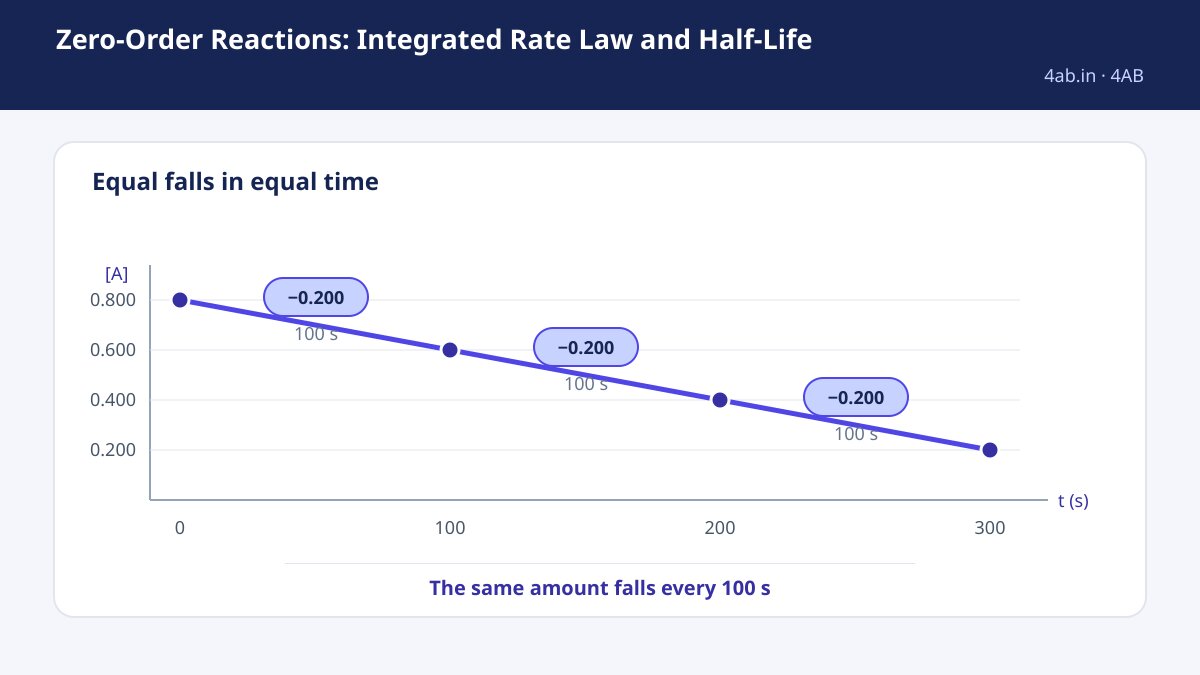
Most reactions slow down as the reactant is used up. A zero-order reaction does not: its rate stays the same until the reactant is almost gone. This looks odd at first, but it appears in reactions on a saturated catalyst surface and in enzyme reactions with plenty of substrate. IIT-JAM, GATE, CSIR-NET and CUET-PG papers ask for the integrated law, the half-life and how to identify the order from data.

The formulas
Integrated law: [A] = [A]0 − kt
Half-life: t1/2 = [A]0 / 2k
Time to finish: tcomplete = [A]0 / k
General half-life for order n (n ≠ 1): t1/2 = (2n−1 − 1) / [(n − 1) k [A]0n−1]
[A]0 is the starting concentration and [A] the concentration at time t. k is the rate constant. For zero order, k has the same unit as rate: mol L−1 s−1 (or atm s−1 for gas pressures). Putting n = 0 in the general half-life gives (2−1 − 1)/(−k/[A]0) = [A]0/2k, which matches the zero-order formula.
What makes it different
- The graph of [A] against t is a straight line with slope −k and intercept [A]0. For first order you must plot ln[A], and for second order 1/[A].
- The half-life is proportional to the starting concentration. Double [A]0 and t1/2 doubles. For first order, t1/2 does not depend on [A]0.
- The reaction has a definite end time, [A]0/k, after which the formula stops applying. A first-order reaction only approaches zero.
Why does the rate not depend on concentration? In surface-catalysed reactions, every active site on the catalyst is already occupied. Adding more reactant cannot make the surface work faster. Enzyme reactions behave the same way when the substrate is far above the saturation level. The reaction is zero order only in that range; at low concentration the same enzyme reaction shows a different order.
Worked example 1: half-life and completion time
A zero-order reaction has [A]0 = 0.800 mol/L and k = 2.0 × 10⁻³ mol L−1 s−1. Find (a) the half-life, (b) the time to complete, (c) [A] at 150 s, (d) the time for 75% reaction.
(a) t1/2 = 0.800 / (2 × 2.0 × 10−3) = 0.800 / 4.0 × 10−3 = 200 s.
(b) tcomplete = 0.800 / 2.0 × 10−3 = 400 s (twice the half-life).
(c) [A] = 0.800 − (2.0 × 10⁻³)(150) = 0.800 − 0.300 = 0.500 mol/L.
(d) 75% reacted means 0.600 mol/L used: t = 0.600 / 2.0 × 10−3 = 300 s.
Worked example 2: identify the order from data
The table gives practice data for A → products.
| t (s) | [A] (mol/L) | Fall in 100 s | Ratio [A]t / [A]t−100 |
|---|---|---|---|
| 0 | 0.800 | – | – |
| 100 | 0.600 | 0.200 | 0.750 |
| 200 | 0.400 | 0.200 | 0.667 |
| 300 | 0.200 | 0.200 | 0.500 |
The fall in each 100 s is the same, 0.200 mol/L, while the ratio changes. For a first-order reaction the ratio would be constant. Here the difference is constant, so the reaction is zero order.
k = 0.200 / 100 = 2.0 × 10⁻³ mol L−1 s−1. Check: [A] reaches zero at 0.800 / 2.0 × 10−3 = 400 s, which continues the pattern.
Worked example 3: pressure of a gas on a surface
A gas decomposes on a hot metal surface by a zero-order process. Its pressure is 60 kPa at the start and falls by 0.30 kPa per minute while the surface is saturated. Find the half-life and the pressure after 40 minutes.
k = 0.30 kPa/min. t1/2 = P0/2k = 60 / (2 × 0.30) = 100 min.
P after 40 min = 60 − 0.30 × 40 = 60 − 12 = 48 kPa.
Check: 48 kPa is 80% of 60 kPa, and 40 min is 0.4 of the half-life of 100 min, which removes 0.4 × 50% = 20%. Same answer.
Worked example 4: effect of changing the starting concentration
For the reaction in Example 1, the experiment is repeated with [A]0 = 1.600 mol/L at the same temperature.
k is unchanged, so t1/2 = 1.600 / (2 × 2.0 × 10−3) = 400 s, double the earlier 200 s. Time to complete = 1.600 / 2.0 × 10−3 = 800 s.
If this were a first-order reaction, t1/2 would have stayed the same. This is the fastest test to separate the two orders in an exam question.
Common mistakes
- Using the first-order half-life 0.693/k. For zero order, t1/2 = [A]0/2k.
- Applying the formula after the reactant is finished. [A] cannot go negative; stop at t = [A]0/k.
- Thinking “zero order” means “no reaction”. It means the rate does not depend on [A], not that the rate is zero.
- Wrong graph. A straight [A]–t line signals zero order. Plotting ln[A] against t gives a curve here.
- Wrong unit for k. It is mol L−1 s−1, not s−1.
Exam relevance
| Feature | Zero order | First order |
|---|---|---|
| Rate law | k | k[A] |
| Straight-line plot | [A] vs t | ln[A] vs t |
| Slope | −k | −k |
| Half-life | [A]0/2k | 0.693/k |
| Depends on [A]0? | Yes, proportional | No |
| Unit of k | mol L−1 s−1 | s−1 |
The data in this page are practice numbers only. Check the current syllabus on the official exam notification for the topics in your paper.
There is no separate zero-order tool, but you can use the Scientific Calculator to check each subtraction and division above.
Open the Chemistry Calculator Suite →Reaction mechanisms stick only with practice: attempt previous-year CSIR-NET questions and a timed quiz.
More Organic articles