Biography · Chemist no. 193 of 350
Ada Yonath (born 1939): The Woman Who Made the Ribosome Crystallise
Introduction
Ada E. Yonath is an Israeli crystallographer who spent decades pursuing a goal that many colleagues thought unreachable: to see the ribosome in atomic detail. Working largely at the Weizmann Institute of Science, she produced the first ribosome crystals, invented cryo-cooling methods for fragile crystals and revealed how antibiotics bind to ribosomes. She shared the 2009 Nobel Prize in Chemistry with Venkatraman Ramakrishnan and Thomas Steitz. Her story is one of stubborn curiosity against doubt.
Early Life and Family
Yonath was born on 22 June 1939 in Jerusalem, then part of British Mandate Palestine. Her parents, Hillel and Esther Lifshitz, had moved there from Poland. The family was poor, and her father, who was in poor health, died when she was young. Yonath has recalled that her family lived in modest conditions, and that she was a curious child who liked to explore and measure the world around her. She attended school in Jerusalem and was drawn to science and mathematics. Her mother worked hard to keep the household together, and Yonath has often credited the family's emphasis on learning for her later determination. She has a daughter and a granddaughter.
Education and Mentors
She studied chemistry at the Hebrew University of Jerusalem, completing a bachelor's degree and a master's degree in biochemistry. She then did her PhD at the Weizmann Institute of Science in Rehovot, working on the structure of collagen using X-ray crystallography, under the guidance of Wolfie Traub. After her doctorate (1968) she did postdoctoral work in the United States at Carnegie Mellon University in Pittsburgh and then at the Massachusetts Institute of Technology. In the early 1970s she returned to Israel and set up the first protein crystallography laboratory in the country at the Weizmann Institute. She also worked with Heinz-Günter Wittmann at the Max Planck Institute for Molecular Genetics in Berlin, where she gained access to ribosome preparations.
Career Timeline
| Year | Event |
|---|---|
| 1939 | Born in Jerusalem |
| 1968 | PhD at Weizmann Institute (collagen structure) |
| Late 1960s-early 1970s | Postdoctoral research at Carnegie Mellon and MIT |
| 1970s | Established protein crystallography laboratory at the Weizmann Institute |
| c. 1980 | First ribosome crystals produced |
| 1980s-90s | Developed cryo-crystallography and heavy-atom cluster phasing; worked also at the Max Planck group in Hamburg |
| 2000-2001 | Atomic structures of the 30S and 50S ribosomal subunits, with and without antibiotics |
| 2009 | Nobel Prize in Chemistry |
Major Scientific Contributions
Yonath's first great contribution was the very idea that ribosomes could be crystallised. Starting around 1980 she explored ribosomes from extremophile organisms, which are more stable, and obtained the first microcrystals. Her second contribution was technical: she realised that the intense X-rays needed for diffraction destroy biological crystals, and she pioneered cryo-crystallography, flash-freezing crystals near 100 K to preserve them. Third, she introduced heavy-atom clusters as labels to help solve the phase problem. Finally, she solved atomic structures of ribosomal subunits and complexes with many antibiotics, showing how drugs such as macrolides, aminoglycosides and others bind and how bacteria become resistant. For the underlying chemistry, see our companion post on her crystallographic discovery.
She also proposed that the "symmetrical region" around the peptide-bond-forming site might be an evolutionary relic of an ancient RNA pocket, a provocative idea for the origin of life.
Awards, Honours and Nobel Prize
- Nobel Prize in Chemistry 2009 with Venkatraman Ramakrishnan and Thomas A. Steitz, "for studies of the structure and function of the ribosome". She was the first Israeli woman to win a Nobel Prize and the first woman to win the Chemistry prize since Dorothy Hodgkin in 1964.
- Membership of the Israel Academy of Sciences and Humanities.
- Membership of the US National Academy of Sciences as a foreign associate.
- At the Weizmann Institute she heads the Helen and Milton A. Kimmelman Center for Biomolecular Structure and Assembly.
Personality, Struggles and Lesser-Known Facts
- Doubt from colleagues. For many years, fellow scientists questioned whether ribosome crystallography would ever succeed. She continued despite limited funding and slow progress.
- Humble beginnings. She grew up in a poor family in Jerusalem and has spoken about studying with few resources.
- Pioneer in Israel. She established the first protein crystallography laboratory in the country.
- Extremophile choice. Her choice of bacteria from hot springs and the Dead Sea was unusual and later widely adopted.
- Challenging the neighbours. Her work used synchrotron facilities in Germany, where she spent long periods collecting data.
- Role model. After the Nobel Prize she became a visible advocate for girls and women in science.
Legacy and Influence on Modern Chemistry
Yonath's cryo-cooling technique became standard in structural biology, benefiting thousands of protein structures. Her ribosome-antibiotic structures started a new era of structure-based drug design against resistant bacteria. She showed that persistence in a "hopeless" problem can transform a field. Today, even though cryo-electron microscopy has become the main method for ribosomes, the crystal structures of Yonath, Steitz and Ramakrishnan remain the reference models.
Lessons for Students
- Do not fear being told it is impossible. A new approach can unlock an old problem.
- Technical innovation drives discovery. Her freezing method mattered as much as her crystals.
- Persistence pays. The path from first crystals (about 1980) to atomic structure (2000) took around two decades.
- Background does not decide destiny. A girl from a modest Jerusalem family became a Nobel laureate.
Quick Facts Box
- Born: 22 June 1939, Jerusalem
- Died: Living (as of writing)
- Nationality: Israeli
- Field: Structural biology, X-ray crystallography
- Famous for: First ribosome crystals; cryo-crystallography; antibiotic-ribosome structures
- Nobel: Chemistry 2009 (with Venkatraman Ramakrishnan and Thomas Steitz)
FAQ
Where does Ada Yonath work?
Mainly at the Weizmann Institute of Science in Rehovot, Israel, with long collaborations in Germany.
What was her PhD about?
The structure of collagen, studied by X-ray diffraction, at the Weizmann Institute.
What is special about her Nobel Prize?
She was the first Israeli woman to win a Nobel Prize and the first woman to win the Chemistry prize in 45 years.
What can students learn from her research methods?
That even a basic physical technique like diffraction needs creative sample preparation, and that low temperature protects fragile crystals from radiation damage.
Published by ABC Chemistry — IIT-JAM | CSIR-NET | GATE Chemistry Coaching. Visit abcchemistry.com
About the chemist
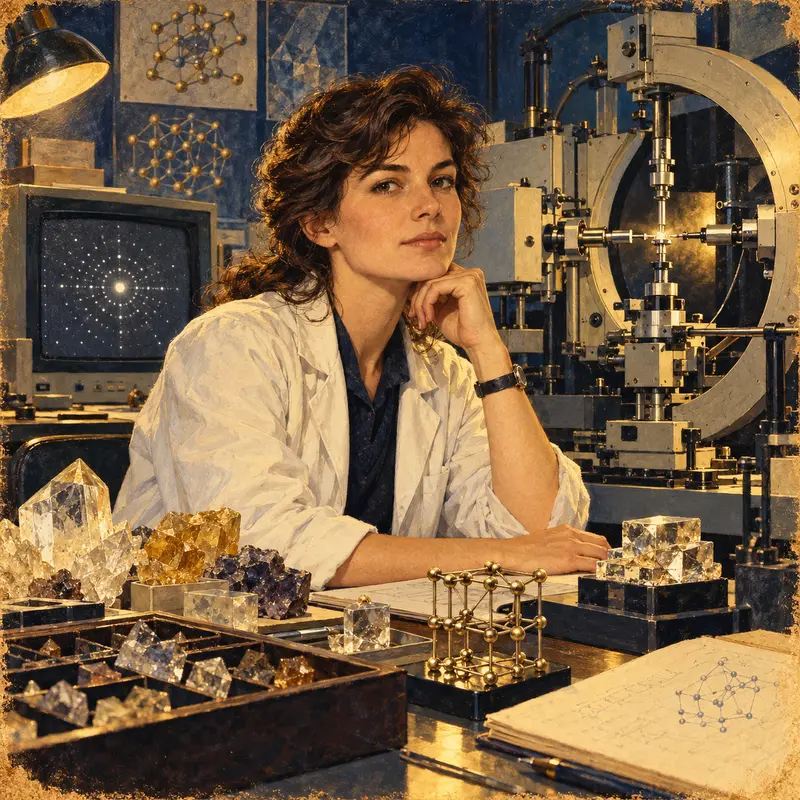
Ada Yonath
1939- · Israel · Nobel Chemistry 2009
Ribosome structure and antibiotic action