The discovery, explained · Chemist no. 172 of 350
Alan Heeger and the Discovery of Conducting Polymers
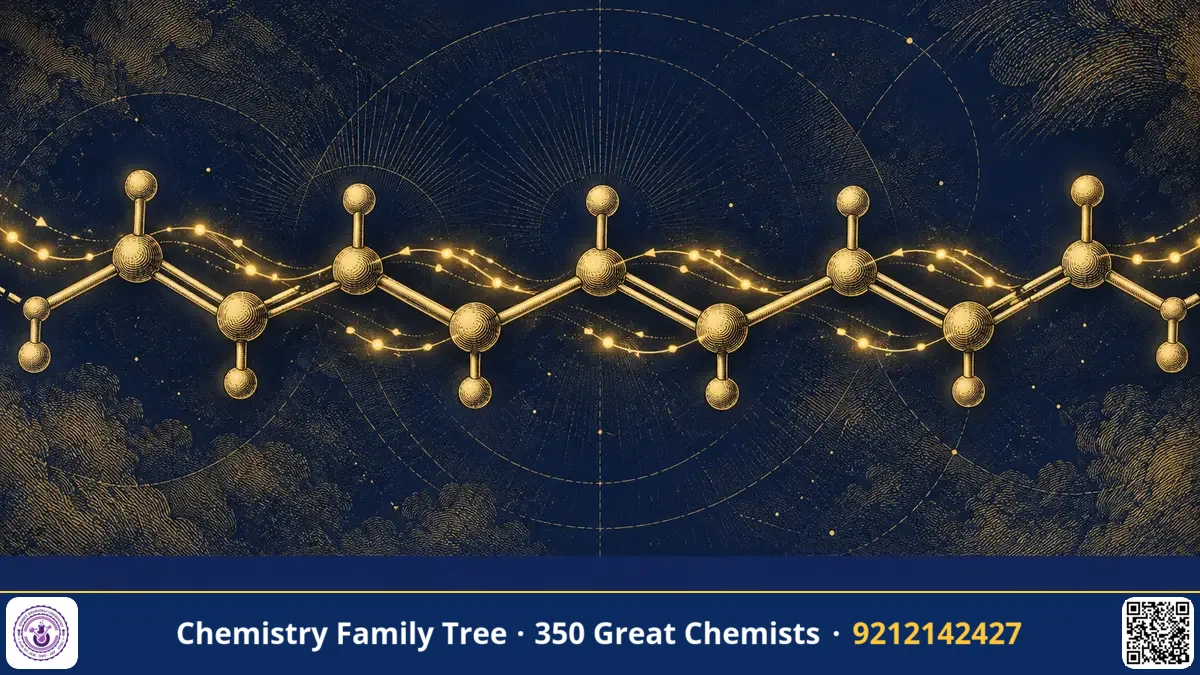
Plastics are everywhere, from electrical wire insulation to carry bags, and they are valued because they do not conduct electricity. In the 1970s, three scientists, Alan Heeger, Alan MacDiarmid and Hideki Shirakawa, showed that a plastic can be made to conduct electricity almost like a metal. They treated the polymer polyacetylene with iodine vapour and its conductivity increased by about a factor of ten million. For this discovery and development of conductive polymers they shared the 2000 Nobel Prize in Chemistry. Heeger, a physicist at the University of Pennsylvania and later at Santa Barbara, led the physical understanding of how the doped polymer conducts.
The Scientific Problem Before the Discovery
Materials are classified by electrical conductivity (σ, in S/cm). Typical values are:
| Material | Conductivity (S/cm), approximate |
|---|---|
| Insulators (Teflon, polyethylene) | 10−18 to 10−14 |
| Semiconductors (silicon) | 10−5 to 102 depending on doping |
| Metals (copper) | about 6 × 10⁵ |
Organic polymers were regarded as insulators because they are made from saturated chains with localised σ bonds. Conducting organic materials were not unknown: charge-transfer salts such as TTF–TCNQ had been studied by physicists in the early 1970s, including Heeger. But a flexible, processable plastic that conducts would be extremely useful. The challenge was to find a polymer with a conjugated backbone, and then to put charge carriers into it.
The Discovery: Step by Step
- Polyacetylene film. In about 1967 at the Tokyo Institute of Technology, Hideki Shirakawa's group was studying the polymerisation of acetylene (HC≡CH) with a Ziegler–Natta catalyst. A visiting student accidentally used a catalyst concentration about 1000 times higher than intended. The result was a shiny, silvery film of polyacetylene instead of a black powder. The film could be made in the cis or trans forms, and the trans form is more stable.
- Meeting in 1976. Shirakawa met Alan MacDiarmid, a chemist at the University of Pennsylvania, at a seminar in Tokyo. MacDiarmid, who worked on metallic-looking inorganic polymer (SN)x, invited Shirakawa to Pennsylvania.
- Doping with halogens. In 1977, the Pennsylvania team of Shirakawa, MacDiarmid, Heeger and their co-workers (including Chiang and Park) exposed polyacetylene films to iodine, bromine or chlorine vapour. The silvery film turned golden and became a good conductor. The conductivity rose from about 10−5 S/cm to the range of 102 S/cm, and later to higher values.
- Physical explanation. Heeger's group measured the electronic and optical properties and worked with theorists to understand the charge carriers. They found that charges in polyacetylene are not simple electrons or holes but solitons, a type of defect in the bond alternation of the chain, and later polarons and bipolarons in other polymers.
The Chemistry Behind It
Conjugation
Polyacetylene has the repeating unit –(CH=CH)n–. Each carbon is sp2 hybridised and has one p orbital perpendicular to the chain. These overlap to form a π system along the backbone. If all C–C bonds were equal, the π band would be half filled and the polymer would be a metal. In reality, the chain shows bond alternation (single and double bonds alternate, about 1.36 Å and 1.44 Å), called Peierls distortion, which opens a band gap of about 1.4 eV. So, undoped polyacetylene is a semiconductor.
Doping
Doping here is different from doping silicon with a few ppm of another element. In conducting polymers it is a redox reaction with large amounts (several percent) of dopant:
p-doping (oxidation):  (CH)ₙ + 3n/2 I₂ → [(CH)ⁿ⁺ (I₃⁻)ₙ]  (approx. 0.1 charge per CH unit)
n-doping (reduction):  (CH)ₙ + n Na → [(CH)ⁿ⁻ (Na⁺)ₙ]
Oxidation by iodine removes electrons from the π system, creating positive charges on the chain with I3− counter-ions. Reduction by an alkali metal adds electrons. In both cases, mobile charge carriers are created and move along the chain and between chains.
Band picture
The charges are accommodated in new states within the band gap (solitons, polarons, bipolarons), and at high doping they merge into bands, giving metallic behaviour. Conductivity σ = n e μ, where n is the carrier concentration and μ the mobility. Doping increases n enormously.
Later conducting polymers
Stable, processable polymers followed: polyaniline, polypyrrole, polythiophene, PEDOT:PSS and poly(p-phenylene vinylene) (PPV). Heeger's later work showed that PPV derivatives can emit light, which led to polymer light-emitting diodes, and that blends of conjugated polymers with fullerene derivatives can make plastic solar cells.
Applications Today
- Antistatic coatings: Coatings on photographic film and packaging for electronic parts.
- Displays: Organic light-emitting diodes (OLEDs) in mobile phones and television screens use conjugated organic materials, with polymer LEDs in some designs.
- Organic solar cells: Thin, flexible, low-cost photovoltaic devices are an active research area.
- Sensors, batteries and supercapacitors: Conducting polymers change conductivity in response to gases or chemicals, and they store charge.
- Electromagnetic shielding and touch screens: PEDOT:PSS is a transparent conductive polymer.
- India context: Many IIT and CSIR laboratories study polyaniline and PEDOT for sensors, supercapacitors and anticorrosion coatings.
Exam Corner
- Polyacetylene –(CH=CH)n– is made from acetylene by Ziegler–Natta polymerisation; the trans isomer is more stable.
- Undoped polyacetylene is a semiconductor with band gap about 1.4 eV; doping with I2 (p-type) or Na (n-type) makes it conducting.
- Requirement for conducting polymer: conjugated π system plus doping (partial oxidation or reduction).
- Charge carriers: solitons (polyacetylene), polarons and bipolarons (others).
- Nobel Prize in Chemistry 2000: Heeger, MacDiarmid, Shirakawa.
Common Misconceptions
- "All plastics conduct after the discovery." Only polymers with conjugated backbones can become conducting after doping.
- "Doping means the same as in silicon." In polymers it is a redox process and requires a large fraction of dopant.
- "Conducting polymers are as good as copper." Their conductivity is still lower than that of copper in most cases, although the best doped films reach metallic levels in some directions.
Quick Revision Box
- Polyacetylene doped with iodine in 1977: conductivity rose by about 107 times.
- Needs conjugation (alternating single and double bonds) plus doping.
- Peierls distortion gives bond alternation and a band gap.
- Charge carriers: solitons, polarons, bipolarons.
- Uses: OLED, solar cells, sensors, antistatic coatings.
- Nobel Prize in Chemistry 2000 shared by Heeger, MacDiarmid and Shirakawa.
FAQ
Is Heeger a chemist or physicist?
Heeger was a physicist. The prize was given in Chemistry because the work created a new class of chemical materials.
What is a soliton in polyacetylene?
It is a defect where the pattern of alternating single and double bonds changes phase, carrying either charge or spin and moving along the chain.
Why was iodine used?
Iodine is an oxidising agent. It takes electrons from the polymer π system, creating mobile positive charges balanced by I3− ions.
What came after polyacetylene?
More stable polymers such as polyaniline, polypyrrole, polythiophene and PEDOT were developed and are used in devices.
Published by ABC Chemistry — IIT-JAM | CSIR-NET | GATE Chemistry Coaching. Visit abcchemistry.com
About the chemist
Alan Heeger
1936- · United States · Nobel Chemistry 2000
Conductive polymers