The discovery, explained · Chemist no. 199 of 350
Arieh Warshel and the QM/MM Method: Calculating How Enzymes Work
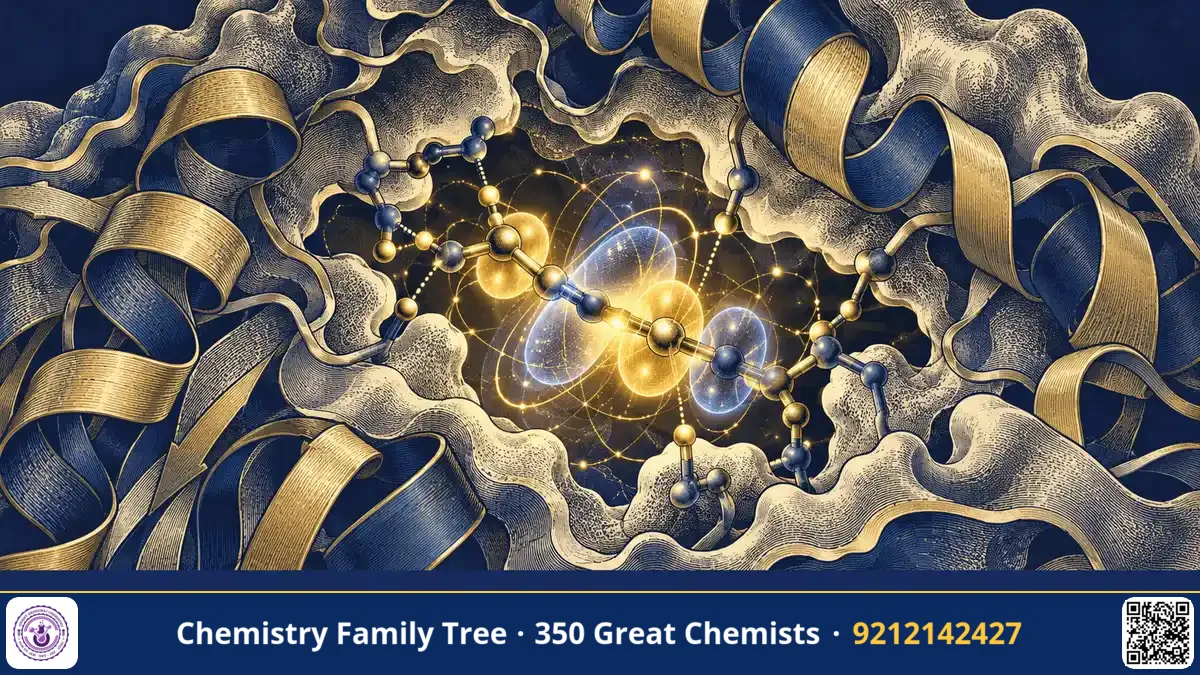
Enzymes speed up reactions by factors of a million to a trillion or more, yet for much of the twentieth century, chemists argued about why. Arieh Warshel, an Israeli-American theoretical chemist now at the University of Southern California, helped provide the tools and the answer. With Martin Karplus he built hybrid quantum-classical methods in 1972; with Michael Levitt he used a multiscale model of lysozyme in 1976; and over many decades he argued, with calculations, that enzymes work chiefly by providing a pre-organised electrostatic environment. In 2013 he shared the Nobel Prize in Chemistry with Karplus and Levitt. Let us see how it works.
The Scientific Problem Before the Discovery
Quantum mechanics can describe a chemical reaction: bond breaking, electron transfer and transition states are all questions about electrons. But the cost of ab initio quantum calculations grows steeply with the number of electrons (formally as N⁴ or more for Hartree-Fock). An enzyme plus water contains tens of thousands of atoms. In the 1960s, even a molecule of a dozen atoms strained the best computers.
Classical molecular mechanics, on the other hand, treats atoms as balls connected by springs. It is fast, but bonds cannot break in it, so it cannot describe a chemical reaction.
Biochemists also proposed many explanations of enzyme catalysis: proximity and orientation of substrates, strain of the substrate, acid-base catalysis, covalent catalysis, and "induced fit". The question was which effects actually lower the activation barrier, and by how much. Pauling had suggested in the 1940s that enzymes bind the transition state more tightly than the substrate, but quantitative proof at the molecular level was lacking.
The Discovery: Step by Step
- Hybrid method for π systems (1972). After his PhD at the Weizmann Institute, Warshel went to Harvard to work with Martin Karplus. Together they developed a program for conjugated molecules, treating the π electrons quantum mechanically and the σ framework classically. This was an early hybrid approach.
- Application to retinal (1970s). Warshel applied similar ideas to the molecule retinal, which absorbs light in vision, and proposed a model for the first step of vision, the isomerisation of 11-cis retinal.
- The QM/MM lysozyme paper (1976). Working with Michael Levitt in Cambridge, Warshel treated the reacting substrate and key residues of the enzyme lysozyme with quantum mechanics, the rest of the protein with a classical force field, and the surrounding water with a polarisable model. The calculation showed that the enzyme's electric field stabilises the charged transition state.
- Empirical Valence Bond (EVB). Warshel developed the EVB method, a practical way to build potential surfaces for reactions in solution and in enzymes by mixing resonance forms (for example, reactant and product states) with parameters calibrated from known reaction data.
- Electrostatic preorganisation. Over decades, calculations on many enzymes, from serine proteases to ATP-hydrolysing proteins, supported the idea that the enzyme's polar groups are already arranged to stabilise the charge distribution of the transition state. In water, solvent molecules must reorganise, which costs energy; in the enzyme the reorganisation was "paid for" earlier, during folding.
The Chemistry Behind It
In QM/MM, the system is divided into a small region where the chemistry occurs and a large environment. The total Hamiltonian is written as:
H(total) = H(QM) + H(MM) + H(QM/MM)
Here H(QM) is the quantum Hamiltonian of the reactive atoms (substrate, catalytic residues, maybe cofactors); H(MM) is the classical force field for the rest; and H(QM/MM) describes how they interact, including electrostatic polarisation of the QM region by the MM charges and van der Waals terms. A technical challenge arises when the boundary cuts across a covalent bond; it is handled by "link atoms" or special boundary schemes.
The catalytic effect is expressed through transition state theory. The rate constant is:
k = (k_B T / h) exp(−ΔG‡ / RT)
A drop in activation free energy ΔG‡ of 1.4 kcal/mol multiplies the rate by about 10 at 298 K (since RT ln 10 ≈ 1.36 kcal/mol). So a reduction of about 8 kcal/mol means roughly 10⁶ acceleration, and about 17 kcal/mol gives 10¹². Warshel's calculations showed that the electrostatic stabilisation provided by the enzyme can account for most of these differences, while dynamic effects (protein vibrations driving reaction) contribute little. This is a debated area, and his view is not accepted by everyone, but the computational approach became a standard test of hypotheses.
EVB can be written, for two states, as the lowest eigenvalue of a 2×2 matrix:
E = ½(H11 + H22) − ½√[(H11 − H22)² + 4H12²]
where H11 and H22 are energies of the reactant and product diabatic states and H12 couples them.
Applications Today
- Enzyme mechanism. QM/MM is a standard tool for studying proteases, kinases, cytochrome P450 and many other enzymes.
- Drug design. Reaction mechanisms inform the design of transition-state analogue inhibitors, a classical route to potent drugs (for example, the HIV protease inhibitors).
- Photobiology. Models of retinal explain colour vision and photoreceptors; related QM/MM models apply to fluorescent proteins.
- Materials and catalysis. The same hybrid ideas help model reactions on surfaces and in solution.
- Biomolecular motors and ion transport. Warshel's group studied ATP synthase, ion channels and other machines.
Exam Corner
- Nobel Prize in Chemistry 2013: Karplus, Levitt, Warshel, for multiscale models for complex chemical systems.
- QM/MM: reactive centre in QM, remainder in MM; H(total) = H(QM) + H(MM) + H(QM/MM).
- Rate constant (Eyring): k = (k_B T/h) exp(−ΔG‡/RT); lowering ΔG‡ by about 1.36 kcal/mol gives a tenfold rate increase at 298 K.
- Electrostatic preorganisation: enzyme polar groups pre-arrange to stabilise the transition state.
- EVB: mixing of valence-bond resonance forms to obtain reactive potential surfaces.
Common Misconceptions
- "Enzymes change the equilibrium." Catalysts do not alter ΔG° of the reaction or the equilibrium constant; they lower the barrier.
- "QM/MM is just an approximation with no value." It is a controlled compromise that brings electronic accuracy where it matters.
- "Lock and key explains catalysis fully." Binding the transition state better than the substrate is the key to catalysis, not only fitting the substrate shape.
Quick Revision Box
- 1972: Warshel and Karplus hybrid method for conjugated molecules.
- 1976: Warshel and Levitt QM/MM study of lysozyme.
- EVB: empirical valence bond approach for reactions in condensed phases.
- Main idea: enzymes stabilise the transition state electrostatically.
- Eyring equation links rate to ΔG‡.
- Nobel Prize in Chemistry 2013.
FAQ
What does QM/MM stand for?
Quantum Mechanics / Molecular Mechanics, a combined approach for large systems.
Why is the transition state important?
It is the highest-energy point along the reaction path. Stabilising it lowers ΔG‡ and speeds the reaction.
Where does Warshel work?
At the University of Southern California in Los Angeles, as a professor of chemistry and biochemistry.
Is enzyme catalysis a likely exam topic?
Yes. Transition state theory, activation energy, Michaelis-Menten kinetics and the basics of catalysis are common in biochemistry and physical chemistry papers.
Published by ABC Chemistry — IIT-JAM | CSIR-NET | GATE Chemistry Coaching. Visit abcchemistry.com
About the chemist
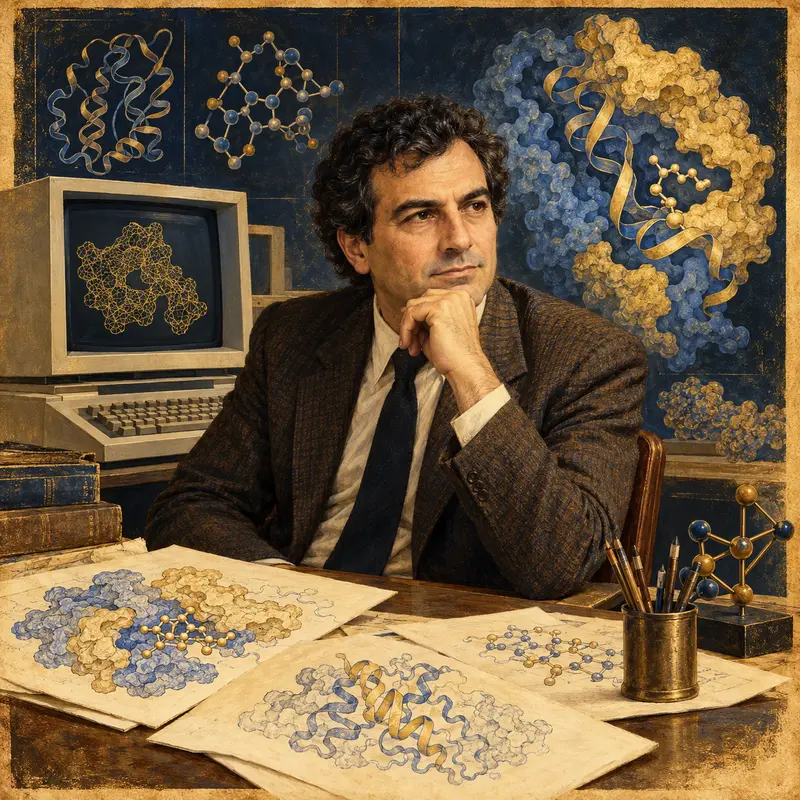
Arieh Warshel
1940- · United States · Nobel Chemistry 2013
Multiscale QM/MM modeling of enzymes