The discovery, explained · Chemist no. 281 of 350
Arthur Hantzsch: Building Pyridines and Thiazoles From Simple Starting Materials
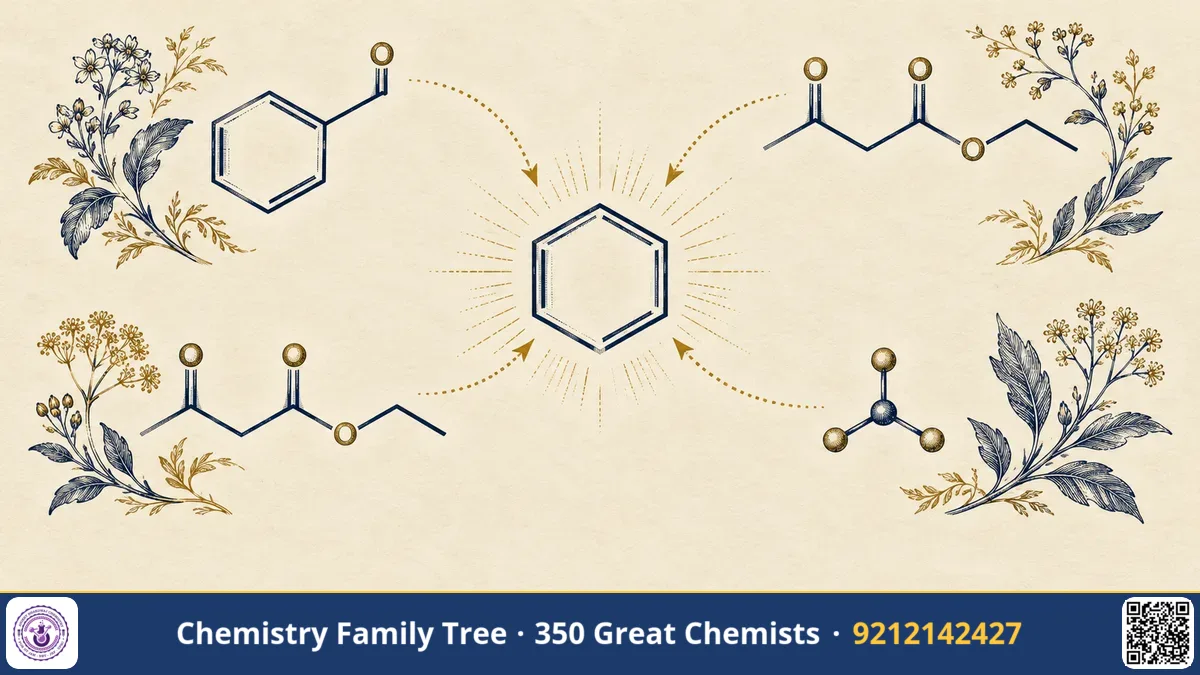
Many drugs, vitamins, dyes and agrochemicals contain a ring with nitrogen, sulphur or oxygen in it. These rings are called heterocycles, and they make up more than half of all known organic compounds. One of the chemists who showed how to build them systematically was Arthur Hantzsch, a German professor whose name is attached to several reactions: the Hantzsch pyridine synthesis (1881), the Hantzsch thiazole synthesis, the Hantzsch pyrrole synthesis, and also to the Hantzsch–Widman system for naming heterocycles. For an Indian student preparing for JAM, NET or GATE, these reactions are common questions. This post explains the logic of each one in simple steps.
The Scientific Problem Before the Discovery
When Hantzsch began his career in the late 1870s, pyridine was known as a smelly liquid isolated from coal tar and bone oil. Its structure, a six-membered ring in which one CH of benzene is replaced by nitrogen, had been proposed by Körner and Dewar a few years before. But there was no good method to build such a ring from simple building blocks, and without a synthesis, the structure was only a hypothesis. A rational synthesis proves a structure: if you mix known fragments and get the predicted ring, the picture is confirmed.
The same problem applied to thiazole, the ring in vitamin B1 (thiamine), and to pyrrole. Chemists needed general methods in which readily available molecules such as aldehydes, ketoesters, ammonia and halo-ketones assembled into rings in a single step.
The Discovery / Experiment
Hantzsch dihydropyridine synthesis (1881). Hantzsch heated two equivalents of ethyl acetoacetate (a β-keto ester) with one equivalent of an aldehyde and ammonia. The result was a 1,4-dihydropyridine, which could then be oxidised to the aromatic pyridine:
RCHO + 2 CH₃COCH₂COOEt + NH₃  →  1,4-dihydropyridine (Hantzsch ester) + 3 H₂O
1,4-dihydropyridine  --[O] (HNO₃ or other oxidant)-->  pyridine-3,5-dicarboxylate
With formaldehyde, the product is diethyl 2,6-dimethyl-1,4-dihydropyridine-3,5-dicarboxylate, known as the Hantzsch ester.
Hantzsch thiazole synthesis (1887). An α-halo ketone is condensed with a thioamide (or thiourea) to give a thiazole:
CH₃COCH₂Cl + H₂N–CS–NH₂ → 2-amino-4-methylthiazole + HCl + H₂O
Hantzsch pyrrole synthesis. A β-keto ester reacts with ammonia (or a primary amine) and an α-halo ketone to give a substituted pyrrole.
Hantzsch also contributed to the Hantzsch–Widman nomenclature, a systematic way of naming heterocycles by combining prefixes for heteroatoms (oxa, thia, aza) with suffixes that show ring size and saturation, as in "oxirane" or "azepine".
The Chemistry Behind It
Mechanism of the pyridine synthesis. The reaction is a multi-component reaction, one of the earliest examples. It runs as two parallel paths that merge:
- One molecule of the β-keto ester condenses with the aldehyde in a Knoevenagel reaction to give an α,β-unsaturated dicarbonyl (the Michael acceptor).
- A second β-keto ester reacts with ammonia to give an enamine (the Michael donor).
- The enamine adds to the Michael acceptor, followed by cyclisation through attack of nitrogen on a ketone and dehydration to give the 1,4-dihydropyridine.
- Oxidation removes two hydrogens (from N–H and C4–H) to gain aromatic stabilisation, forming the pyridine ring.
The driving force of the last step is aromaticity: pyridine has six π electrons in a planar ring, just like benzene, with the nitrogen lone pair lying in the plane (sp²) and not part of the aromatic sextet. That is why pyridine is basic (pKa of conjugate acid about 5.2) while pyrrole, whose lone pair is part of the sextet, is not.
Mechanism of the thiazole synthesis. Sulphur, being a soft nucleophile, attacks the carbon bearing halogen (SN2), then the nitrogen attacks the carbonyl to close the ring, and loss of water gives the aromatic thiazole.
Applications Today
- Calcium channel blockers: The 1,4-dihydropyridine ring made by Hantzsch's method is the core of nifedipine, amlodipine, felodipine and nimodipine, widely used in India to treat hypertension and angina. Amlodipine is among the most prescribed tablets in the country.
- Biomimetic reductions: The Hantzsch ester is a mild, metal-free hydride donor, modelled on NADH, used in organocatalytic transfer hydrogenation.
- Thiazole drugs and dyes: The thiazole ring appears in thiamine, sulphathiazole and many modern drugs and dyes.
- Combinatorial chemistry: Multi-component reactions of this type allow rapid generation of compound libraries in drug discovery.
- Nomenclature: Hantzsch–Widman names are used in IUPAC rules and in every textbook that names rings like thiirane or oxazole.
Exam Corner
- Hantzsch pyridine synthesis: aldehyde + 2 β-keto ester + NH₃ gives a 1,4-dihydropyridine, then oxidation gives pyridine.
- It is a four-component-style assembly (three reactant types) involving Knoevenagel, enamine formation, Michael addition, and cyclisation.
- Hantzsch thiazole: α-halo ketone + thioamide/thiourea gives a thiazole.
- Pyridine is aromatic with a basic N lone pair in the plane; pyrrole's lone pair is part of the aromatic sextet.
- Hantzsch ester acts as a hydride (NADH-like) donor.
Common Misconceptions
- "The first product is already pyridine." No, the first isolated product is the non-aromatic 1,4-dihydropyridine, and a separate oxidation step is needed.
- "Pyridine's nitrogen lone pair is part of the aromatic system." It is not; it lies in the ring plane in an sp² orbital, which is why pyridine behaves as a base.
- "Hantzsch synthesis gives only one ring type." Hantzsch's name is attached to pyridine, thiazole and pyrrole syntheses, so always read the reagents carefully.
Quick Revision Box
- Hantzsch pyridine synthesis (1881): RCHO + 2 ketoester + NH₃.
- First product: 1,4-dihydropyridine; oxidation gives pyridine.
- Thiazole: α-haloketone + thioamide.
- Nifedipine and amlodipine are 1,4-dihydropyridine drugs.
- Hantzsch ester is a mild reducing agent, NADH mimic.
- Hantzsch–Widman system names heterocycles.
FAQ
What are the starting materials in the Hantzsch pyridine synthesis?
An aldehyde, two equivalents of a β-keto ester such as ethyl acetoacetate, and ammonia or ammonium acetate.
Why is oxidation needed?
The condensation yields a 1,4-dihydropyridine that is not aromatic. Removing two hydrogens gives the aromatic pyridine ring, which is much more stable.
Why does the thiazole synthesis start with an α-halo ketone?
The halogen provides an electrophilic carbon for the sulphur nucleophile, and the ketone carbon provides the second electrophilic site for nitrogen, making ring closure easy.
What is the Hantzsch ester used for?
It transfers hydride to activated double bonds and imines, giving metal-free reductions similar to the role of NADH in cells.
Published by ABC Chemistry — IIT-JAM | CSIR-NET | GATE Chemistry Coaching. Visit abcchemistry.com

About the chemist
Arthur Hantzsch
1857-1935 · Germany
Hantzsch pyridine synthesis