Biography · Chemist no. 245 of 350
Auguste Laurent (1807-1853): The Brilliant Chemist Who Was Not Heard
Introduction
Auguste Laurent was a French chemist who gave organic chemistry some of its most valuable ideas and received little reward for them. He proposed the nucleus theory, discovered phthalic acid, worked on phenol, anthracene and naphthalene derivatives, and, with Charles Gerhardt, helped to prepare the ground for modern structural chemistry. He died at 45. His legacy in one line: a scientist ahead of his time, whose ideas were accepted fully only after he was gone.
Early Life and Family
Laurent was born on 14 November 1807 near Langres, in the Haute-Marne region of north-eastern France. His family were of modest means; his father is described as a wine merchant. He lost his father in childhood and was brought up with limited resources. As a boy he showed interest in minerals and in nature, and this interest in crystals and mineralogy remained with him all his life and affected the way he thought about molecules.
Education and Mentors
Laurent studied at the Ecole des Mines in Paris, where he trained as a mining engineer and learnt mineralogy and crystallography. After graduating he worked for a time in the Service of Mines, but he found that he preferred chemistry. He then became an assistant to Jean-Baptiste Dumas at the Ecole Centrale des Arts et Manufactures. He took his doctorate in 1837 with a thesis presenting the first form of his nucleus theory. His mentors thus included Dumas, with whom he published on anthracene, but their relationship later turned sour.
Career Timeline
| Year | Event |
|---|---|
| 1807 | Born near Langres, France |
| 1830s | Studies at the Ecole des Mines, Paris, then assistant to Dumas |
| 1836 | Discovers phthalic acid; first form of the nucleus theory |
| 1837 | Doctorate from the Sorbonne |
| 1838 | Appointed professor of chemistry at Bordeaux |
| 1841 | Studies phenol (phenyl hydrate) from coal tar |
| 1845-1846 | Moves to Paris; begins close work with Gerhardt |
| 1848 | Appointed assayer at the Paris Mint |
| 1853 | Dies in Paris on 23 April of tuberculosis |
Major Scientific Contributions
- Nucleus theory: A basic carbon-hydrogen core with substitution of hydrogen to give derived nuclei. This is a forerunner of the idea of a parent skeleton.
- New compounds: Phthalic acid (from naphthalene), work on phenol and picric acid, and studies on anthracene, which he and Dumas isolated in coal tar in the early 1830s.
- Atoms, molecules and equivalents: He stressed that these three terms must be separated. This made possible the correct treatment of elements like H2 and Cl2 as diatomic.
- Chemical classification: His thinking, together with Gerhardt, produced the theory of types, where compounds are classified as being derived from simple types such as water, hydrogen or ammonia.
- Crystallography: He studied the relationship between crystal form and composition, linking chemistry to mineralogy.
Type theory (Gerhardt, building on Laurent):
Water type:   H-O-H  ->  C2H5-O-H (alcohol), C2H5-O-C2H5 (ether)
Ammonia type: NH3    ->  CH3-NH2 (methylamine)
Awards, Honours and Nobel Prize
Laurent received few honours in his lifetime. He was never elected to the Academie des Sciences, in spite of his work; the power in French chemistry was held by established figures. He was appointed a professor at Bordeaux and later an assayer at the Mint, which gave him a small laboratory but no university post in Paris. After his death his friends and followers did much to bring his work to light. He lived before the Nobel Prize (first awarded in 1901).
Personality, Struggles and Lesser-Known Facts
- He was known to be direct and passionate about his ideas, and he did not hide his criticism of senior chemists. This hurt his chances of promotion.
- At Bordeaux he had a poor laboratory and worked in difficult conditions; his health began to decline in these years.
- His quarrels with Dumas about priority in the theory of substitution are well known. Laurent's view was that Dumas had taken ideas from him; Dumas, in a position of power, refused to accept this.
- When he moved to Paris, he shared a laboratory and worked closely with Gerhardt. The two became friends and partners, writing joint papers, and later were sometimes called the Laurent-Gerhardt school.
- His main book, "Methode de chimie" (Chemical Method), was finished while he was dying and was published in 1854. It was translated into English by William Odling in 1855.
Legacy and Influence on Modern Chemistry
Laurent's ideas became better known in the late 1850s. Cannizzaro, who in 1858 revived Avogadro's hypothesis, was working in the same intellectual tradition. Kekule, who studied in Paris in the 1840s, knew the Laurent-Gerhardt circle, and the type theory led directly to the idea of valency and then to structure theory. The phthalic acid derivatives he discovered became the basis of a whole industry of dyes and plastics. Today, any chemist drawing a substituted ring with the substituents attached to a parent skeleton is using a way of thinking that Laurent helped to establish.
Lessons for Students
- Good ideas may not be accepted at once. Keep records, publish clearly and be patient.
- Use ideas from other fields. Laurent's mineralogy training gave him a view of structure that others lacked.
- Define your terms. His insistence on clear meanings for atom and molecule is a model of scientific language.
- Look after your health and your working conditions; science is a long journey.
Quick Facts Box
- Born: 14 November 1807, near Langres, France
- Died: 23 April 1853, Paris
- Nationality: French
- Field: Organic chemistry, crystallography
- Famous for: Nucleus theory; phthalic acid; clarification of atom and molecule
- Nobel Prize: None (died before the prizes began)
FAQ
What is Auguste Laurent known for?
He is known for the nucleus theory of organic compounds, the discovery of phthalic acid, and for his partnership with Charles Gerhardt.
Where did Laurent work?
He worked in Paris, taught for some years at Bordeaux and was later an assayer at the Paris Mint.
How did Laurent die?
He died of tuberculosis in 1853 at the age of 45.
What happened to his book?
His book "Methode de chimie" appeared in 1854, after his death, and was translated into English by William Odling in 1855.
Published by ABC Chemistry — IIT-JAM | CSIR-NET | GATE Chemistry Coaching. Visit abcchemistry.com
About the chemist
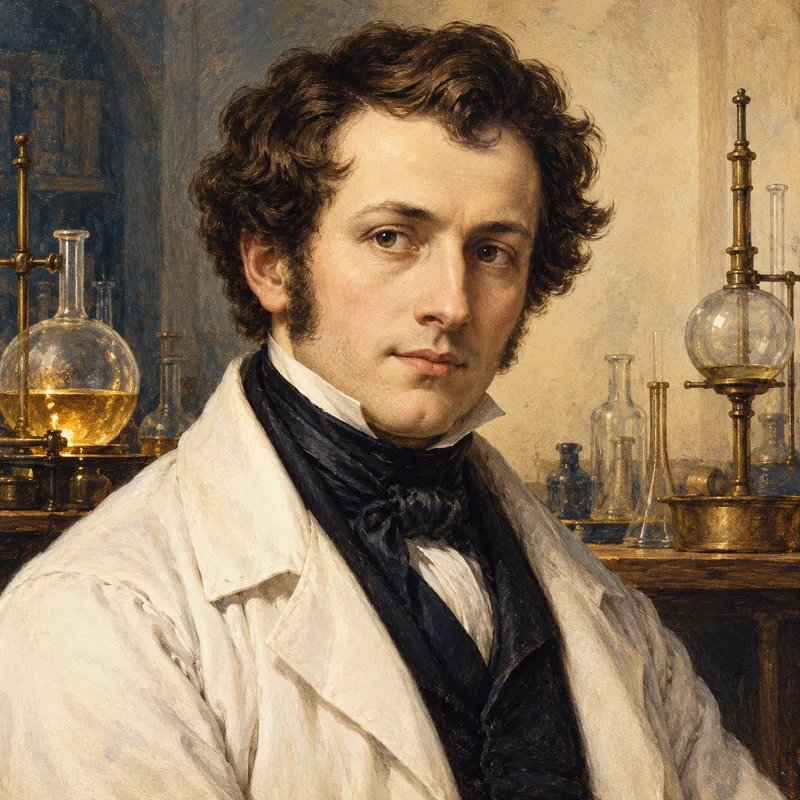
Auguste Laurent
1807-1853 · France
Nucleus theory; substitution reactions