The discovery, explained · Chemist no. 294 of 350
Norethindrone: How Carl Djerassi's Team Made the First Oral Progestin
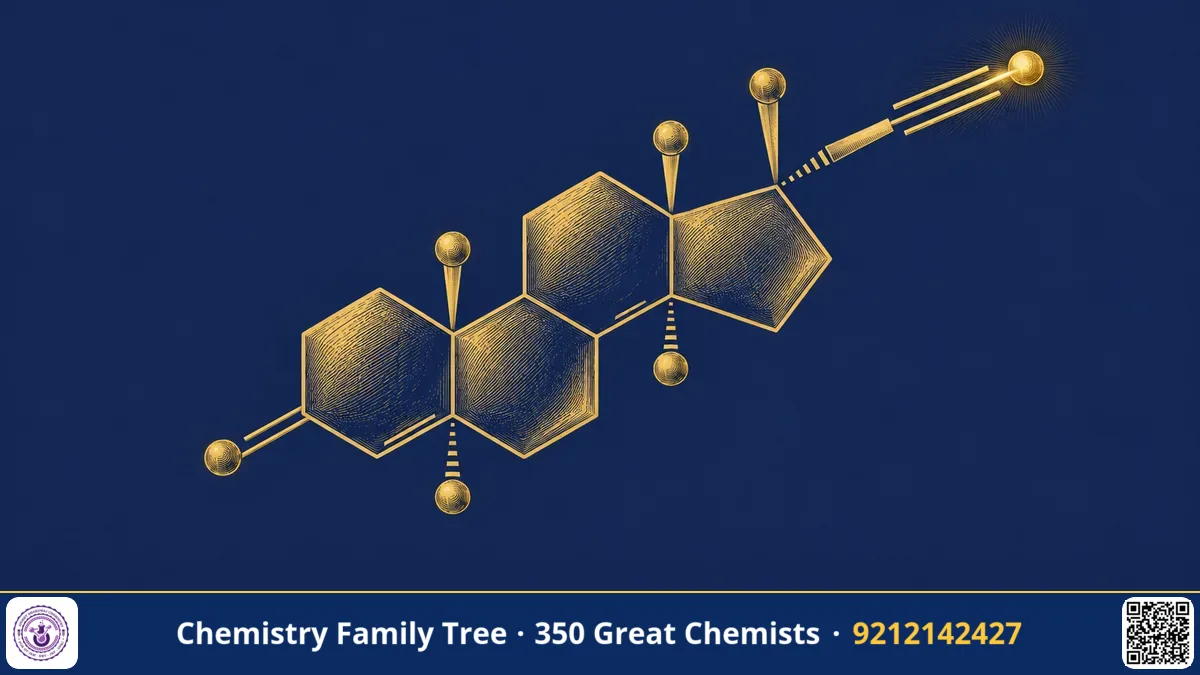
In October 1951, in a small laboratory in Mexico City, a young team led by Carl Djerassi synthesised a steroid that would change society. The compound was norethindrone (also called norethisterone), a synthetic hormone that was active when swallowed. It became the active ingredient of the first generation of oral contraceptive pills and is still used today. This discovery connected organic synthesis, steroid chemistry and public health, and it shows how a change of just one carbon atom and one triple bond can transform a molecule's biological behaviour.
The Scientific Problem Before the Discovery
Progesterone, the natural hormone that maintains pregnancy and suppresses ovulation, was known to be a promising agent for controlling fertility and treating menstrual disorders. But there were two big problems:
- Supply: Progesterone was extremely expensive in the 1940s. The American chemist Russell Marker had found a way to make it from diosgenin, a sapogenin from Mexican yams (Dioscorea), which greatly reduced the cost. The Mexican firm Syntex was built on this chemistry.
- Oral activity: When swallowed, progesterone is quickly degraded in the liver and gut, so it works poorly. It had to be injected, which is impractical for long-term use.
A chemist therefore needed a progesterone-like molecule that survives the digestive system and acts at the progesterone receptor.
The Discovery: Step-by-Step
Djerassi joined Syntex in Mexico City in 1949, together with George Rosenkranz and a talented young Mexican chemist, Luis Miramontes. The Syntex team had already shown a prominent success in 1951 by preparing cortisone from diosgenin-derived material. Djerassi's group then turned to a new idea based on two observations:
- Ethisterone (17α-ethynyltestosterone) was known to be orally active as a progestational agent. Adding an ethynyl group at C-17 blocks metabolic oxidation of the 17-hydroxyl group and slows the first-pass degradation.
- 19-Nortestosterone (testosterone minus the C-19 methyl group) was known to be more potent as a progestin than testosterone itself.
Combining the two features gave 17α-ethynyl-19-nortestosterone, the target. In the laboratory, Miramontes carried out the synthesis in October 1951 starting from a 19-nor steroid precursor made from the estrogen skeleton. In outline:
Step 1: Estradiol/estrone 3-methyl ether → 17-ethynyl derivative (ethynylation of the 17-ketone with acetylide)
Step 2: Birch reduction (Li or Na in liquid NH₃, alcohol) of the aromatic A ring → dihydro enol ether
Step 3: Mild acid hydrolysis → β,γ-unsaturated ketone
Step 4: Stronger acid → isomerisation to the conjugated enone = norethindrone
The key transformation is the Birch reduction, which converts the aromatic A ring of the estrogen into a non-conjugated diene without destroying the rest of the skeleton. Acidic hydrolysis then unmasks the ketone, and isomerisation places the double bond in conjugation with the carbonyl group (Δ⁴-3-ketone), the same functional arrangement that is found in progesterone and testosterone.
The Chemistry Behind It
Steroid skeleton. Steroids have four fused rings (A, B, C, D), numbered 1-17 with angular methyl groups at C-10 (C-19) and C-13 (C-18). Norethindrone lacks the C-19 methyl group, hence the prefix "nor".
Why the ethynyl group helps. A tertiary alcohol with an ethynyl group at C-17α cannot be easily oxidised to the 17-ketone, the main route of deactivation. It also hinders conjugation with glucuronic acid. The result is that the drug survives first-pass metabolism.
Why the missing C-19 methyl helps. Removing the angular methyl group changes how the molecule fits the progesterone receptor, and increases progestational activity relative to androgenic effects.
Birch reduction mechanism. A solvated electron adds to the aromatic ring to give a radical anion, which is protonated by the alcohol; a second electron and a second proton complete the reduction. Electron-donating substituents such as -OCH₃ remain on sp² carbons of the diene.
Ar-H + 2 e⁻ + 2 ROH → 1,4-cyclohexadiene + 2 RO⁻
How the pill works. Synthetic progestins act on the pituitary and hypothalamus through negative feedback, suppressing LH and FSH release, and prevent ovulation. They also thicken cervical mucus. The first commercial pill, Enovid, used a different progestin (norethynodrel, developed by Frank Colton at Searle), while Syntex's norethindrone was marketed by other companies and became widely used.
Other major contributions
- Octant rule: With William Moffitt, Djerassi and colleagues showed how optical rotatory dispersion and circular dichroism of saturated ketones can predict stereochemistry, since the signs of the Cotton effect depend on substituents in each of eight spatial octants around the carbonyl group.
- Mass spectrometry: Djerassi's group at Stanford systematically studied fragmentation patterns of steroids and natural products, and helped found the modern interpretation of organic mass spectra.
Applications Today
- Contraception and family planning: Norethindrone is still used in progestin-only pills and in combination pills with ethinylestradiol.
- Gynaecological treatment: It is prescribed for endometriosis, abnormal uterine bleeding and delaying menstruation.
- Steroid industry: Plant sapogenins (diosgenin) and Birch reduction are used worldwide to make steroid drugs. India has a large steroid-API industry.
- Chiroptical analysis: ORD and CD are still used for stereochemical assignment of natural products.
- Public health: Oral hormonal contraception is one of the most widely used family planning methods in the world.
Exam Corner
- Norethindrone = 17α-ethynyl-19-nortestosterone; the ethynyl group makes it orally active.
- Birch reduction: Na or Li in liquid NH₃ with ROH converts arenes to 1,4-cyclohexadienes; electron-donating groups end up on the double bond.
- Diosgenin from Dioscorea yams is the starting material for Marker degradation to progesterone.
- Octant rule predicts the sign of the Cotton effect for saturated cyclohexanones.
- Steroid skeleton: rings A, B, C are six-membered and D is five-membered (cyclopentanoperhydrophenanthrene).
Common Misconceptions
- "Djerassi invented the first pill alone." The pill was a team effort involving many scientists, including Pincus, Rock, Colton, Miramontes and Rosenkranz. Djerassi led the Syntex chemistry group that made norethindrone, and often described himself as one contributor among several.
- "Norethindrone is the same as progesterone." It is a synthetic analogue with a different structure and better oral activity.
- "Birch reduction gives cyclohexane." It stops at the 1,4-diene stage.
Quick Revision Box
- Norethindrone synthesised at Syntex, Mexico City, in October 1951.
- Team: Luis Miramontes, Carl Djerassi, George Rosenkranz.
- Structural features: 17α-ethynyl group and no C-19 methyl group.
- Key reaction: Birch reduction of the aromatic A ring, then acid isomerisation to the Δ⁴-3-ketone.
- Mode of action: suppresses LH and FSH, preventing ovulation.
- Djerassi also developed the octant rule and mass-spectral methods.
FAQ
Why is norethindrone active by mouth when progesterone is not?
The 17α-ethynyl group blocks rapid metabolic breakdown in the liver, so the compound survives long enough to reach the bloodstream and act on receptors.
What does "nor" mean in norethindrone?
The prefix "nor" means that a carbon atom (here the C-19 methyl group) has been removed from the parent steroid skeleton.
What is the Birch reduction used for in this synthesis?
It reduces the aromatic A ring of the estrogen-type precursor to a diene so that the 3-keto-Δ⁴ system can be generated after hydrolysis.
Is Carl Djerassi called the "father of the pill"?
He was often given that title, which he accepted with some humour, since the pill depended on the work of many scientists.
Published by ABC Chemistry — IIT-JAM | CSIR-NET | GATE Chemistry Coaching. Visit abcchemistry.com
About the chemist
Carl Djerassi
1923-2015 · United States
Oral contraceptive; steroid chemistry