The discovery, explained · Chemist no. 141 of 350
Anfinsen's Experiment: The Sequence Decides the Shape
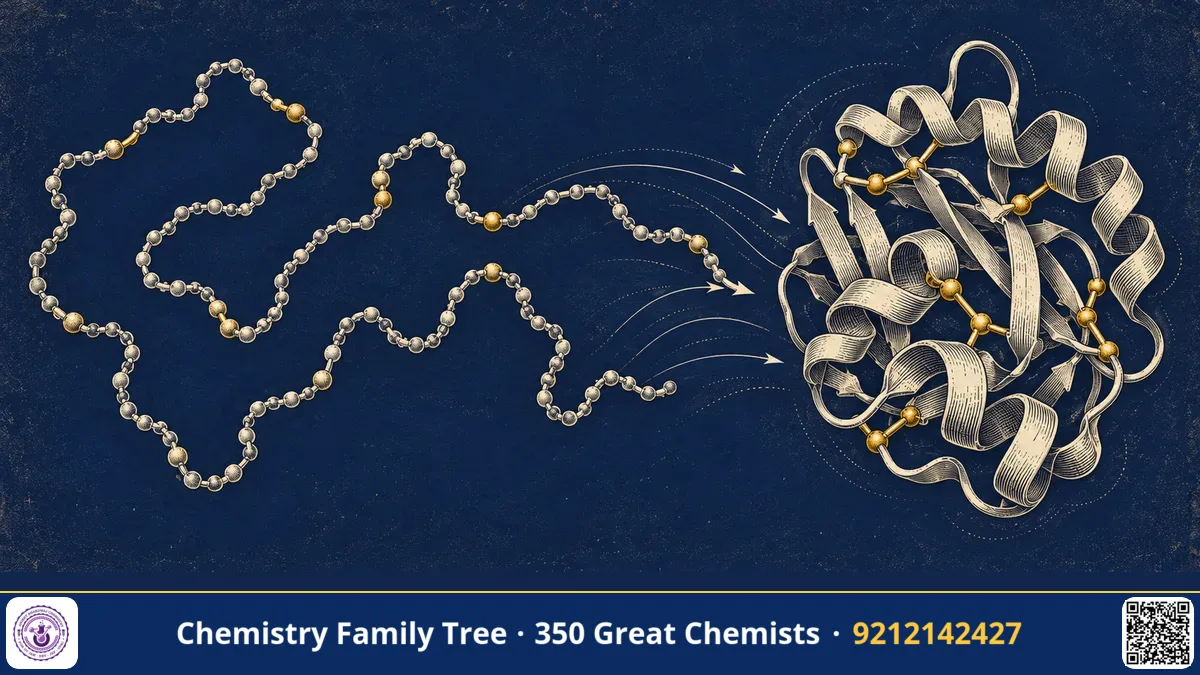
A protein is made by joining amino acids in a line, yet its biological work depends on a precise three-dimensional shape. How does the straight chain become a compact, working enzyme within seconds? In the late 1950s and early 1960s, Christian B. Anfinsen answered this with an elegant experiment on the enzyme ribonuclease. He unfolded the protein completely, lost its activity, and then watched it refold by itself and regain activity. The conclusion was simple but powerful: the amino acid sequence contains all the information needed to fold into the native structure. This idea, the thermodynamic hypothesis, earned him a share of the 1972 Nobel Prize in Chemistry and is the starting point of all protein-folding research.
The Scientific Problem Before the Discovery
By the 1950s, Frederick Sanger had shown that insulin has a definite amino acid sequence, so a protein was known to be a specific chain and not a random mixture. Linus Pauling had proposed the alpha helix and beta sheet as regular secondary structures. But two questions remained open. First, is the three-dimensional shape written in the sequence, or do cellular machines, templates or other molecules direct the folding? Second, if the sequence alone is enough, how can a chain find the right shape from an astronomical number of possible conformations?
Some scientists suspected that proteins folded as they were being synthesised on the ribosome, or that special helper factors guided them. If so, a purified protein, once unfolded, might never find its way back. Anfinsen's experiment was designed to test exactly this.
The Discovery and Experiment
Anfinsen chose bovine pancreatic ribonuclease A, a small enzyme of 124 amino acids that cuts RNA. It was ideal because it is small, stable, easy to purify, and its sequence was known. It also contains four disulfide bridges formed between eight cysteine residues, which hold the structure together.
- Start with the native enzyme. Active ribonuclease, with its four correct S-S bonds, was purified.
- Denature it. The protein was treated with 8 M urea, which breaks up non-covalent forces, and with a reducing agent, beta-mercaptoethanol, which cleaves disulfide bonds into free thiols. The chain became a random coil and lost all activity.
- Remove the denaturants. The reducing agent and urea were removed, by dialysis, in air, so oxygen could slowly re-oxidise the thiol groups back to disulfides.
- Test for activity. The enzyme recovered nearly all of its original activity, and the product behaved like native ribonuclease.
The significance of the result was increased by a second observation. When the reduced protein was oxidised while still in urea, the cysteines paired randomly. With eight cysteines, there are 105 possible ways to pair them into four disulfides. A random pairing would give only about 1 percent correct enzyme, and the product was indeed only slightly active, around 1 percent. But when the scrambled protein was placed in a buffer with a trace of thiol, which allows disulfides to shuffle, it slowly rearranged to the active form. That showed the native pairing is the most stable one under the conditions used.
The Chemistry Behind It
Thermodynamic hypothesis
Anfinsen proposed that the native structure is the conformation with the lowest Gibbs free energy, given the amino acid sequence and the surrounding conditions. In symbols, folding is spontaneous when ΔG = ΔH - TΔS < 0. The folded protein sits at the minimum of the free-energy landscape, so the path taken does not matter, only the final state.
Forces that stabilise the fold
- Hydrophobic effect. Non-polar side chains cluster inside, releasing ordered water and increasing the entropy of the solvent. This is the main driving force.
- Hydrogen bonds. They stabilise alpha helices and beta sheets between backbone C=O and N-H groups.
- Van der Waals forces and ionic interactions between close side chains.
- Disulfide bonds. Covalent links, formed by oxidation:
2 R-SH → R-S-S-R + 2H+ + 2e-.
Levinthal's paradox
Cyrus Levinthal pointed out that a chain cannot search all possible conformations randomly, because that would take longer than the age of the universe. Yet proteins fold in milliseconds to seconds. The resolution is that folding is guided downhill on a funnel-shaped energy landscape, with local structures forming first and the rest following. This is often described as a folding funnel.
Limits of the hypothesis
Later work revealed molecular chaperones, such as the heat-shock proteins, that help many proteins fold in the crowded cell by preventing aggregation. They do not carry structural information; they assist the protein in reaching the structure already encoded in its sequence. Also, protein disulfide isomerase speeds up the shuffling of disulfides in cells. Some proteins are kinetically trapped, and prions show that some sequences can adopt more than one stable form.
Applications Today
- Structure prediction. Modern computational methods, including AlphaFold, predict three-dimensional structure from sequence. This is possible only because sequence determines structure.
- Biopharmaceuticals. Recombinant insulin and other protein drugs made in bacteria often form inclusion bodies, which have to be unfolded and refolded using methods based on Anfinsen's principles.
- Disease understanding. Misfolding underlies Alzheimer's disease, Parkinson's disease and cystic fibrosis, and many mutations act by changing folding stability.
- Enzyme engineering. Industrial enzymes in detergents and in the production of biofuels are designed for stability by altering the sequence.
- Protein design. If the sequence determines the shape, a sequence can be designed for a desired shape.
Exam Corner
- Anfinsen's experiment used ribonuclease A (124 amino acids, 4 disulfide bonds, 8 cysteines); urea and beta-mercaptoethanol denature it.
- Number of possible random pairings of 8 cysteines into 4 disulfides = 105; random reoxidation gives about 1 percent activity.
- The thermodynamic hypothesis: the native state has the minimum Gibbs free energy, and primary structure determines tertiary structure.
- Urea disrupts hydrogen bonding and hydrophobic interactions; beta-mercaptoethanol reduces S-S to 2 SH.
- Anfinsen shared the 1972 Nobel Prize in Chemistry with Stanford Moore and William H. Stein for work on ribonuclease.
Common Misconceptions
- "Chaperones disprove Anfinsen." They do not. Chaperones prevent wrong aggregation and speed up folding, but the final structure is still determined by the sequence.
- "Urea breaks peptide bonds." It does not. Urea disrupts non-covalent interactions; peptide bonds remain intact.
- "Folding is a random search." It is a guided process down an energy funnel, which is why it is fast.
Quick Revision Box
- Enzyme used: bovine pancreatic ribonuclease A.
- Denaturants: 8 M urea plus beta-mercaptoethanol; activity lost.
- Removal by dialysis in air: activity regained, so sequence encodes structure.
- Thermodynamic hypothesis: native state = lowest free energy.
- Levinthal's paradox is resolved by a funnel-like energy landscape.
- Nobel Prize in Chemistry, 1972 (shared).
FAQ
What is Anfinsen's dogma?
It is the statement that the native three-dimensional structure of a protein is determined by its amino acid sequence, under suitable physiological conditions.
Why was ribonuclease chosen?
It is small, stable, easy to purify, its sequence was known, and its activity is simple to measure, so recovery of structure could be checked.
Is Anfinsen's Nobel in Medicine?
No. He was awarded the Nobel Prize in Chemistry in 1972, shared with Moore and Stein.
How is this useful for GATE and CSIR-NET?
Questions on protein structure levels, denaturation agents, disulfide bonds and the forces stabilising folding come directly from this experiment.
Published by ABC Chemistry — IIT-JAM | CSIR-NET | GATE Chemistry Coaching. Visit abcchemistry.com

About the chemist
Christian Anfinsen
1916-1995 · United States · Nobel Chemistry 1972
Protein folding and sequence-structure link