The discovery, explained · Chemist no. 265 of 350
Rudolf Clausius and Entropy: Why Heat Flows Only One Way
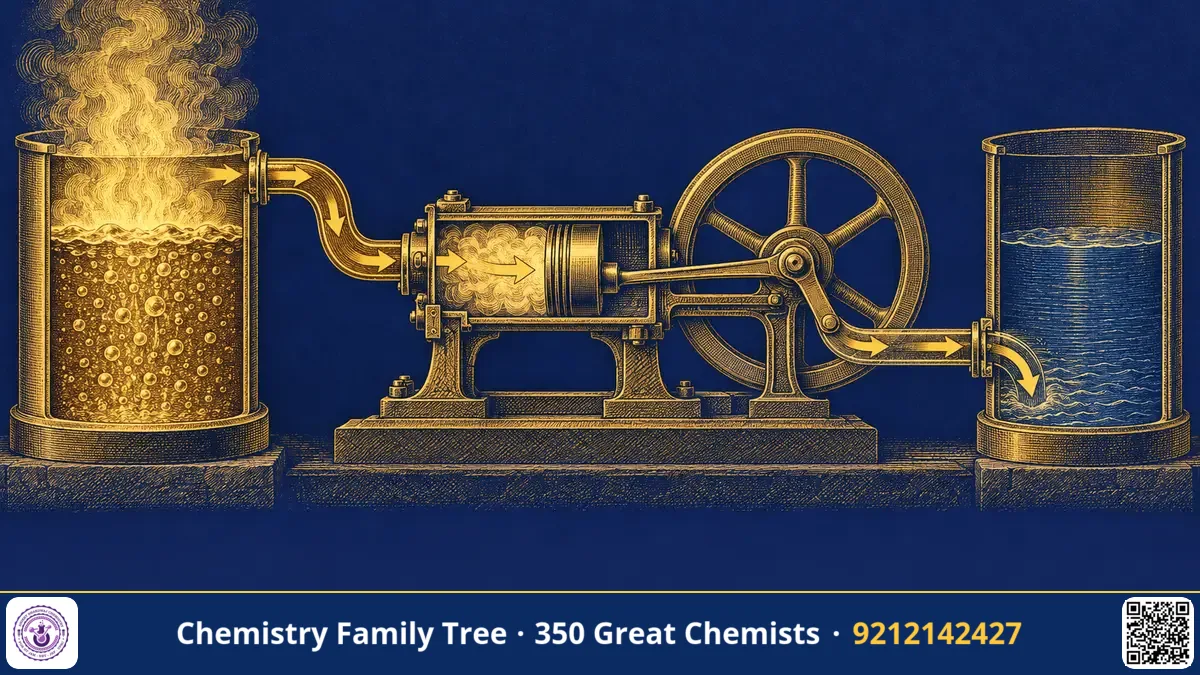
A hot cup of tea cools down. It never becomes hotter by taking heat from the cooler room. Ice melts in warm water, and the reverse never happens by itself. The first law of thermodynamics, which says energy is conserved, allows both. Something else is needed to explain why nature moves in one direction. That "something else" was clearly stated by the German physicist Rudolf Clausius, who in 1850 stated the second law of thermodynamics and in 1865 gave the name entropy to a new state function. Entropy is now central to chemistry: it decides whether a reaction is spontaneous. This blog explains Clausius's ideas in simple terms with exam-oriented formulas.
The Scientific Problem Before the Discovery
In 1824 the French engineer Sadi Carnot had analysed steam engines and shown that the efficiency depends on the temperatures of the hot and cold reservoirs. But Carnot used the caloric theory, in which heat is a fluid that is conserved. In the 1840s Joule and Mayer showed that heat and work are equivalent, which was the first law. Now there was a contradiction: how could Carnot's results be correct if heat is not conserved but converted into work?
In 1850 Clausius, then at the Royal Artillery and Engineering School in Berlin, solved this problem. He showed that both ideas could be true: energy is conserved (first law), and there is another principle regarding the direction of heat flow (second law).
The Discovery: Clausius's Steps
- 1850: Statement of the second law. "Heat cannot of itself pass from a colder to a hotter body." Heat flow from cold to hot needs work to be done. This is the Clausius statement, which is equivalent to the Kelvin-Planck statement that no cyclic engine can convert heat completely into work.
- 1854: Reversible cycles. For a reversible cycle, the sum of Q/T around the cycle is zero. In today's notation: ∮ dQ_rev / T = 0.
- 1865: Entropy. From this, Clausius saw that dQ_rev/T is the change of a state function. He called it entropy, from the Greek tropē, meaning "transformation", choosing a word that sounds like "energy".
dS = dQ_rev / T            ΔS = ∫ dQ_rev / T
For any process:  dS ≥ dQ / T     (Clausius inequality)
Isolated system:  ΔS ≥ 0
He summarised the two laws of the universe in a famous line: "The energy of the universe is constant. The entropy of the universe tends to a maximum."
Examples of entropy change:
Melting of ice at 273 K:  ΔS = ΔH_fus / T = 6010 J mol⁻¹ / 273 K ≈ 22 J K⁻¹ mol⁻¹
Isothermal expansion of an ideal gas:  ΔS = nR ln(V2/V1)
Heating at constant pressure:  ΔS = n C_p ln(T2/T1)
The Chemistry Behind It
Entropy is a measure of the number of ways in which energy and matter can be arranged, or of "disorder". Ludwig Boltzmann gave the molecular meaning later: S = k ln W, where W is the number of microstates.
- Spontaneity: For an isolated system, a process is spontaneous if ΔS > 0. For a system at constant temperature and pressure: ΔG = ΔH − TΔS, and a reaction is spontaneous if ΔG < 0. The total entropy change is ΔS_total = ΔS_system + ΔS_surroundings, where ΔS_surr = −ΔH/T.
- Trends: S(gas) > S(liquid) > S(solid). Entropy increases with temperature, with the number of moles of gas and with molecular complexity.
- Third law: Entropy of a perfect crystal is zero at absolute zero (Nernst, Planck).
- Clausius-Clapeyron equation: Clausius worked out how vapour pressure changes with temperature for a liquid:
d ln P / dT = ΔH_vap / (R T²)
ln(P2/P1) = −(ΔH_vap/R)(1/T2 − 1/T1)
This is used to find the enthalpy of vaporisation, and to predict boiling points at reduced pressure, as in vacuum distillation and cooking in a pressure cooker.
Kinetic theory: In 1857-1858 Clausius also developed the kinetic theory of gases. He introduced the idea of the mean free path, the average distance a molecule travels between collisions, which explained why gases diffuse slowly even though molecules move fast. He also showed that the rotational and vibrational motions contribute to heat capacity.
Electrolytic dissociation: In 1857 Clausius suggested that in an electrolyte solution some molecules are already split into ions, and that they are not formed only by an electric current. This idea was a forerunner of Arrhenius's theory of 1884.
Applications Today
- Spontaneity of reactions: Chemists use ΔG = ΔH − TΔS for every reaction, from ammonia synthesis to protein folding.
- Heat engines and refrigerators: Efficiency and coefficient of performance of engines, power plants and air conditioners come from the second law. Carnot efficiency: η = 1 − T_c/T_h.
- Phase changes: Clausius-Clapeyron equation is used in meteorology (humidity and cloud formation) and in vacuum distillation in industry.
- Environmental science: Entropy ideas guide energy efficiency studies and the limits of recycling.
- Biology: Living cells maintain order by increasing the entropy of their surroundings.
Exam Corner
- dS = dq_rev/T; entropy is a state function; units J K⁻¹ mol⁻¹.
- Clausius statement: heat cannot flow spontaneously from cold to hot body.
- ΔS(universe) > 0 for spontaneous processes, = 0 for reversible ones.
- Clausius-Clapeyron: ln(P₂/P₁) = (ΔH_vap/R)(1/T₁ − 1/T₂).
- Entropy of fusion: ΔS_fus = ΔH_fus/T_m; Trouton's rule: ΔS_vap ≈ 88 J K⁻¹ mol⁻¹ for many liquids.
Common Misconceptions
- "Entropy always increases." Only for isolated systems or the universe. A system can lose entropy if its surroundings gain more.
- "Entropy means only disorder." It is better described as dispersal of energy among available microstates.
- "Second law forbids order." Crystals and living things form, because the surroundings gain entropy.
Quick Revision Box
- 1850: Clausius states the second law; 1865: names entropy.
- dS = dq_rev / T; ΔS_universe ≥ 0.
- Energy of universe constant; entropy tends to maximum.
- Clausius-Clapeyron links vapour pressure and ΔH_vap.
- Also: mean free path (kinetic theory) and early ionic dissociation idea.
- Boltzmann: S = k ln W.
FAQ
What is the Clausius statement of the second law?
Heat cannot of itself flow from a colder body to a hotter body.
Why is it called entropy?
Clausius took the Greek word for transformation and made it sound like "energy".
What is the Clausius-Clapeyron equation used for?
To find how vapour pressure varies with temperature and to calculate enthalpy of vaporisation.
Is entropy a state function?
Yes. Its change depends only on the initial and final states, though it is calculated along a reversible path.
Published by ABC Chemistry — IIT-JAM | CSIR-NET | GATE Chemistry Coaching. Visit abcchemistry.com
About the chemist
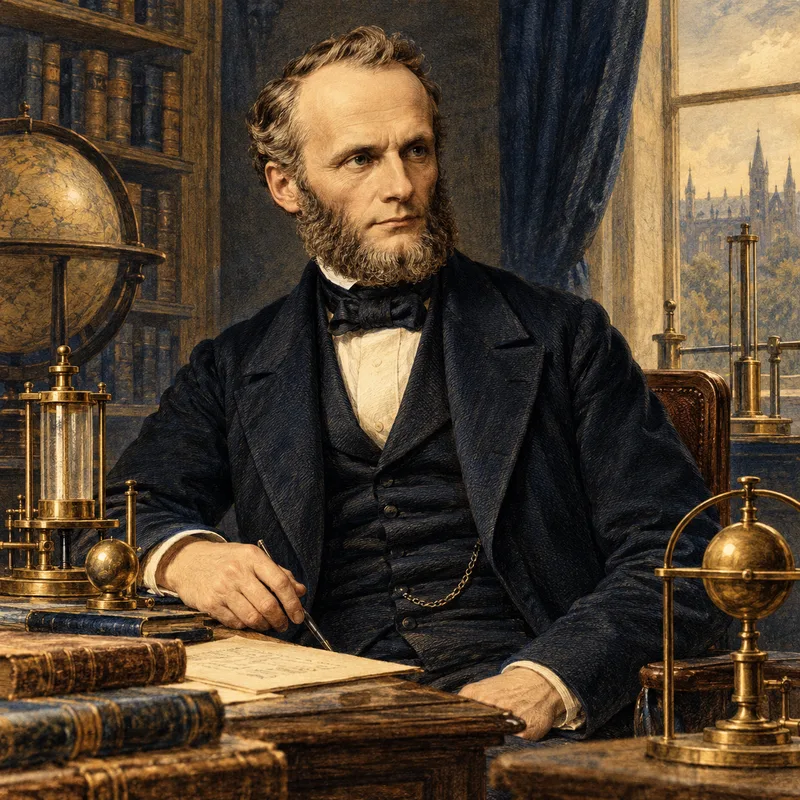
Rudolf Clausius
1822-1888 · Germany
Second law of thermodynamics; entropy