The discovery, explained · Chemist no. 194 of 350
Dan Shechtman and the Discovery of Quasicrystals
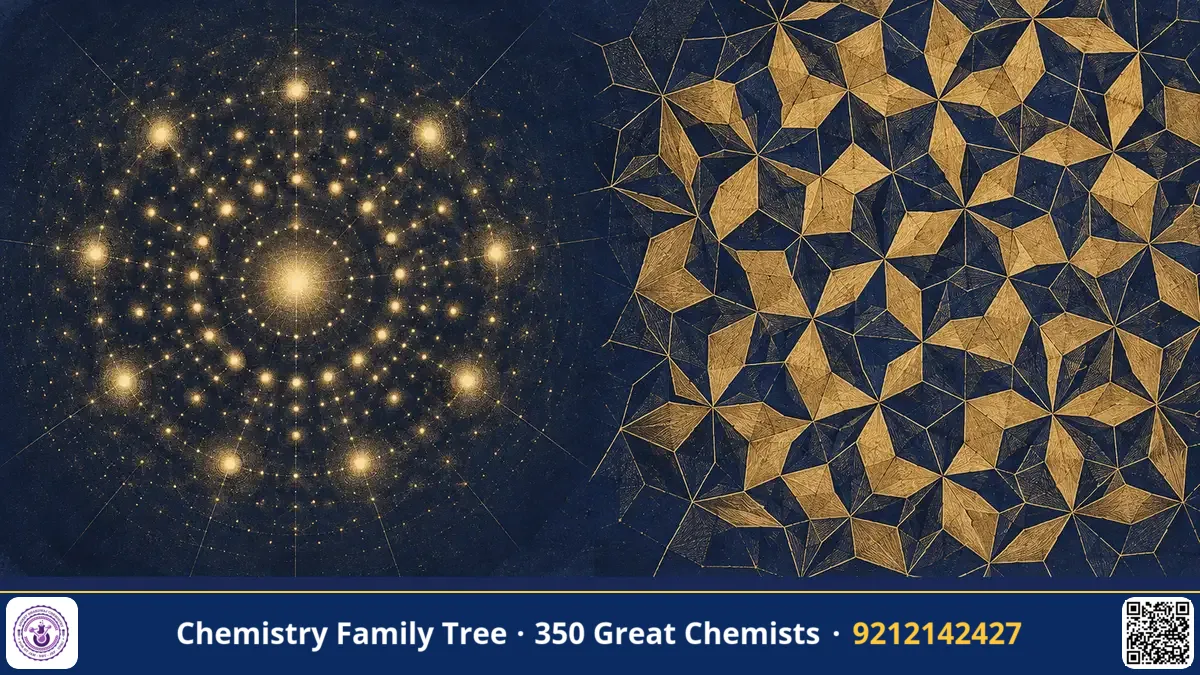
On 8 April 1982, Dan Shechtman, a materials scientist working at the US National Bureau of Standards in Maryland, looked at an electron diffraction pattern from a rapidly cooled aluminium-manganese alloy. It showed sharp spots arranged with ten-fold symmetry. According to every textbook of the time, that was impossible for a crystal. Shechtman wrote in his notebook, "10 Fold ???". After years of doubt and ridicule he was proved right, and in 2011 he received the Nobel Prize in Chemistry "for the discovery of quasicrystals". His story changed the definition of a crystal and is a favourite theme in solid-state chemistry exams.
The Scientific Problem Before the Discovery
A crystal was defined as a solid whose atoms are arranged in a pattern that repeats periodically in three dimensions. This periodic arrangement is called a lattice, and the smallest repeating unit is the unit cell. A key theorem of crystallography states that a periodic lattice can have only 2-fold, 3-fold, 4-fold or 6-fold rotational symmetry. Why? You cannot tile a flat plane completely, without gaps or overlaps, using regular pentagons, heptagons or octagons. Five-fold symmetry (and any symmetry like 8-, 10- or 12-fold) was therefore forbidden in crystals.
Solids were thus divided into two classes: crystalline (ordered and periodic, giving sharp diffraction spots) and amorphous (disordered, giving diffuse rings). Diffraction patterns with sharp spots were taken as proof of periodicity. This was the dogma in the early 1980s, and it was so strongly held that a result contradicting it looked like an error.
The Discovery: Step by Step
- Making the alloy. Shechtman, on sabbatical at the National Bureau of Standards (now NIST), studied rapidly solidified aluminium alloys. He melted an Al-Mn alloy (about Al₆Mn) and cooled it extremely fast, by melt spinning onto a cold surface.
- Electron microscopy. He examined thin flakes in a transmission electron microscope (TEM) and recorded selected-area electron diffraction patterns.
- The surprise. The pattern displayed sharp spots forming a ten-fold ring, and when he tilted the sample the pattern showed the symmetry of an icosahedron: 6 five-fold axes, 10 three-fold axes and 15 two-fold axes.
- Checking for errors. He considered twinning, where several ordinary crystals intergrow in different orientations to mimic five-fold symmetry. Careful experiments showed that this could not explain the pattern.
- Resistance and publication. His colleagues were sceptical, and he was asked to leave his research group for a time. He then worked with Ilan Blech, Denis Gratias and John Cahn, and the paper "Metallic Phase with Long-Range Orientational Order and No Translational Symmetry" appeared in Physical Review Letters in 1984.
- Acceptance. In 1987 French and Japanese groups grew large single quasicrystals of Al-Cu-Fe and Al-Pd-Mn. Later a natural quasicrystal mineral, icosahedrite (Al₆₃Cu₂₄Fe₁₃), was found in a meteorite from the Khatyrka region of Russia.
The Chemistry Behind It
A quasicrystal is an ordered but non-periodic solid. Its atoms are arranged in a pattern that never exactly repeats, but is not random: it has long-range order. This is why it gives sharp diffraction spots with "forbidden" symmetry. The two-dimensional analogue is the Penrose tiling, made from two rhombus shapes which cover the plane without gaps, with five-fold local symmetry but without translational repetition. Roger Penrose designed such tilings in the 1970s, and the mathematics was known before the physical discovery.
Mathematically, a quasicrystal can be seen as a slice through a higher-dimensional periodic lattice. An icosahedral quasicrystal is a projection of a six-dimensional lattice into three dimensions. The ratio of lengths in these structures often involves the golden ratio:
φ = (1 + √5) / 2 ≈ 1.618
Because the pattern of atoms never repeats, quasicrystals have unusual properties. They tend to be hard but brittle, poor conductors of heat and electricity (unusual for a metal alloy), and have low surface friction and low adhesion. Their stability is a topic of research; some are thermodynamically stable (like Al-Cu-Fe), while others form only under rapid cooling and are metastable.
| Property | Crystal | Quasicrystal | Amorphous |
|---|---|---|---|
| Order | Long-range, periodic | Long-range, non-periodic | Short-range only |
| Diffraction | Sharp spots, symmetries 2, 3, 4, 6 | Sharp spots, symmetry such as 5, 8, 10, 12 | Diffuse rings |
| Unit cell | Yes | No | No |
Applications Today
- Non-stick coatings. Quasicrystalline coatings have low friction and low stickiness. Frying pans with such a coating were marketed by a French company, though they were later withdrawn.
- Hard steels. Fine quasicrystalline particles strengthen some steels used in surgical instruments and razor blades; a Swedish firm used them in thin, hard steel for needles and blades.
- Thermal barrier coatings. Their low heat conductivity makes them candidates for engine parts.
- Hydrogen storage and catalysis. Research explores quasicrystal surfaces as catalysts.
- Wider science. The discovery led the International Union of Crystallography to redefine "crystal" as any solid with an essentially discrete diffraction pattern.
Exam Corner
- Nobel Prize in Chemistry 2011: Dan Shechtman, for the discovery of quasicrystals (sole winner).
- Crystallographic restriction theorem: periodic lattices allow only 1-, 2-, 3-, 4- and 6-fold rotation axes; 5-fold is forbidden.
- Quasicrystals have long-range order but no translational periodicity; example alloys: Al-Mn, Al-Cu-Fe, Al-Pd-Mn.
- Icosahedral quasicrystal symmetry: 6 five-fold, 10 three-fold, 15 two-fold axes.
- Penrose tiling is the 2D model; the golden ratio φ ≈ 1.618 appears in the geometry.
Common Misconceptions
- "Five-fold symmetry is impossible in any solid." It is impossible in periodic crystals, but possible in quasicrystals, which are not periodic.
- "Quasicrystals are glass." No. Glass is amorphous with no long-range order; quasicrystals are ordered and give sharp diffraction spots.
- "Shechtman was instantly celebrated." He faced strong opposition for years, including from the chemist Linus Pauling, who argued that the pattern came from twinning.
Quick Revision Box
- Discovered in April 1982 by Dan Shechtman in a rapidly cooled Al-Mn alloy.
- Seen using TEM electron diffraction showing 10-fold symmetry.
- Published in 1984 in Physical Review Letters with Blech, Gratias and Cahn.
- Ordered but aperiodic; no unit cell.
- Natural example: icosahedrite from a meteorite.
- Nobel Prize in Chemistry 2011.
FAQ
Why is five-fold symmetry forbidden in crystals?
Because regular pentagons cannot tile a plane without gaps, so a lattice that repeats in space cannot have a five-fold axis.
Who opposed Shechtman?
Many crystallographers did, and Linus Pauling was the most famous critic. Pauling suggested that the pattern arose from twinned crystals.
Are quasicrystals found in nature?
Yes. Icosahedrite, found in the Khatyrka meteorite, is a natural quasicrystal.
Why did the Nobel Prize go in Chemistry, not Physics?
The discovery changed the fundamental understanding of how atoms are arranged in solids, a core chemical question, so the Royal Swedish Academy of Sciences honoured it in Chemistry.
Published by ABC Chemistry — IIT-JAM | CSIR-NET | GATE Chemistry Coaching. Visit abcchemistry.com

About the chemist
Dan Shechtman
1941- · Israel · Nobel Chemistry 2011
Discovery of quasicrystals