The discovery, explained · Chemist no. 332 of 350
Darshan Ranganathan and Peptide Nanotubes: Building Molecular Tubes with Hydrogen Bonds
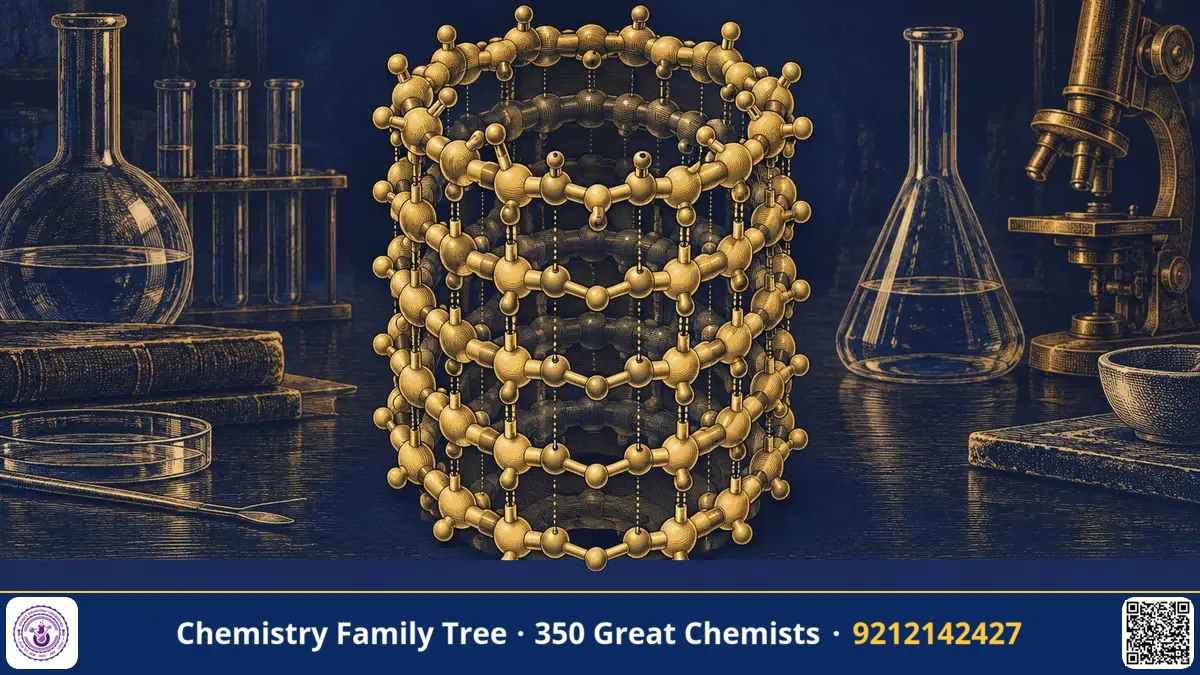
Imagine small ring-shaped molecules that stack one above the other, like coins in a roll, and are held together only by hydrogen bonds, forming a hollow tube a few nanometres wide. This is a self-assembling peptide nanotube. Darshan Ranganathan, an Indian organic chemist who worked at the Indian Institute of Technology Kanpur and later at the Indian Institute of Chemical Technology (IICT), Hyderabad, designed and made many such structures from cyclic peptides, and also explored how small peptides fold into hairpins and helices. His work belongs to the fields of bioorganic and supramolecular chemistry, and it is a good way to learn how weak non-covalent forces can build large organised structures.
The Scientific Problem Before the Discovery
In the 1970s and 1980s, supramolecular chemistry (recognised by the 1987 Nobel Prize to Cram, Lehn and Pedersen) showed that molecules can recognise each other by non-covalent forces. Biology goes further. Proteins fold into precise shapes, and membranes contain channels that are tubes made of protein. Two questions were open. First, how do the sequence and the geometry of a peptide chain decide its folded structure? Second, can chemists design synthetic molecules that organise themselves into tubes, so that we can make artificial channels and nanomaterials?
The challenge was control. Peptides can assemble in many ways, usually giving amorphous or fibrous aggregates. The task was to design the building block so that only one regular arrangement is possible.
The Discovery: Step by Step
The design principle, associated with the work of M. Reza Ghadiri and also pursued independently by Ranganathan, uses cyclic peptides with alternating D- and L-amino acids. In Ranganathan's laboratory, cyclic peptides of various ring sizes were synthesised from amino acid building blocks, including those containing special residues such as α,α-disubstituted or aminoisobutyric acid and modified units, and their stacking was examined.
- Step 1: Design the ring. A cyclic peptide made of an even number of residues with alternating D- and L-configuration lies flat in a ring, with all the side chains pointing outward and all the N–H and C=O groups of the backbone pointing up and down, perpendicular to the plane of the ring.
- Step 2: Make the peptide. A linear peptide is made by standard solution or solid-phase coupling (for example with carbodiimide reagents), and the ends are joined by cyclisation at high dilution to avoid polymerisation.
- Step 3: Trigger assembly. Lowering the solubility, for example by acidifying, or by changing solvent, leads rings to stack.
- Step 4: Characterise. Evidence includes IR spectra showing hydrogen-bonded amide bands, electron microscopy, X-ray diffraction and, in some cases, single-crystal structures that show the tube.
Ring + Ring + ... → [ring]n  stacked tube
each ring held to the next by antiparallel β-sheet type hydrogen bonds:
   N–H ··· O=C   (about 2.9–3.0 Å between N and O)
Ranganathan also designed other peptide-based systems: bis-peptide hairpins, helices, and molecules where amino acids are linked through spacers to give tubular or channel-like systems. These studies tested rules for folding and hydrogen-bonded self-assembly.
The Chemistry Behind It
Why alternating D and L? In a cyclic peptide made only of L-amino acids, the backbone amide groups point in different directions and the ring is puckered. Alternating D and L residues allow all the carbonyl groups to point to one face and all the N–H groups to the other. The ring becomes flat and the side chains project out, as in a β-sheet strand.
Hydrogen bonds. When two flat rings stack, each NH on one ring bonds with a C=O on the next ring. The rings are therefore linked in the manner of an antiparallel β-sheet, only closed into a circle. A hydrogen bond is a directional interaction of 10–40 kJ/mol; many of them working together give a strong, stable tube.
| Interaction | Approximate strength | Role |
|---|---|---|
| Covalent bond | 150–400 kJ/mol | Within the ring |
| Hydrogen bond | 10–40 kJ/mol | Stacking of rings |
| van der Waals | 0.4–4 kJ/mol | Packing of side chains |
| Hydrophobic effect | Entropy driven | Association in water |
Cooperativity. Once a few rings stack, the next ring binds more strongly, which is an example of cooperativity in self-assembly. The inner diameter of the tube depends on the ring size, about 7–8 Å for an eight-residue ring.
Applications Today
- Ion channels. Nanotubes can span membranes and transport ions or small molecules, a model for biological channels and a possible route to antibacterial agents.
- Nanomaterials. Tubes with defined pores can be used as templates, sensors and filters.
- Drug delivery. Self-assembling peptides are studied as carriers and hydrogels.
- Understanding disease. The same hydrogen-bonded stacking is related to amyloid fibres in Alzheimer's disease, so the model systems help in understanding protein misfolding.
- Training Indian chemists. Ranganathan guided many students in India, and his textbook-style approach to bioorganic chemistry shaped Indian courses.
Exam Corner
- Non-covalent forces: hydrogen bonding, van der Waals, π–π stacking, hydrophobic effect and electrostatic interactions drive self-assembly.
- A cyclic peptide with alternating D and L residues gives flat rings that stack into nanotubes.
- Peptide bond: planar, partial double bond character, trans.
- Cyclisation is performed at high dilution to favour intramolecular reaction.
- The 1987 Nobel Prize in Chemistry: Cram, Lehn and Pedersen, for host-guest and supramolecular chemistry.
Common Misconceptions
- "Non-covalent means weak and unstable." Many weak bonds acting together can give very stable structures, such as DNA's double helix.
- "Peptide nanotubes are carbon nanotubes." They are completely different in composition and bonding. Peptide tubes are held by hydrogen bonds; carbon nanotubes are covalent.
- "Ranganathan's work was only theoretical." It was strongly experimental, based on synthesis and structure determination.
Quick Revision Box
- Cyclic peptide with alternating D/L residues is flat.
- Rings stack by NH···O=C hydrogen bonds.
- Inner diameter depends on number of residues.
- High dilution favours cyclisation.
- Self-assembly shows cooperativity.
- Ranganathan worked at IIT Kanpur and IICT Hyderabad.
FAQ
Who invented the peptide nanotube concept?
The cyclic D,L-peptide nanotube design is most associated with M. Reza Ghadiri's group (1993). Ranganathan's group developed related and independent designs and contributed a wide range of peptide assemblies.
What is self-assembly?
It is the spontaneous organisation of molecules into ordered structures through non-covalent interactions without outside direction.
Why are D-amino acids used?
They allow the ring to adopt a flat conformation in which all the amide groups are aligned for stacking.
Why study this for exams?
It brings together stereochemistry, peptide bond planarity, hydrogen bonding and supramolecular chemistry, all common topics in JAM and NET.
Published by ABC Chemistry — IIT-JAM | CSIR-NET | GATE Chemistry Coaching. Visit abcchemistry.com

About the chemist
Darshan Ranganathan
1941-2001 · India
Supramolecular chemistry; peptide nanotubes