The discovery, explained · Chemist no. 225 of 350
Computational Protein Design: How David Baker Taught Computers to Build New Proteins
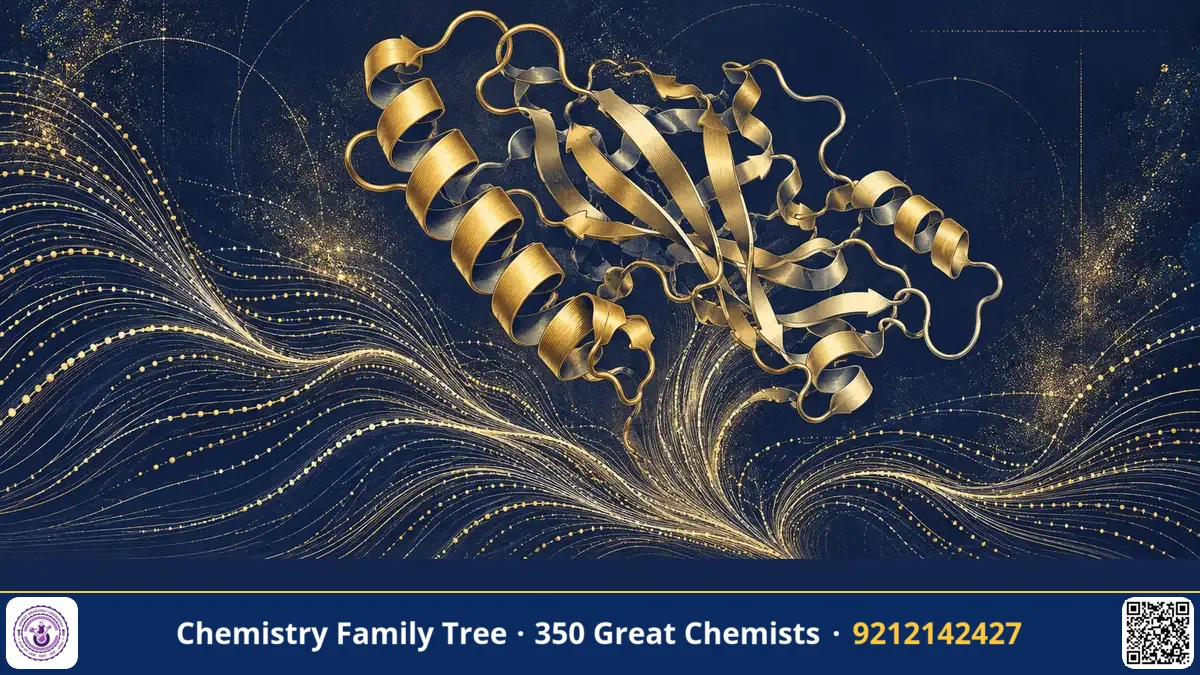
Nature has produced proteins for billions of years through evolution. Every enzyme, antibody, hormone and muscle fibre in your body is a protein, folded from a chain of amino acids into a precise three-dimensional shape. For decades, scientists could study these proteins but not create entirely new ones. David Baker, a biochemist at the University of Washington in Seattle, changed that. With his software Rosetta and the 2003 design of a protein called Top7, which does not exist in nature, he showed that a computer can design a sequence of amino acids that folds into a chosen new shape. In 2024, Baker received half of the Nobel Prize in Chemistry "for computational protein design". The other half went to Demis Hassabis and John Jumper for protein structure prediction.
This post explains the folding problem, how Baker's approach works, the chemistry of protein structure, and what you should know for exams.
The Scientific Problem Before the Discovery
Proteins are polymers of 20 different amino acids, joined by peptide bonds. In 1961, Christian Anfinsen showed that the sequence of amino acids alone contains the information needed for a protein to fold into its native structure (the thermodynamic hypothesis, for which he shared the 1972 Nobel Prize in Chemistry). This gave rise to two linked problems:
- The protein folding (structure prediction) problem: given a sequence, what is the 3D structure?
- The inverse folding (protein design) problem: given a desired 3D structure, what sequence will fold into it?
Both are hard because of the astronomical number of possibilities. A protein of only 100 amino acids has 20^100 possible sequences, more than the number of atoms in the observable universe. Levinthal's paradox points out that a protein cannot find its structure by random search; it must follow a funnel-shaped energy landscape toward the lowest free energy state. Computers needed to represent this energy landscape well enough to rank sequences.
The Discovery / Experiment
Baker's group started in the 1990s by building a program to predict structure. The Rosetta method was based on a simple observation: short segments of protein sequence tend to adopt a limited set of local shapes seen in known structures. Rosetta assembled fragments of known protein structures (3 and 9 residues long) and used Monte Carlo search to find the combination with the lowest energy.
To go from prediction to design, the group reversed the logic. The design cycle for Top7, published in Science in 2003 by Brian Kuhlman, Baker and colleagues, was:
- Choose a target fold that has never been observed in nature, an alpha/beta arrangement of 93 amino acids.
- Use Rosetta to alternate between (a) sequence design, selecting amino acids for each position, and (b) structure optimisation, adjusting the backbone, so as to minimise the energy.
- Synthesise the gene for the best sequence, express the protein in bacteria and purify it.
- Check the structure experimentally by X-ray crystallography and NMR.
The measured structure of Top7 matched the computer design with an atomic-level precision of about 1.2 angstrom root-mean-square deviation. Top7 was also very stable, unfolding only at high temperatures. It was the first demonstration that a fully new protein fold could be designed with accuracy.
After this, Baker's laboratory designed many other things: enzymes for non-natural reactions, proteins that bind to specific targets, self-assembling protein cages and nanomaterials, vaccine candidates (for example nanoparticles carrying viral antigens, used in a COVID-19 vaccine approved in South Korea and elsewhere), and de novo proteins that neutralise toxins. Later, deep learning tools such as RFdiffusion and ProteinMPNN from his laboratory made the design of binders and enzymes much faster.
The Chemistry Behind It
Forces that fold proteins. Rosetta's energy function approximates the physical interactions in a protein:
| Interaction | Role in folding |
|---|---|
| Hydrophobic effect | Non-polar side chains (Leu, Ile, Val, Phe) bury in the core, releasing ordered water |
| Hydrogen bonds | Stabilise alpha-helices and beta-sheets |
| van der Waals forces | Close packing of atoms |
| Electrostatics / salt bridges | Attraction between opposite charges, solvent effects |
| Disulfide bonds | Covalent S-S links between cysteines |
Secondary structure. The alpha-helix has 3.6 residues per turn and hydrogen bonds between C=O of residue i and N-H of residue i+4. Beta-sheets have hydrogen bonds between strands. Ramachandran plots show allowed phi and psi angles. These rules are used by Rosetta.
Free energy. Folding is favourable when ΔG = ΔH − TΔS is negative. The entropy loss of the chain is compensated by the entropy gain of water released in the hydrophobic effect and by favourable enthalpy of interactions. Design methods search for sequences that make the target fold the lowest-energy state and that are unlikely to adopt other folds.
The Nobel committee pointed out that the other half of the 2024 prize, to Hassabis and Jumper's AlphaFold2, predicts the structure from a sequence. Baker's design goes the other way, from structure to sequence. They complement each other.
Applications Today
- Vaccines. Designed protein nanoparticles that display viral antigens in repeating patterns provoke strong immune responses.
- Therapeutics. De novo binders that block viruses, toxins or cancer targets, and designed cytokine mimics.
- Enzymes. Custom enzymes to break down pollutants, plastics or toxins, or to carry out new chemical reactions.
- Diagnostics and biosensors. Designed proteins that glow or change shape when they bind to a target.
- Materials. Self-assembling protein cages, fibres and filters; relevant to Indian research on affordable diagnostics and sustainable chemistry.
Exam Corner
- Anfinsen's dogma: the native structure of a protein is determined by its amino acid sequence.
- Protein design is the inverse problem of structure prediction.
- Top7 (2003) was a computer-designed 93-residue protein with a new fold.
- Levinthal's paradox: proteins cannot fold by exhaustive random search.
- 2024 Nobel Prize in Chemistry: Baker (design) and Hassabis and Jumper (prediction).
Common Misconceptions
- "Baker's work is the same as AlphaFold." AlphaFold predicts structure from a sequence; Baker designs sequences for new structures.
- "Designed proteins are just copies of natural ones." Top7 had a fold not seen in nature.
- "AI replaced the experiments." Designs must still be produced and tested in the laboratory.
Quick Revision Box
- Software: Rosetta (fragment assembly and energy minimisation).
- 2003: Top7, the first designed protein with a novel fold (93 amino acids).
- Design cycle: choose fold, design sequence, express, verify by X-ray/NMR.
- Key forces: hydrophobic effect, hydrogen bonds, van der Waals interactions.
- Newer tools: RFdiffusion and ProteinMPNN (deep learning).
- Nobel Prize in Chemistry 2024: half to Baker.
FAQ
What does de novo mean?
It means "from the beginning": a protein designed from scratch rather than modified from a natural protein.
What is Rosetta?
It is a software suite for predicting and designing protein structures and interactions, developed by Baker's laboratory and a worldwide community.
What is Foldit?
Foldit is an online game developed at the University of Washington in which players solve protein folding and design puzzles, contributing to real research.
How is protein design useful for medicine?
It enables custom binders, vaccine scaffolds and enzymes, offering new treatments and diagnostics that are not found in nature.
Published by ABC Chemistry — IIT-JAM | CSIR-NET | GATE Chemistry Coaching. Visit abcchemistry.com
About the chemist
David Baker
1962- · United States · Nobel Chemistry 2024
Computational protein design