The discovery, explained · Chemist no. 219 of 350
Iminium Catalysis: How David MacMillan Built a Metal-Free Way to Make Chiral Molecules
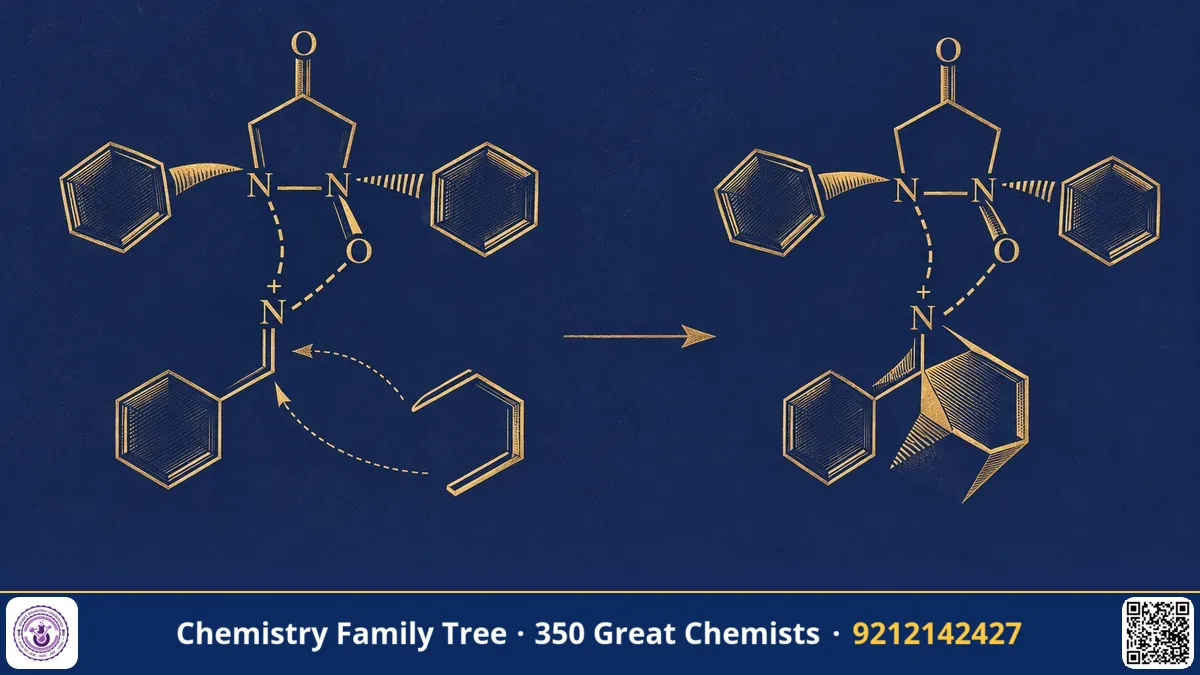
In 2000, David MacMillan, then a young professor at the University of California, Berkeley, reported that a small organic molecule, an imidazolidinone derived from the amino acid phenylalanine, could catalyse an enantioselective Diels-Alder reaction. He also gave the field its name: organocatalysis. A few months earlier, Benjamin List had reported proline-catalysed aldol reactions. Together, the two papers launched a new area of chemistry, and in 2021 the two scientists shared the Nobel Prize in Chemistry "for the development of asymmetric organocatalysis".
MacMillan's key idea is iminium catalysis. A chiral secondary amine reacts with an alpha,beta-unsaturated aldehyde to form an iminium ion, which is a much better electrophile than the aldehyde itself and sits in a well-defined chiral environment. This post explains the problem, the experiment, the orbital reasoning, and later developments such as SOMO catalysis and photoredox catalysis.
The Scientific Problem Before the Discovery
The Diels-Alder reaction, a [4+2] cycloaddition between a diene and a dienophile, builds six-membered rings and up to four stereocentres in one step. It is one of the most useful reactions in synthesis. Lewis acids (such as AlCl3, TiCl4 or chiral boron and copper complexes) speed it up by coordinating to the carbonyl group of the dienophile and lowering its LUMO energy.
As a student, MacMillan was working on chiral Lewis acid catalysts. These worked, but they were often moisture-sensitive and needed dry solvents, inert atmosphere and low temperatures. He noticed that many Lewis acid catalysts failed in the presence of water or air, and that metal-based catalysts were expensive and sometimes toxic. Could the same activation be provided by a robust organic molecule?
His thinking was inspired by the way a Lewis acid works: lowering the LUMO of the dienophile. An iminium ion, formed from an aldehyde and an amine, has the same effect. The C=N+ unit is more electron-poor than C=O, so the conjugated system is activated toward nucleophiles and dienes.
The Discovery / Experiment
MacMillan designed chiral imidazolidinones, five-membered heterocycles made from amino acids such as L-phenylalanine (in the first-generation catalyst) and a ketone (such as acetone). The catalyst is used as its hydrochloride salt.
- The chiral secondary amine condenses reversibly with the enal (for example cinnamaldehyde) to form an iminium ion.
- The iminium ion has a preferred geometry, the (E)-isomer, with the benzyl group of the catalyst shielding one face.
- The diene (such as cyclopentadiene) can approach only from the open face, and the cycloaddition proceeds enantioselectively.
- Water hydrolyses the product iminium, releasing the cycloadduct and regenerating the catalyst.
Enal + R2NH (cat.) ⇌ iminium ion (LUMO lowered)
Iminium + cyclopentadiene → cycloadduct iminium
Cycloadduct iminium + H2O → chiral aldehyde + R2NH
The reaction gave Diels-Alder adducts with high enantioselectivity (commonly above 90% ee) and good endo/exo selectivity, in solvent mixtures that even contained water. That was a big contrast with moisture-sensitive Lewis acids. The 2000 paper, in the Journal of the American Chemical Society, is the one that introduced the term "organocatalysis".
The Chemistry Behind It
LUMO-lowering. Frontier molecular orbital theory explains the normal-electron-demand Diels-Alder reaction as an interaction between the HOMO of the diene and the LUMO of the dienophile. A lower LUMO means a smaller HOMO-LUMO gap and a faster reaction. Iminium formation lowers the LUMO of the enal in the same way as a Lewis acid.
Iminium versus enamine. Both List and MacMillan use secondary amines, but in different ways:
| Feature | Enamine catalysis (List) | Iminium catalysis (MacMillan) |
|---|---|---|
| Substrate | Saturated aldehyde/ketone | Alpha,beta-unsaturated aldehyde/ketone |
| Intermediate | Enamine (nucleophile, HOMO-raising) | Iminium ion (electrophile, LUMO-lowering) |
| Typical reaction | Aldol, Mannich, alpha-functionalisation | Diels-Alder, Michael, conjugate addition |
SOMO catalysis (2007). MacMillan's group extended the idea by oxidising an enamine with a one-electron oxidant such as ceric ammonium nitrate (CAN) to give a 3-pi-electron radical cation with a singly occupied molecular orbital (SOMO). This species reacts with weak nucleophiles such as allyl silanes, a polarity that is quite different from the usual enamine.
Photoredox catalysis. Later he combined organocatalysis with visible-light photoredox catalysts (such as iridium or ruthenium polypyridyl complexes) to generate radicals under mild conditions. This allowed the enantioselective alpha-alkylation of aldehydes and many new bond formations, including decarboxylative couplings and metallaphotoredox reactions, in which a photocatalyst works with a nickel catalyst.
Applications Today
- Drug discovery. Photoredox and metallaphotoredox methods allow late-stage functionalisation of drug-like molecules, helping medicinal chemists make analogues quickly. Many pharmaceutical companies use these methods.
- Natural product synthesis. MacMillan's group used organocascade reactions to synthesise complex alkaloids such as strychnine in a short number of steps.
- Industrial synthesis. Organocatalytic Diels-Alder and Michael reactions provide chiral building blocks without metal contamination.
- Green chemistry. Visible light and small organic catalysts reduce the use of heavy metals and harsh reagents.
Exam Corner
- The Diels-Alder reaction is a thermal [4+2] cycloaddition, suprafacial on both components (pericyclic reaction, allowed by Woodward-Hoffmann rules).
- Lewis acids and iminium ions lower the dienophile LUMO, narrowing the HOMO-LUMO gap and speeding up the reaction.
- Endo selectivity arises from secondary orbital overlap.
- Iminium catalysis activates enals; enamine catalysis activates saturated carbonyls.
- List and MacMillan: Nobel Prize in Chemistry 2021, asymmetric organocatalysis.
Common Misconceptions
- "Organocatalysis means the catalyst is natural." It simply means a metal-free organic molecule; many are designed and synthetic.
- "Iminium and enamine are the same." They have opposite polarity: one makes the substrate electrophilic, the other makes it nucleophilic.
- "The catalyst changes the equilibrium." A catalyst, organic or otherwise, only changes the rate (lowers the activation energy), not the thermodynamics.
Quick Revision Box
- Year: 2000, University of California, Berkeley.
- Catalyst: chiral imidazolidinone (from phenylalanine) as its HCl salt.
- Activation: iminium ion formation lowers the LUMO of an enal.
- Reaction: enantioselective Diels-Alder with cyclopentadiene.
- Extensions: SOMO catalysis (2007) and photoredox / metallaphotoredox catalysis.
- Nobel Prize 2021, shared with Benjamin List.
FAQ
What is iminium catalysis?
It is activation of an alpha,beta-unsaturated carbonyl compound by reversible formation of an iminium ion with a chiral amine, making the compound more electrophilic and controlling the face of attack.
Who coined the word organocatalysis?
MacMillan used the term in his 2000 paper on the enantioselective organocatalytic Diels-Alder reaction.
Why use organic catalysts instead of metals?
They are generally cheaper, more stable to air and water, less toxic and easier to remove from products, which matters for pharmaceuticals.
What is photoredox catalysis?
It uses a light-absorbing catalyst that, after excitation by visible light, transfers single electrons to or from substrates, generating radicals under mild conditions.
Published by ABC Chemistry — IIT-JAM | CSIR-NET | GATE Chemistry Coaching. Visit abcchemistry.com
About the chemist
David MacMillan
1968- · United States · Nobel Chemistry 2021
Asymmetric organocatalysis