Biography · Chemist no. 305 of 350
Douglas Hartree (1897–1958): Computing the Atom
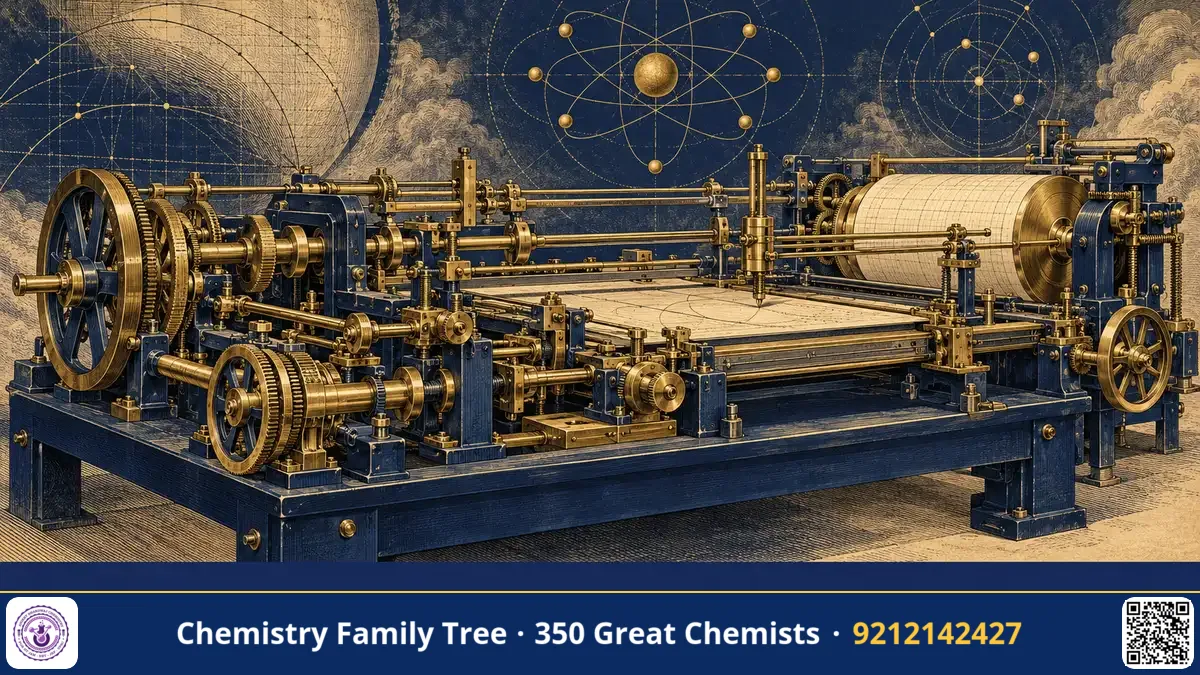
Douglas Rayner Hartree was an English mathematician and physicist who combined quantum theory with numerical computation at a time when "computer" still meant a person with a calculating machine. He created the self-consistent field method for many-electron atoms, built a working differential analyser from toy construction-set parts, and became one of Britain's first experts in electronic computing. The atomic unit of energy, the hartree, is named after him. His legacy in one line: he showed that the many-electron problem could be attacked by systematic numerical iteration, which is the basis of modern computational chemistry.
Early Life and Family
Hartree was born on 27 March 1897 in Cambridge, England. His father, William Hartree, was a lecturer in engineering at Cambridge, The young Douglas grew up in an environment of books, mathematics and practical mechanical interests. William Hartree later collaborated with his son on atomic calculations, which is a rare father-and-son partnership in science.
Education and Mentors
Hartree went to Bedales School and then to St John's College, Cambridge. His studies were interrupted by the First World War, in which he worked on anti-aircraft ballistics, a field that taught him how to turn mathematical equations into numerical tables. This experience shaped his career. After the war he returned to Cambridge, completed the Mathematical Tripos and then did research with Ralph Fowler, who was a leading theoretical physicist and a link to Niels Bohr's circle in Copenhagen. He visited Copenhagen and read Schrödinger's papers closely when wave mechanics appeared in 1926. He completed his doctorate in the 1920s.
Career Timeline
| Year | Event |
|---|---|
| 1897 | Born in Cambridge |
| 1914–1918 | Works on anti-aircraft ballistics during the First World War |
| 1927 | Proposes the self-consistent field method for atoms |
| 1929 | Becomes Professor of Applied Mathematics at the University of Manchester |
| 1934 | Builds a differential analyser at Manchester using Meccano parts, in a model of Vannevar Bush's design |
| 1939–1945 | Wartime work on ballistics, radar and other defence problems |
| 1946 | Visits the United States and studies the ENIAC electronic computer |
| 1946 | Becomes Plummer Professor of Mathematical Physics at Cambridge |
| 1958 | Dies in Cambridge on 12 February |
Major Scientific Contributions
The self-consistent field (1927–28). Hartree gave the first practical method for calculating wavefunctions of many-electron atoms. He computed the atomic structure of many elements, giving orbital shapes and sizes that agreed well with experiment. These results appeared in a long series of papers. Fock's extension in 1930 introduced antisymmetry, and the combined method is now called Hartree–Fock theory. See our discovery article for the equations.
Numerical analysis and machines. The differential analyser built at Manchester solved differential equations mechanically. Hartree used it to study atomic problems, heat flow and other topics. After the Second World War he became an advocate of electronic computers and wrote "Calculating Machines" (1947) and "Numerical Analysis" (1952), which taught many scientists how to compute.
Applications beyond atoms. He worked on the propagation of radio waves in the ionosphere (the Appleton–Hartree equation for the refractive index of an ionised medium bears his name) and on boundary-layer and heat transfer problems. These show his skill in applying numerical mathematics to varied physical problems.
Awards, Honours and Nobel Prize
Hartree did not win a Nobel Prize. He was elected a Fellow of the Royal Society in 1932. The unit "hartree" is a lasting honour used in every computational chemistry program. He is also commemorated by the Hartree Centre, a UK supercomputing and software centre, named after him. Other specific medals are not listed here since they cannot be reliably confirmed.
Personality, Struggles and Lesser-Known Facts
- Meccano computer. In the 1930s, he and his student Arthur Porter constructed a small differential analyser with Meccano parts. It was cheap but accurate enough for research, and it gained fame as a "toy" that solved real problems.
- Women computers. He worked closely with Phyllis Nicolson, who later co-created the Crank–Nicolson method for solving heat-flow equations. Such early collaborators were often overlooked in history.
- Family collaboration. His father William Hartree helped with the hand calculations of atomic wavefunctions, showing how laborious the work was before electronic machines existed.
- Early supporter of electronic computers. After seeing ENIAC in 1946 he strongly urged British universities to build digital machines. His advice contributed to the growth of computing at Manchester and Cambridge.
- Method improved by others. Fock and Slater added antisymmetry to his method in 1930, and the combined method carries the names of both Hartree and Fock.
Legacy and Influence on Modern Chemistry
Today, almost every ab initio program begins with an SCF cycle. DFT, which won Walter Kohn the Nobel Prize in Chemistry in 1998, also uses a self-consistent procedure (the Kohn–Sham equations). The Nobel Prize in Chemistry in 1998 and again in 2013 recognised computational methods that stand on the foundation Hartree built. Students of GATE and NET meet his name as the unit of energy, the Hartree equations, and the Hartree–Fock method. The hartree equals 27.211 eV.
Lessons for Students
- Combine theory and computing. Hartree's greatest strength was linking the formula to the number.
- Do not wait for the perfect tool. He built a computer from a toy kit when no other was available.
- Iteration works. Guess, test, improve is not only a computational method but a good way to learn.
- Credit your team. Science depends on collaborators such as his father and Phyllis Nicolson.
Quick Facts Box
- Born: 27 March 1897, Cambridge, England
- Died: 12 February 1958, Cambridge, England
- Nationality: British
- Field: Mathematical physics, numerical analysis, quantum chemistry
- Famous for: Self-consistent field method, Manchester differential analyser, Appleton–Hartree equation
- Nobel: None (FRS 1932)
FAQ
What is a hartree?
It is the atomic unit of energy, equal to twice the ionisation energy of hydrogen: 27.211 eV or about 2625.5 kJ/mol.
Did Hartree invent Hartree–Fock theory alone?
No. Hartree proposed the self-consistent product wavefunction method; Fock and Slater then added the antisymmetry (exchange) needed for the Pauli principle.
Why is a Meccano machine famous?
It showed that useful scientific computing could be done with simple, low-cost mechanical parts, years before electronic computers were available.
Is Hartree important for chemistry exams?
Yes. Hartree–Fock, SCF, Koopmans' theorem and the Slater determinant are standard topics in physical chemistry for CSIR-NET and GATE.
Published by ABC Chemistry — IIT-JAM | CSIR-NET | GATE Chemistry Coaching. Visit abcchemistry.com
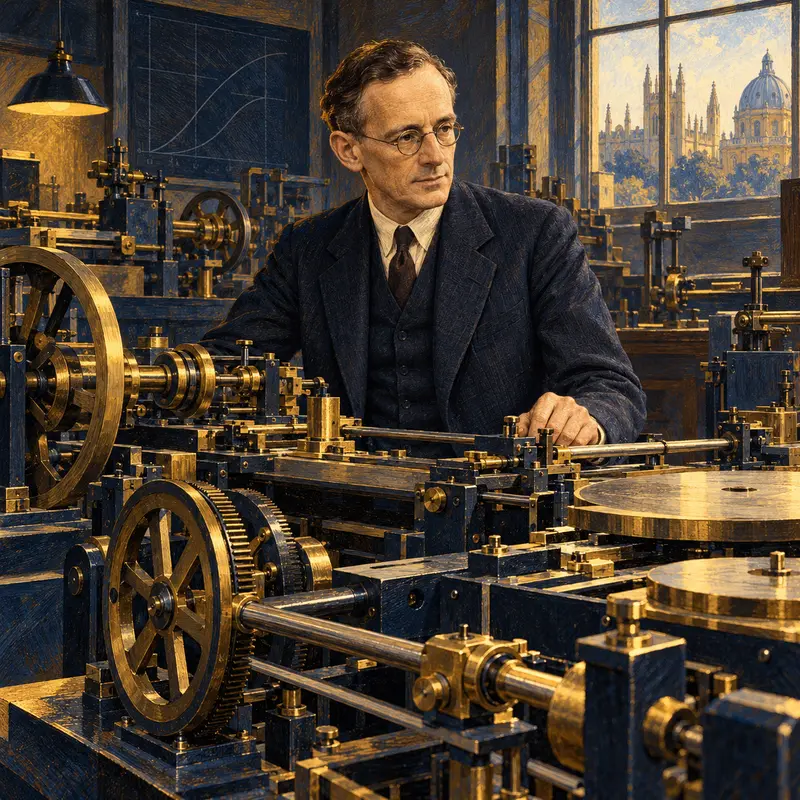
About the chemist
Douglas Hartree
1897-1958 · United Kingdom
Hartree-Fock self-consistent field method